Pike will eat all three, so the useful question is which one suits the water you’re on, the rules that apply there and the way you like to fish. I use lures and deadbaits and don’t use livebait, but I’d rather you had the full picture than a lecture. Each method has real strengths and real limits.
Some product links in this post are affiliate links to Total Fishing Tackle and Fishing Tackle & Bait. If you buy through one we may earn a commission at no extra cost to you. How that works.
Livebaiting: legal in places, banned in others
The legal position varies by country and by water, and it matters more than any tactical argument.
- England and Wales: the Environment Agency has said it doesn’t plan a national ban, and livebaiting with fish caught on the day from the same water has generally been accepted. Rules can change, so check with the Environment Agency if you’re unsure.
- Cumbria: a byelaw introduced in 2002 prohibits using live or dead freshwater fish and eels as bait on 14 lakes, including Windermere, Ullswater and Derwentwater, to protect rare native fish. Our Lake District guide covers the area.
- Scotland: live baiting is prohibited.
- Individual fisheries: many clubs, syndicates and day-ticket waters ban it, and the Angling Trust’s British Pike Championships disqualify anyone found with live baits.
The Pike Anglers’ Club code of conduct also says moving livebait from one water to another is an offence and should never be done. Moving fish between waters without consent can spread disease and invasive species, and a bait that escapes or gets tipped back is a stocking you didn’t intend.
What livebait does well is produce takes from fish that ignore everything else, and it’s why some experienced anglers still use it where it’s allowed. What it does badly is welfare, since a hooked bait fish is distressed, and logistics, since you need fresh bait fish, a bucket and an aerator. Where it’s banned, it’s off the table whatever the argument for it.
Deadbaits: the patient method
A deadbait is a dead fish fished static on the bottom, suspended under a float, or sometimes moved with a twitch of the rod. Sea fish like mackerel and smelt are popular, and so are coarse fish like roach where the fishery allows them.
Deadbait is cheap and legal almost everywhere, it works in cold water when pike don’t want to chase, and the scent trail from an oily bait draws fish from a distance.
The catch is that it’s slow. You stay put, and if the pike aren’t in range you can sit for hours. Deep hooking is also a real risk with poorly set-up rigs, which is why trace design and hook choice matter. I cover rigs in a later post, and the deadbaiting guide is the place to start in the meantime.
If you deadbait, the kit matters as much as the bait. The Fox Rage Predator Deadbait Kebab Kit lets you build a bottom or popped-up kebab bait from fish chunks on a pin, which can help on pressured waters. A Fox Rage Predator Deadbait Pencil float presents a bait over depth and lifts on the bite, and an oil like Holy Mackerel Natural Predator can be injected into a bait that has been in the freezer a while.

Lures: the searching method
Lures let you cover water. You can fish a bank of fifty swims in a day and find where the pike are sitting, rather than hoping they find you.
A lure is quick to start with: pick up a rod and be fishing in minutes. A good one lasts for years and leaves no bait waste.
Against that, pike sometimes follow and turn away, especially in very cold water. You’ll lose lures to snags too, and treble hooks need careful handling. If you’re just starting, the lure fishing beginner’s guide and lure fishing for pike cover the basics.
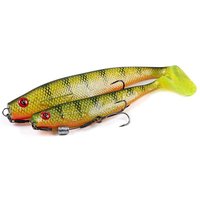
A decent mid-priced shad like the Fox Rage Loaded Pro Shad 14cm is a sensible first lure to learn on. It’s sold ready-rigged, so you can concentrate on the retrieve.
How they compare
| Method | Best at | Weak at | Where it fits |
|---|---|---|---|
| Livebait | Triggering fish that ignore other baits | Welfare, banned on many waters, needs live bait fish | Only where explicitly permitted |
| Deadbait | Cold water, long sessions, big baits | Slow, risk of deep hooking if rigged badly | Stillwaters, slow rivers, winter |
| Lures | Covering water, finding fish fast | Pike sometimes follow without taking | Almost anywhere, all year |
How I’d choose
Early in the season, or on a water I don’t know, I start with lures to find fish. Once the water drops towards winter and the fish get lazy, deadbaits earn their place. The right mix depends on the water and your rules, and if a fishery says no to a method, that settles it.
Whichever you pick, you need a rod that matches. A 2.4m lure rod like the Fox Rage Warrior Pike Spin handles lures up to 120g, while a dedicated 12ft deadbait rod is the better choice if you’re mostly fishing static baits.
Gear that fits this
Some options that match this approach, grouped by type.
Lures worth adding: Fox Rage Zander Pro Shad 16cm and Fox Rage Pro Shad Jointed 14cm.
Reels: Okuma Revenger 4000A, Okuma Revenger 6000A and Savage Gear Thoriz C3000.
For rods, Fox Rage Warrior Shad and Spin and Fox Rage Prism X Pike Cast.

Questions anglers ask
Is livebaiting legal in the UK?
It depends where you are. In England and Wales it hasn’t been banned nationally, though many fisheries ban it and some areas such as 14 Cumbrian lakes restrict fish bait altogether. In Scotland it’s prohibited. Always check the rules for the specific water.
Is deadbait or lure fishing better for pike?
Neither is better in every situation. Lures help you find fish and cover water, while deadbaits can be more effective in cold water and on long sessions. Many anglers use both in the same season.
Can I use fish from another water as bait?
No. The Pike Anglers’ Club code of conduct says moving livebait between waters is an offence, and it can spread disease and non-native species. Use bait bought from a shop or caught from the water you’re fishing, if the fishery permits it.

Rob Hadley grew up fishing the rivers and drains of the Norfolk Broads, and it was inevitable that pike would become his species of choice. He’s been targeting predators seriously for over 20 years – starting on dead baits, moving through live bait rigs, and eventually landing on lure fishing as his preferred method about eight years ago.
These days he fishes the Broads through winter, travels to Chew Valley Lake each spring for its outsized fish, and spends the warmer months working soft plastics on rivers across the East Midlands for perch and zander. He’s had pike to 31lb and perch to 3lb 9oz, and reckons both records are beatable on the right day with the right set-up.
At The River Bend, Rob writes the predator species guides, lure fishing technique articles, and most of the winter fishing content.
Covers: Pike, perch, zander, lure fishing, winter fishing, predator rigs