Sea trout and brown trout are the same species – Salmo trutta. The difference is behaviour, not genetics. Some Salmo trutta spend their entire lives in rivers and lakes as brown trout. Others migrate to sea to feed and grow before returning to their birth river to spawn. These migratory fish are what UK anglers call sea trout. In Scotland they are sometimes called sewin (in Wales), finnock (small first-return sea trout in Scotland), or herling. They are the same fish.
The sea-run habit produces a very different fish to the resident brown trout. A typical brown trout in an upland stream weighs under 1lb. The same fish, had it run to sea and fed for a season on sand eels and crustaceans, might return as a 4-6lb sea trout. A fish that completes multiple sea migrations can reach double figures. The British record sea trout stands at 28lb 1oz (Haddo Estate, Scotland, 1992) – verify current records with the British Record Fish Committee.
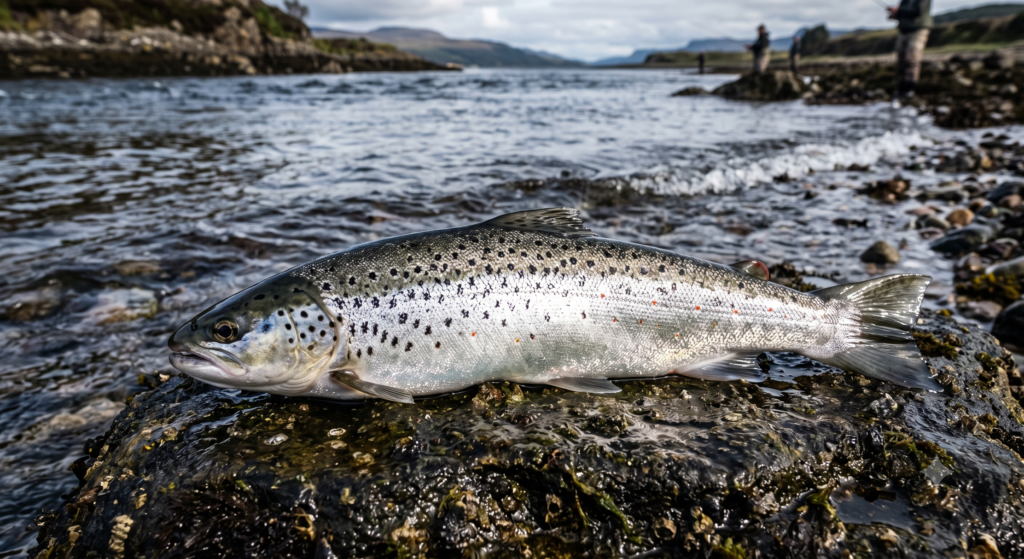
Identification: Sea Trout vs Brown Trout vs Salmon
Correctly identifying a fresh-run sea trout versus a small salmon versus a kelt or lightly coloured brown trout is a skill that takes time to develop:
Sea trout:
– Bright silver flanks when fresh-run, fading to brown-gold as they spend time in fresh water
– Scattered black and brown spots, often X-shaped or star-shaped, extending below the lateral line
– Tail slightly forked, tail wrist (caudal peduncle) relatively wide compared to salmon
– Can be grasped by the tail wrist without slipping – unlike salmon whose narrower tail wrist makes this more difficult
– Adipose fin typically orange-tipped
– Head relatively larger and more rounded than salmon of the same size
– Upper jaw (maxilla) extends to or slightly beyond the rear edge of the eye
Atlantic salmon (comparison):
– Similar silver flanks when fresh but typically fewer spots, not extending below the lateral line
– Tail very slightly forked but thinner at the wrist – a salmon “by the tail” is hard to hold
– Body more streamlined, head smaller in proportion to body
– When returned to fresh water for spawning, both species develop coloration (kype in males)
In practice, the distinction between a fresh-run sea trout in the 2-5lb range and a small grilse (young salmon) is one of the hardest identification challenges in UK angling. In poor light on a night fishing session it is especially difficult. When in doubt: photograph, check with local anglers familiar with that river, and handle the fish with care.
Distribution and Rivers
Sea trout are found throughout the UK wherever rivers hold adequate spawning habitat and there is a route to sea. They require the same conditions as Atlantic salmon: clean gravel beds in the upper river for spawning, low pollution, adequate flow, and free passage past any obstructions.
Best UK sea trout rivers:
Wales (sewin): The Teifi, Tywi, Mawddach, Dovey (Dyfi), and Conway are the premier Welsh sea trout rivers. The Welsh term “sewin” is used interchangeably with sea trout in Wales and these rivers have a strong tradition of night fly fishing for the species. The Teifi in particular is famous for its sewin runs.
Scotland: The Border Esk, Annan, Nith, Dee (Galloway), and many west coast rivers. Highland rivers including the Gruinard, Loch Maree system, and rivers of the Outer Hebrides hold strong sea trout populations. Scotland generally has better sea trout numbers than England.
England: The Eden (Cumbria), Lune, Ribble, Exe, Tamar, and rivers of Devon and Cornwall. Sea trout in England are generally less abundant than Scotland and Wales and some English rivers that historically held good runs have declined significantly.
Ireland: Very strong sea trout runs in Connemara (Costello and Fermoyle), the west of Ireland generally, and rivers in County Kerry. Irish sea trout fishing, particularly lough fishing, is internationally renowned.
Habitat and Life Cycle
Spawning: Sea trout spawn in the same redds (gravel beds) as brown trout, typically in the headwaters and upper tributaries of their home river, between October and January. Like salmon, they return to the river of their birth (natal river homing).
Juvenile stage: After hatching, sea trout spend 2-4 years in the river as parr, virtually identical to young brown trout. At smoltification (typically spring, age 2-4), they change to a silver appearance and migrate to sea.
Sea phase: Sea trout feed voraciously in coastal and estuarine waters for between a few weeks and several years before returning. Most UK sea trout make their first return after 1-2 sea winters. They feed primarily on sand eels, sprats, and crustaceans.
Return to river: Sea trout typically enter rivers from June onwards (some rivers as early as April). The timing varies by river and year. Unlike salmon, sea trout are capable of feeding in fresh water to some degree, which makes them more catchable as their time in the river extends.
Multiple returns: Unlike Pacific salmon which die after spawning once, sea trout (like Atlantic salmon) can survive spawning and return to sea. Fish that have spawned are called kelts. They lose condition rapidly during spawning and kelts are sometimes caught inadvertently in early spring – they should be returned carefully. Most UK rivers prohibit retention of kelts.
Seasonal Behaviour and the Best Time to Fish
Spring runs (April-June): Early fish fresh from the sea. These are in peak condition but numbers are typically lower than summer. Day fishing with fly or spinner can be productive, particularly in spate conditions.
Summer (July-August): Main run period on most rivers. Night fishing with the fly is the classic approach. Sea trout are most active in the two hours after dark and the hour before dawn – during full daylight they are notoriously difficult to catch.
Autumn (September-October): Fish that entered the river in summer are now coloured and their sea-run vigour is declining. Autumn spates (rain bringing the river up) often trigger a further push of fish.
Night fishing: Sea trout are primarily nocturnal feeders in fresh water. This is well-established across all UK sea trout rivers. The classic approach is to arrive at a known pool as darkness falls, fish the dusk period carefully, then intensify effort in the first two hours of darkness. The best catches of sea trout in Wales and Scotland are taken at night on the fly.
Fishing Methods
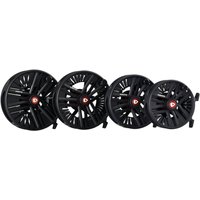
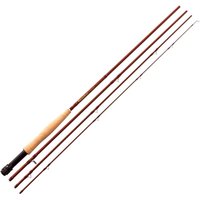
Fly fishing (primary method)
Fly fishing is the dominant method for UK sea trout, particularly in Wales and Scotland where tradition is strong. Approaches:
Wet fly at night: The classic UK sea trout technique. Fish across and downstream through the pool on a floating or intermediate line, with a team of two or three wet flies. Common patterns: Medicine fly (tube fly), Butcher, Peter Ross, Teal Blue and Silver, Black Pennel, Secret Weapon. Size 8-12 doubles or trebles on tubes in the dark; smaller single hooks in low, clear conditions.
Surface (waking) flies: At the end of the night, when sea trout become more difficult on conventional wet flies, a surface-disturbing fly (Wake fly, Muddler Minnow on the surface) fished across and downstream with a tight line to create a V-wake often produces savage takes. This is a specialised technique more widely used in Scotland.
Double-handed rod: On larger rivers, a 12-14ft double-handed rod is used for sea trout, the same as for salmon. On smaller rivers, an 10-11ft single-handed rod in 6-8 weight is appropriate.
Spinner and lure fishing
Spinning for sea trout with a small silver or gold spinner (size 1-3) is highly effective in coloured water and spate conditions when fly fishing is impractical. Toby spoons, Mepps Aglia, and Flying C lures are all productive. In some regions and on some rivers, spinning is less culturally accepted than fly fishing – check local practice and any fishery rules.
Bait fishing
Worm (lobworm or dendrobaena) is the most effective sea trout bait in spate conditions. A worm presented on a size 6-10 hook, trundled along the bottom on a light running lead, is the go-to approach when the river is carrying coloured water after rain. Prawn and shrimp are also effective but banned on many UK salmon and sea trout rivers.
Regulations
Sea trout fishing in England and Wales requires an EA rod licence with a salmon and sea trout endorsement (the standard trout licence covers sea trout on many rivers – check current EA licence types). In Scotland, river access is via permits from the riparian owner or controlling club – there is no national rod licence in Scotland.
Sea trout are subject to closed seasons that vary by river and country. Many rivers now operate catch-and-release for sea trout during the main run period due to population pressures. Check the current rules for your specific river before fishing.
Conservation
Sea trout populations have declined on many UK and Irish rivers over recent decades. Contributing factors include:
– Sea lice infestations associated with salmon farm cages in estuaries (particularly in Scotland and Ireland)
– Changing prey fish (sand eel) availability at sea
– River habitat degradation
– Climate change affecting river temperatures and flow
Catch-and-release is now standard practice on most UK sea trout rivers. A fish that has travelled from sea to spawn deserves to be returned. Use barbless or single hooks, keep the fish in the water as much as possible, and support the head and belly horizontally when photographing.
Gear that fits this
If you’re kitting out for this, these fit.
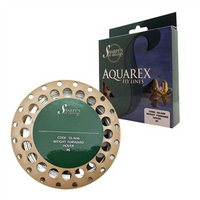
For fly lines, Sharpes of Aberdeen Aquarex Fly Lines Forward Sinking #6, Snowbee XS Ivory Floating Fly Line #5 and Airflo Superflo Mini Tip Fly Line 3' Fast Int. Tip WF8 are all worth a look.
Leaders and tippet worth adding: Scientific Anglers Absolute Trout Tippet 30m 1X (0,25 mm) 13.9lb, Fulling Mill Masterclass Fluorocarbon 50M 5.03lb 5x and Fulling Mill World Class Fluorocarbon V2 50m 20lb.
On the reels side, Lamson Remix S-Series Smoke 3 Pack Fly Reel, Guideline Aeon Fly Reel- Black/Silver #11/13 and Guideline NOVA Reel Stardust #8/10.
Rods: Guideline Rivolt Single Handed Fly Rod #7 10', Guideline Embrace Fly Rod and Reel Kit #9 9' and Scott Fly Rod Co Sector Series Fly Rod 9'0'' #6 4-pc.
Frequently Asked Questions
Is a sea trout licence the same as a trout licence?
In England and Wales, the EA issues rod licences for different fish types. Sea trout (as a migratory salmonid) may require a salmon and sea trout licence rather than a standard non-migratory trout licence. Check the current EA rod licence options as these have changed historically. In Scotland there is no national rod licence but you need a permit from the river owner.
What is the difference between sea trout and brown trout legally?
In England and Wales, brown trout and sea trout are the same species (Salmo trutta) but are subject to different regulations because of their migratory status. Sea trout are classified as migratory salmonids alongside salmon and are subject to closed seasons, size limits, and bag limits that differ from resident brown trout. Check the specific rules for your river.
Why do sea trout take lures and flies if they do not feed in fresh water?
The conventional wisdom is that Atlantic salmon cease feeding on re-entering fresh water; sea trout are less absolute in this. Sea trout do take small prey items in fresh water and continue feeding to a degree during their river residence. The aggressive take to a fly at night may be a combination of territorial response, reflex feeding, or aggression – the mechanics are debated but the practical result is consistent.
What is a sewin?
Sewin is the Welsh name for sea trout (Salmo trutta, migratory form). The terms are interchangeable. Welsh sea trout rivers use sewin throughout – the Teifi, Tywi, and other major Welsh sea trout rivers all refer to their fish as sewin.
Can sea trout be caught during the day?
Occasionally, particularly in coloured water, early in the season when fish are fresh-run, or in low-light conditions. The majority of quality sea trout fishing is at dusk and through the night. Some anglers specifically target the “dusk window” of an hour around sunset as a reliable feeding period even in summer.