The Shropshire Union Canal (“Shroppie” to the anglers who fish it regularly) runs 66 miles from Ellesmere Port on the Mersey Estuary to Autherley Junction near Wolverhampton, where it connects to the Staffordshire and Worcestershire Canal. It is one of the most distinctive canals in England – cut in the late 18th century by the engineer Thomas Telford, it is characterised by deep cuttings and high embankments that give it a more dramatic, wooded character than many lowland canals.
For anglers, the Shropshire Union is notable for two things: its perch fishing (which has produced some remarkably large fish in recent years) and its accessibility (the towpath runs its full length and is accessible under a CaRT Gold Licence across almost all stretches).
The Canal’s Character
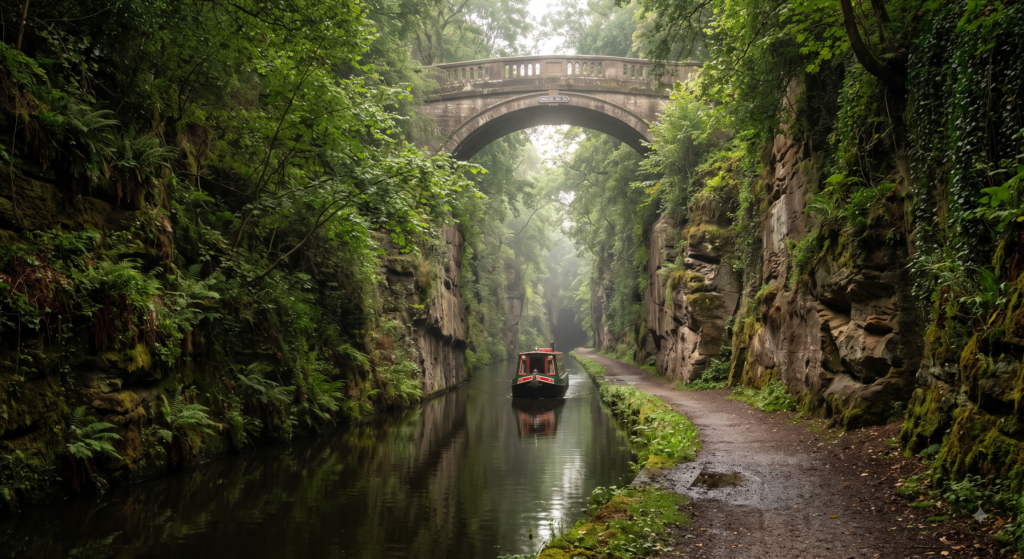
The Shropshire Union is notable for its deep cuttings. Telford cut through hills rather than following their contours, creating sections 15-25 feet below the surrounding land with near-vertical banks of clay and rock. These cuttings have distinctive ecological properties: they are often well-shaded, retain cold water longer in summer, and the steep banks create underwater ledges and features that concentrate fish.
The depth in cuttings is often greater than in standard lowland canals – up to 3 metres in some sections. The canal holds very clear water in stable conditions, which suits perch and pike hunting by sight, and makes careful approach and presentation critical.
The main line runs through Staffordshire and Cheshire, passing through Chester, Nantwich, and Market Drayton. The canal also has arms – the Llangollen Canal branches from Ellesmere and runs into Wales; the Newport Branch runs east from near Norbury Junction.
Licences and Access
Both an EA rod licence and a CaRT Gold Licence are required. The towpath is accessible on foot for its full length. Many stretches are also controlled by local angling clubs, particularly in the Chester and Nantwich areas, and club membership may be required in addition to the Gold Licence. The Norbury Wharf area and many of the rural Staffordshire sections are open to Gold Licence holders without additional club membership.
Species and Where to Find Them
Perch
The Shropshire Union’s perch fishing is exceptional by canal standards. Perch to 4lb+ have been caught from the canal in recent seasons, and fish of 2-3lb are regular captures in productive areas. The deep cuttings and wooden lock structures provide ambush habitat that large perch use in the same way they use reed beds and lily pads in still waters.
Effective perch techniques:
– Drop-shot worm or maggot: A size 6 drop-shot hook with a worm or two maggots, fished 20-30cm above a 7-10g bullet weight, worked slowly along lock walls, bridge supports, and below overhanging trees
– Small lures (2-3 inch soft plastic): Drop-shot or lightweight jig (5-10g), fished alongside canal structures with a slow, subtle action
– Lobworm on a light running ledger: Effective in the evening when large perch move into the margins to hunt
The best perch areas are generally around lock flights (particularly the Audlem flight near Nantwich and the Grub Street cutting area), the deep Woodseaves cutting in Staffordshire, and any section where overhanging trees drop into the water.
Pike
The Shropshire Union holds pike throughout its length, with double-figure fish present in most sections. Deadbaiting from the bank is the standard approach: a small roach or smelt on a snap tackle, running ledger or float ledger, cast alongside the far bank or near any visible feature.
The wooded cuttings and deep embankment areas hold pike that hunt in the clear water using sight. Lure fishing with shads and spinnerbaits works particularly well in these clearer stretches, as pike can see lures at greater distance than in coloured water.
Roach
Roach are widespread and in good numbers on the Shroppie. Canal roach respond to squatt and pinkie (small maggots) fed through a pole cup, fished on a fine bush float at 6-10 metres. The clear water makes a lighter presentation advantageous – finer hooklinks (0.8-1lb) and smaller hooks (size 20-22) produce better roach results than standard river tactics.
In winter, the Shropshire Union’s roach are concentrated in the deeper cutting sections where the insulation of depth keeps water temperatures marginally higher. Large winter roach shoals have been found in the Grub Street and Woodseaves cutting areas.
Bream and Skimmers
Skimmer bream (4-10oz) are common and make up a significant part of the match catch on open sections. Larger bream are less consistent but are found in wider sections near locks and in the Chester area where the canal widens. Groundbait and feeder approaches work for skimmers; pole fishing with groundbait mix as the hookbait presentation is a common canal match tactic.
Tench
Summer tench are present in sections with good marginal vegetation. They are less abundant on the Shroppie than on weedier lowland canals, but the deep cutting sections can hold tench to about 4lb. Early morning fishing in the first hour of light, using corn or lobworm on a simple running ledger in the margins, is the most reliable approach.
Best Sections
Woodseaves and Grub Street cuttings (Staffordshire): Widely considered the most productive section for perch and pike. The Woodseaves cutting is approximately 1.5 miles long and up to 6 metres below the surrounding land. Dark, clear water, overhanging woodland, and minimal boat traffic (this section is remote and not popular with holiday boats) make it excellent for predator fishing.
Audlem flight (Cheshire): A flight of 15 locks with the associated lock-cottage buildings and weir features providing excellent perch habitat. Accessible from Audlem village. Active boat traffic in summer; much quieter from October.
Norbury Junction area (Staffordshire): The junction of the Newport Branch and the Llangollen branch (at Hurleston further along). Good all-round fishing with accessible parking. CaRT Gold Licence fishing without additional club membership on most of this section.
Chester arm: The section approaching Chester is popular with match anglers and holds good roach. Club-controlled in some areas near Chester itself.
Nantwich area: Good skimmer bream fishing, relatively accessible and well-served by local tackle shops.
Seasonal Notes
The Shropshire Union fishes best from September through March. Summer boat traffic disrupts many stretches, particularly near Nantwich and the Chester area where holiday boats are most active. The remote Staffordshire cuttings see less boat disturbance and can fish throughout the year.
Winter is the standout season. Perch are in the best condition from October through January. Roach concentrate in the deeper cuttings. Pike are active. Boat traffic has largely ceased.
Frequently Asked Questions
Is the Shropshire Union Canal known for big perch?
Yes. The Shroppie has produced perch over 4lb in recent seasons, which is exceptional for any canal in England. The combination of deep, clear cutting water, abundant prey fish, and relatively low angling pressure in the more remote sections appears to suit large perch growth.
What licence do I need for the Shropshire Union Canal?
An EA rod licence and a CaRT Gold Licence are required for the majority of the canal. Some club-controlled sections near Chester and Nantwich require additional club membership. Always check for any club water signs on the towpath before fishing.
Can I fish the Llangollen Canal on the same CaRT licence?
Yes. The Llangollen Canal is also a CaRT waterway and the CaRT Gold Licence covers it. The Llangollen is the arm that branches from the main Shroppie line at Hurleston Junction and runs into Wales, passing through Ellesmere and Chirk. Good perch and pike fishing in the Welsh borderland sections.
What is the best method for perch on the Shroppie?
Drop-shot fishing with a worm or small soft plastic lure is the most consistently productive method. Work slowly along lock walls, bridge columns, and overhanging tree sections. Fish in the morning and evening, particularly in autumn when perch are most active. Keep footfall and noise to a minimum in the clear, quiet cutting water.
Does the Shropshire Union Canal have barbel?
No. Barbel are not present in the Shropshire Union Canal. They require running water with gravel beds and good oxygenation – canal conditions do not suit them. The nearest barbel fishing to the Shroppie’s route is on the River Severn (accessible from Shrewsbury and further south).