Invasive non-native species (INNS) are one of the biggest threats to UK freshwater biodiversity. Several species introduced either deliberately or accidentally have spread through river systems, canals, and lakes, outcompeting native species, altering habitats, and in some cases causing significant ecological damage. As someone who moves between waters with tackle, bait, and equipment, an angler can inadvertently contribute to the spread of invasive species.
Understanding which species are invasive, what the law says, and what you must do to prevent spread is an important part of responsible UK fishing.
The Legal Position
Schedule 9 of the Wildlife and Countryside Act 1981
Under Schedule 9 of the Wildlife and Countryside Act 1981 (as amended), it is a criminal offence to:
– Release a Schedule 9 species into the wild
– Allow a Schedule 9 species to escape into the wild
This applies to both animals and plants. Many invasive aquatic species that anglers encounter are listed on Schedule 9 or equivalent legislation in Scotland (Wildlife and Natural Environment Act 2011) and Northern Ireland.
Penalties can include fines and in serious cases prosecution under criminal law.
Specific byelaws and consent requirements
Beyond Schedule 9, specific species have additional requirements. The Environment Agency and Natural England can issue consents for moving certain species between waters (for example, moving signal crayfish for scientific purposes). Without such consent, any movement of certain species between disconnected water bodies is illegal.
Invasive Species Anglers Need to Know
Signal crayfish (Pacifastacus leniusculus)
Signal crayfish are native to North America and were introduced to UK waters in the 1970s for commercial farming. They have spread extensively through UK rivers, canals, and lakes. Signal crayfish:
– Carry crayfish plague (Aphanomyces astaci), a disease that kills native white-clawed crayfish
– Undercut and destabilise river banks
– Eat fish eggs, young fish, invertebrates, and aquatic plants
– Can reach very high population densities
Legal position: Signal crayfish are listed under invasive species legislation. You must not transfer them to new waters. If caught incidentally while fishing (they take baits readily), they must not be returned to the water in waters where they are not already established. You can kill and eat them. Check with the Environment Agency for current guidance on your specific water.
Crayfish trapping: Trapping signal crayfish requires an Environment Agency licence.
Topmouth gudgeon (Pseudorasbora parva)
A small Asian cyprinid species accidentally introduced with fish stock imports. Present in some UK stillwaters. Spreads via water movements and equipment. Very difficult to eradicate once established. Check any small fish caught on commercial fisheries – topmouth gudgeon is a notifiable invasive species and must be reported to the Environment Agency if encountered.
Zander (Sander lucioperca)
Zander were deliberately introduced to the Great Ouse Relief Channel in 1963. While established in certain connected river systems, they are considered an invasive non-native species in England in areas where they are not established. Moving live zander between disconnected water bodies requires Environment Agency consent.
Wels catfish (Silurus glanis)
Introduced in the 19th century, wels catfish are established in some UK waters but are not native. They cannot be introduced to new waters without Natural England/Environment Agency consent.
Grass carp (Ctenopharyngodon idella)
Non-native herbivorous carp. Require EA consent to introduce to new waters. Do not breed in UK conditions without artificially elevated temperatures.
American signal crayfish vs white-clawed crayfish
Native white-clawed crayfish (Austropotamobius pallipes) are protected under the Wildlife and Countryside Act. They are declining severely due to crayfish plague carried by signal crayfish. If you find what appears to be a white-clawed crayfish (smaller, plain brown, without the white patch on the underside of the claws that signals have), do not disturb it and report the sighting to the Environment Agency.
Invasive Aquatic Plants
Anglers can inadvertently spread invasive aquatic plants on equipment:
Floating pennywort (Hydrocotyle ranunculoides): Listed under Schedule 9. Fast-growing floating mat that blocks waterways. Attached to boots, waders, and landing nets.
Water primrose (Ludwigia grandiflora): Spreads vegetatively from fragments.
Parrot’s feather (Myriophyllum aquaticum): Common in garden ponds, spreads from fragments into natural waterways.
Himalayan balsam (Impatiens glandulifera): Not aquatic but very common on riverbanks, crowds out native vegetation.
Check, Clean, Dry: The Biosecurity Protocol
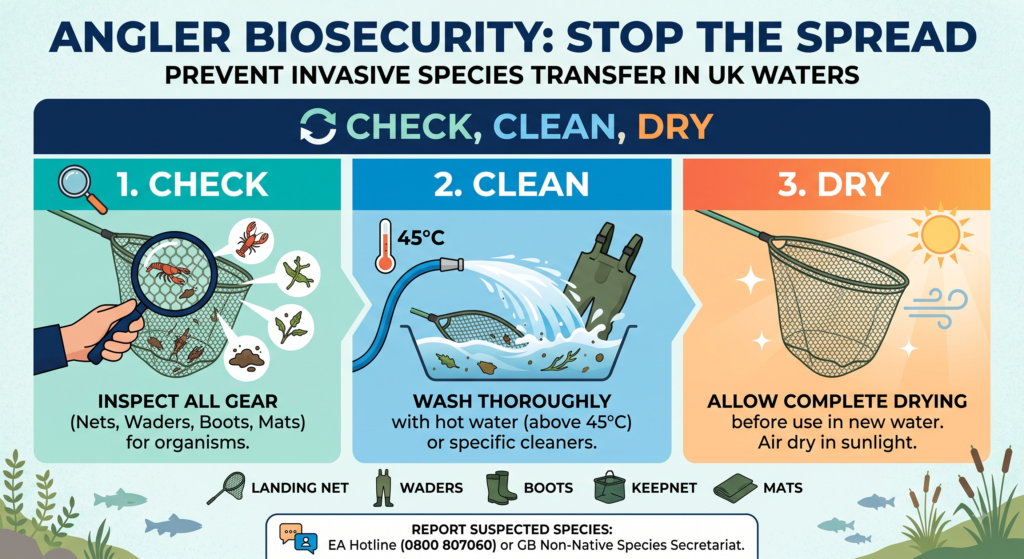
The Environment Agency and the GB Non-Native Species Secretariat promote the “Check, Clean, Dry” protocol for anglers and anyone moving between water bodies:
CHECK your equipment for mud, plant fragments, and animals (crayfish, snails, small fish). Remove anything you find by hand.
CLEAN all equipment thoroughly with water and a brush where possible. Hot water (above 45°C) kills most organisms. Specific biosecurity products are available from tackle shops.
DRY all equipment completely before using it in another water body. Most aquatic organisms and plant fragments cannot survive prolonged drying. If you cannot dry equipment fully before your next session, use the cleaning stage more thoroughly.
This applies to: landing nets, waders, boots, keepnets, bait buckets, bite alarms, unhooking mats, and any other equipment that contacts the water or wet bankside.
Reporting Invasive Species
If you encounter a species you suspect is non-native and invasive:
- Great Britain: Report to the GB Non-Native Species Secretariat via the iRecord app or the INNS report form on GOV.UK
- England: Contact the Environment Agency incident hotline (0800 807060)
- Topmouth gudgeon: This is a notifiable species – the EA must be informed
Accurate photographic evidence with a GPS location is extremely helpful.
Frequently Asked Questions
Can I eat signal crayfish?
Yes, and many anglers do. Signal crayfish from UK waters are edible and considered good eating. You can legally trap them with an EA licence and eat them. Killing and eating signal crayfish removes them from the environment and causes no harm. Do not return them alive to the water or move them alive to another water.
If I catch a zander in a river where they are established, can I take it home?
If you are fishing a water where zander are already established (the Great Ouse system and connected waters, for example), zander can be retained or returned alive – they are already present. Do not move live zander to waters where they are not established. Check current local guidance as the extent of established populations changes.
How do I know if a fishery has crayfish plague?
Crayfish plague is generally invisible until a white-clawed crayfish population collapses. If a fishery previously had native crayfish and you can no longer find them, plague may have passed through. If you are fishing on or near a water known to have native white-clawed crayfish, apply full biosecurity – any equipment that has been in signal crayfish water could carry the plague.
Is it illegal to keep a fish from an invasive species?
Keeping fish for the table from UK freshwaters is generally legal subject to minimum size limits and bag limits. There is no prohibition on retaining, for example, a wels catfish from a water where it is established, unless the fishery rules specifically prohibit it. However, you cannot release fish from one water body to another without appropriate consent.
What should I do if I accidentally catch a species I don’t recognise?
Do not return it to the water if you are unsure. Photograph it, note the location, and contact the Environment Agency or use the iRecord app to report. Most common UK freshwater fish are easily identifiable; an unfamiliar small species should be treated with caution.