Fly fishing has a reputation for complexity that keeps many anglers away from it for years. In reality, the basics are straightforward: you are presenting an artificial fly (a hook dressed with fur, feather, and thread to imitate a natural insect or small fish) to a fish, using the weight of the line rather than the lure to cast. That shift – the line is the weight, not the fly – is the one concept that makes fly casting different from any other form of casting, and once that clicks, the rest follows.
For UK beginners, the most accessible entry point is stillwater trout fishing on a put-and-take reservoir or fishery. These are commercial operations stocked with rainbow and brown trout, open to day tickets, and typically lenient with beginners who need space to cast and fish that are willing to take. The chalk streams and wild river trout of the south are the postcard image of UK fly fishing, but they are not the starting point – they require better casting, more knowledge of entomology, and usually a permit.
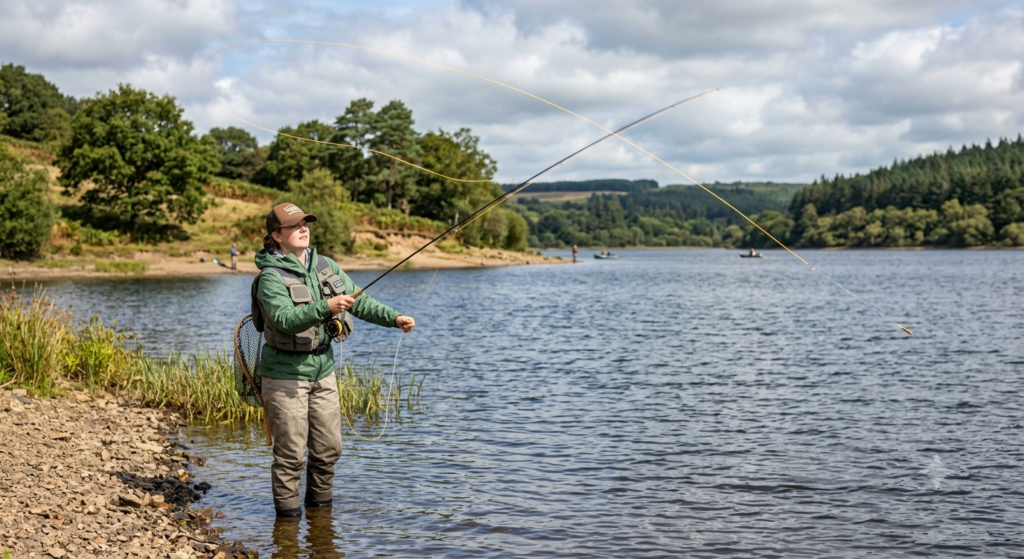
How Fly Fishing Works
In conventional fishing, the lure or bait has enough weight to carry the line behind it when cast. In fly fishing, the opposite is true: the artificial fly is almost weightless – the fly line is the heavy element, and the cast uses the momentum of the moving line to deliver the fly.
The fly line: A modern fly line is a tapered plastic coating over a braided core, with the front taper (the tip) transitioning to a thicker, heavier running or shooting head. This taper allows smooth energy transfer during the cast. Lines are rated by weight (AFTM 1-12), matching the rod weight.
The leader: A tapered monofilament connection between the fly line and the fly. The leader transfers energy from the heavier fly line to the almost-weightless fly. Leaders typically run 9-12ft with a tippet (the final, finest section) of 3-8lb breaking strain.
The fly: An artificial hook dressed with materials to suggest a natural food item. Flies are broadly categorised as:
– Dry flies (fish at or on the surface, imitating adult insects)
– Wet flies (fish below the surface)
– Nymphs (imitate aquatic insect larvae and pupae)
– Streamers and lures (imitate small fish or attract with movement)
Choosing a Beginner Setup
For stillwater trout fishing in the UK, a practical beginner setup is:
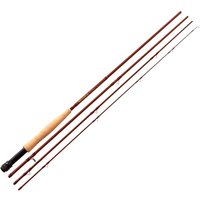
Rod: 9ft single-handed fly rod, AFTM 5 or 6 weight. A 5-weight is versatile enough for most stillwater fishing and can handle small nymphs through to larger lures. Most beginner courses use 5-6 weight rods. The rod should have a medium-fast action (stiff tip, more flex toward the butt) for easier casting.
Reel: A simple disc-drag fly reel balanced to the rod and line weight. For trout fishing, the reel stores backing (30-50m of thin Dacron) behind the fly line. The reel’s primary function is line storage – the drag is almost irrelevant on small trout but becomes important if you hook a large fish.
Line: A weight-forward floating line matched to the rod weight (WF5F for a 5-weight rod). The weight-forward design concentrates the heavy head in the first 9-10 metres of line for easier casting. A floating line handles most stillwater trout situations – dry fly, wet fly near surface, nymph down to 2-3 metres.
Additional lines (later): An intermediate line (sinks slowly, 2-5cm/sec) for fishing nymphs and wet flies at depth. A fast-sinking line for deep reservoir work. Beginners can ignore these initially.
Leader: A knotless tapered leader 9-12ft, 5lb tippet. Pre-made leaders in monofilament or fluorocarbon are available. Change the tippet section when it shortens from fly changes.
Flies: For UK stillwater beginners:
– Black buzzer (midge pupa imitation, size 10-14) – most important fly on most UK reservoirs
– Hare’s Ear Nymph (size 10-14)
– Pheasant Tail Nymph (size 12-16)
– Elk Hair Caddis or CDC dry fly (size 14-16)
– Woolly Bugger or Blob (attractor lure – size 10-12)
The Cast: The Overhead Cast
The overhead cast is the foundation of fly fishing. All other casts are derived from it.
The key principle: The fly line must be moving to load the rod. The rod bends (loads) under the momentum of the moving line. When it straightens (unloads), the energy is transferred to the line, which straightens and delivers the fly.
The basic stroke:
- Start: Hold the rod at roughly 10 o’clock. 6-8 metres of line on the water in front of you.
- Pick-up: Lift the rod tip smoothly, accelerating to lift the line off the water.
- Back cast: Accelerate the rod firmly from 10 o’clock to 1 o’clock (or 12-1 o’clock). Stop abruptly. The line unfurls behind you.
- Pause: Wait until the line has almost fully straightened behind you before beginning the forward cast.
- Forward cast: Accelerate from 1 o’clock to 10 o’clock. Stop firmly. The line unfurls forward.
- Shoot: As the line unfurls forward, release the excess line held in your free hand to extend the cast.
Common beginner errors:
– Starting the back cast before the line is moving (pulling on a slack line loads nothing)
– Sweeping past 12 o’clock and going too far behind you (drops the back cast, loses momentum)
– Not pausing long enough for the back cast to straighten
– “Wrist break” – bending the wrist too far, losing the crisp stop
The best investment for a beginner is two hours with a qualified instructor at a fly fishing school or local club lesson. Most UK put-and-take trout fisheries offer tuition, and an hour with a good instructor is worth three months of self-taught practice.
Where to Fish: UK Stillwater Trout Fisheries
The most accessible trout fishing in England and Wales is on put-and-take stillwater trout fisheries. These range from:
Small farm ponds and managed pools: Typically heavily stocked, fly only, day-ticket basis. Fish run 1-3lb rainbow trout. Good starting points for beginners because the fish are plentiful and the environment is forgiving.
Reservoirs (mid-size): Rutland Water (Leicestershire), Grafham Water (Cambridgeshire), Bewl Water (East Sussex), Chew Valley Lake (Somerset), Draycote Water (Warwickshire). These are large, natural-feeling waters with wild-ish behavior from stocked fish. Boat hire is available at most. A step up from a farm pond – fish harder but more rewarding.
Chalk stream day tickets: Rivers Test, Itchen, Kennet. The pinnacle of English trout fishing. Expensive (£39.99-500+/day on better beats), technically demanding, heavily rule-governed (usually upstream dry fly only). Not for beginners – a goal to work toward.
Scotland: Wild brown trout in Scottish lochs are accessible, cheap (sometimes free), and offer extraordinary scenery. The fishing is harder – wild fish are smaller and more cautious – but the experience is different from any stillwater commercial.
Reading the Water: Where Trout Hold
On a stillwater trout fishery, trout tend to be at:
– Depth where the temperature is optimal (often 2-5m in summer)
– Near features: dam walls, inflows, reed beds, points of land
– Around hatching insects: Where you see rises, fish are there
Rising fish: Rings on the surface indicate fish feeding at or near the surface. These fish can be taken on dry flies or emerger patterns presented carefully. Rising fish are the target of choice for dry-fly fishers.
Non-rising fish: Most of the time, trout are not visibly rising. They are feeding at depth on nymphs and invertebrates. Fish a nymph or intermediate-line wet fly through the water column at the likely depth.
Tactics for UK Stillwater Beginners
The washing line method
Two or three wet flies (or buzzers) on a single leader, fished on a slow-sinking line or floating line with weighted flies. Cast, count down to depth, and retrieve slowly. The flies “hang” vertically in the water column and swing slightly as they are retrieved. Effective all year.
Buzzer fishing under a bung
A “bung” (a large buoyant indicator, sometimes literally a piece of foam or a Thingamabobber) on the leader holds one or two buzzers (midge pupa imitations) at a set depth. Cast out, watch the indicator – when it moves or dips, strike. This is the most accessible stillwater trout method for beginners and is devastatingly effective when fish are feeding on midges.
Dry fly on summer evenings
On warm summer evenings, watch for surface rings. Cast a CDC dry fly or elk hair caddis to rising fish, wait, and watch. Takes on the dry are the most visual and exciting part of trout fishing.
Essential Rules and Access
Rod licence: An EA rod licence is required for trout fishing in England and Wales. A standard freshwater licence covers trout. If you intend to fish for salmon or sea trout, a salmon and migratory fish licence is required.
Season: Most UK trout fisheries (stillwaters) are open year-round. River trout fishing has statutory seasons that vary by river and species: brown trout season in England typically runs April 1 to September 30. Check the specific fishery.
Stocking and return limits: Put-and-take fisheries typically operate on a “limit” basis: you purchase a ticket for a certain number of fish (2 fish, 4 fish, etc.) and must stop fishing or pay for more once you reach the limit. A proportion of caught fish are killed and taken home; others may be returned on a specific “catch-and-release” session.
Tackle restrictions: Most chalk streams and premium rivers are fly-only and may specify upstream dry fly only (no nymphing, no wet fly fishing). Commercial stillwaters are typically less restricted – fly only, but methods vary.

Gear that fits this
Some options that match this approach, grouped by type.
Fly lines worth adding: Airflo Delta Taper Camo Clear Fly Line WF6 Fast Inter 1.5", Airflo Superflo Mini Tip Fly Line 12' Fast Int. Tip WF8 and Guideline Fario Elite WF #3.
On the leaders and tippet side, Fulling Mill Mono Indicator Pink & Yellow 30m 4.40lb 2.00kg 4X, Drennan Subsurface Fly Line Tippet Leader Material Green 5lb and Frog Hair High Performance Tippet 30m Spool 2X/11.1lb.
Reels: Guideline NOVA Reel Stardust #8/10, Lamson Remix S-Series Daybreak Fly Reel and Guideline Fario Fly Reel Bronze ±4.
For rods, Airflo Airlite V2 Comp Special Fly Rod 10' #7, Wychwood Flow Fly Rod 6ft #3 and Daiwa Wilderness Trout Fly Rod 10' 4PC #7 are all worth a look.
Frequently Asked Questions
What weight fly rod should a beginner use?
A 9ft #5 or #6 weight rod is the most common recommendation for UK stillwater beginners. A 5-weight covers most stillwater situations from nymph fishing to small lures. If you are planning to fish larger reservoirs or in wind, a 6-weight is more useful. For chalk stream fishing, a lighter 3-4 weight is more appropriate (but chalk streams are not the beginner’s starting point).
Do I need to tie my own flies?
No. Pre-tied flies are available from all tackle shops and online. Most beginners buy flies for years before learning to tie their own, if they ever do. Starting with commercial flies is perfectly sensible – you will lose plenty to snags and trees before you have learned enough to want to tie your own.
How long does it take to learn to fly cast?
Most people can learn the overhead cast well enough to catch fish in an afternoon with good instruction. Developing a consistent, efficient cast to 15 metres takes a few sessions of practice. Mastering distance casting, Spey casting, and presentation skills is a lifetime’s work.
Can I fly fish for coarse fish like rudd and chub?
Yes. Fly fishing is not restricted to trout and salmon. Rudd, chub, dace, perch, and pike can all be caught on fly. Surface fly fishing for rudd on summer evenings is particularly good fun. For coarse fish on fly, a light 3-5 weight rod with a floating line and a small dry fly or wet fly is appropriate.
What is the difference between a dry fly and a wet fly?
A dry fly is designed to float on the surface of the water and imitate an adult insect (a sedge, a mayfly, a midge). A wet fly is designed to sink below the surface and imitate a drowning insect, emerging nymph, or small fish. Most trout are caught on wet flies or nymphs in the UK because fish feed below the surface for most of the day.