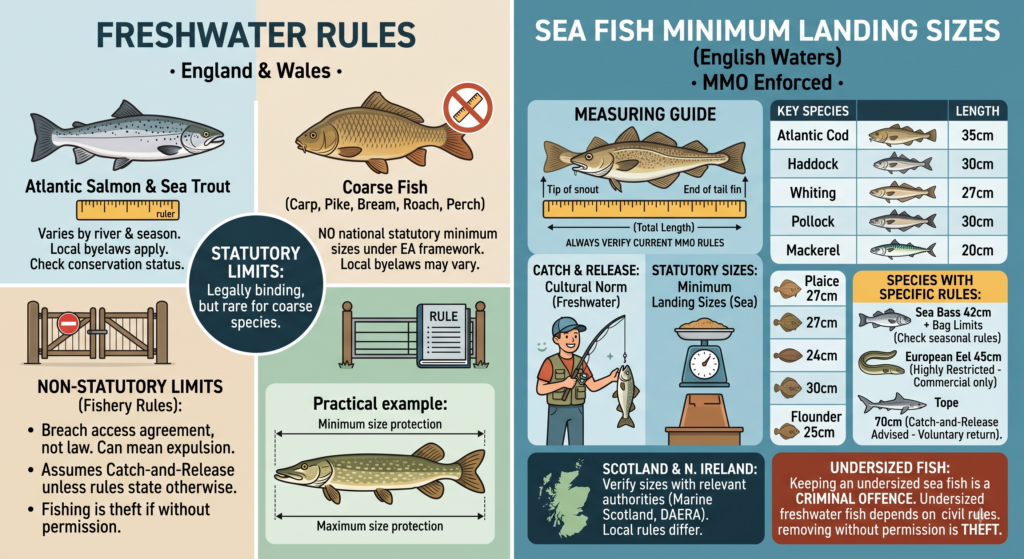
Most UK freshwater fish are returned alive to the water after catching. The majority of coarse anglers do not retain fish for the table at all – this is a cultural norm in UK coarse fishing, not a legal requirement (with some exceptions). Sea fishing has a different tradition and a more developed system of statutory minimum landing sizes enforced by law.
This article covers both frameworks: the legal minimum sizes for sea fish in the UK, the statutory and non-statutory size limits that apply to some freshwater species, and the difference between a legal size limit and a fishery-imposed size rule.
Important note: Minimum landing sizes for sea fish change periodically as conservation measures are updated. The figures in this article reflect current rules at the time of writing but you must verify current sizes with the Marine Management Organisation (MMO) before retaining any sea fish. Rules differ between England, Wales, Scotland, and Northern Ireland.
Freshwater Minimum Sizes
Statutory minimum sizes (England and Wales)
The Environment Agency can set statutory (legally binding) size limits under the Salmon and Freshwater Fisheries Act 2000. However, in practice, few freshwater species have a national statutory minimum size in England and Wales.
Salmon and sea trout: Size limits for salmon and sea trout vary by river, season, and conservation status. Many rivers now operate mandatory catch-and-release for salmon throughout the season. Where retention is permitted, a minimum size may be imposed by the river’s local byelaws. Check the specific byelaws for your river – there is no single national minimum size for salmon.
Coarse fish: There are no national statutory minimum sizes for common coarse fish species (carp, bream, roach, perch, pike, etc.) in England and Wales under the general EA framework. Individual rivers and drains may have specific byelaws – check EA byelaws for your specific watercourse.
Non-statutory size limits (fishery rules)
Many private fisheries and clubs impose their own minimum size rules as a condition of fishing. These are not law but breach them and you breach your access agreement – which can mean expulsion from the fishery. Common examples:
- Carp fisheries often impose a minimum size (e.g., 10lb) before a fish can be removed for the purpose of transfer or stocking – retaining carp for the table from a private fishery would normally require the fishery’s explicit permission regardless of size
- Match fishing venues may impose maximum keepnet limits by weight or by number of fish rather than a minimum size
- Pike fisheries often specify minimum and maximum sizes to protect large pike
The practical rule for freshwater fishing: Unless your fishery’s rules specifically permit retaining fish, assume catch-and-release is expected. Removing fish from most private stillwaters and club rivers is not acceptable without prior permission, regardless of whether a statutory minimum size applies.
Sea Fish Minimum Landing Sizes (England)
Sea fish minimum landing sizes (MLS) are set by UK fisheries regulations. The figures below apply in English waters (6-200 nautical miles offshore) and broadly reflect inshore sizes, but specific rules can vary by area. Always check with the MMO for current figures before retaining fish.
| Species | Minimum Landing Size (cm) |
|---|---|
| Atlantic cod (Gadus morhua) | 35cm |
| Haddock | 30cm |
| Whiting | 27cm |
| Pollock (Pollack) | 30cm |
| Mackerel | 20cm |
| Herring | 20cm |
| Plaice | 27cm |
| Sole | 24cm |
| Turbot | 30cm |
| Brill | 30cm |
| Dab | 23cm |
| Flounder | 25cm |
| Eel (European eel) | 45cm (highly restricted – see below) |
| Bass (sea bass) | 42cm (plus significant bag limits) |
| Tope | 70cm (see below) |
| Smoothhound | Check current rules |
| Thornback ray | 45cm |
| Lesser spotted dogfish | No minimum but retention should be minimal |
These sizes are measured from the tip of the snout to the end of the tail fin (total length). Fish below the minimum size must be returned to the sea immediately.
Bass: Sea bass is subject to particularly strict rules in English waters. In addition to the 42cm minimum, there are bag limits (currently 1 bass per day for recreational anglers under specific seasonal rules). Bass rules change frequently – check current MMO guidance.
European eel: Under severe conservation pressure across Europe. While they remain legal to catch-and-release, retention is tightly controlled and effectively restricted to licensed commercial eel fishermen in most situations. Recreational anglers should treat all eels as catch-and-release only.
Tope: The tope is a small shark species found in UK coastal waters. Under IUCN conservation guidelines and voluntary agreements with the UK’s major angling organisations, tope should be returned alive. They are highly targeted in shore and boat fishing. A minimum landing size of 70cm exists but most knowledgeable sea anglers return all tope regardless of size.
Scotland and Northern Ireland
Minimum landing sizes in Scotland are broadly similar to England but administered separately by Marine Scotland. Northern Ireland rules are administered by DAERA. If fishing in Scottish or Northern Irish waters, verify sizes with the relevant authority rather than relying on English MMO rules.
What Happens If You Keep an Undersized Fish?
Retaining a sea fish below its minimum landing size is a criminal offence under UK fisheries law. Enforcement is carried out by the Marine Management Organisation (England), Marine Scotland (Scotland), and Natural Resources Wales. Penalties can include fines and confiscation of fishing equipment.
For freshwater fish, the position depends on whether a statutory size limit applies (rare for coarse fish) or whether a fishery rule has been broken. Breaching a fishery rule is a civil matter between the angler and the fishery owner. Removing fish from a water without permission may constitute theft under the Theft Act 1968.
Frequently Asked Questions
Are there size limits for pike in UK freshwater fishing?
There are no national statutory minimum sizes for pike in England and Wales. However, in practice, virtually all pike caught in freshwater are returned – this is the accepted norm among pike anglers and is expected on almost every pike fishery. The Pike Angling Club of Great Britain advocates full catch-and-release for pike. Many commercial fisheries ban pike retention entirely.
Can I keep roach or bream to eat in the UK?
There is no statutory minimum size for roach or bream in England and Wales. However, removing fish from a private fishery without the owner’s permission is not permitted regardless of species or size. On public rivers and some club waters, retention may be permitted by specific rules. In practice, removing coarse fish for the table is extremely rare in modern UK fishing.
What is the minimum size for cod in the UK?
The minimum landing size for cod in English waters is 35cm (tip of snout to end of tail fin). This is a legal requirement under UK fisheries regulations and fish below this size must be returned. Check current MMO guidance as conservation measures affecting cod are frequently updated.
Do sea fish minimum sizes apply to shore anglers?
Yes. Minimum landing sizes apply to all recreational sea anglers in English waters, regardless of whether they are fishing from shore, boat, pier, or estuary. The rules apply when retaining fish. Catch-and-release of undersized fish is not an offence.
Where can I check current minimum landing sizes?
For sea fish in England: the Marine Management Organisation (MMO) publishes current minimum landing sizes on GOV.UK. For freshwater fish: the Environment Agency’s rod fishing byelaws page. For Scotland: Marine Scotland’s website. Rules change – check the official source rather than relying on angling publications or third-party guides.