The Atlantic salmon is the most iconic and culturally significant fish in the British Isles. For centuries it was so abundant that apprentices in some English and Scottish towns had legal protections against being fed salmon more than three times a week. That era has gone. The Atlantic salmon is now in serious and well-documented decline across its range, and catching one in the UK is increasingly difficult, increasingly significant, and increasingly tied to questions about what kind of fishing the sport wants to be.
In practical terms, the salmon is a large migratory fish that spends its adult life at sea, returns to the river of its birth to spawn, and on Scotland’s best spate rivers still runs in numbers worth fishing for – though nothing like the numbers of fifty years ago. In England and Wales, salmon runs have collapsed on many rivers, and a genuine salmon is now a remarkable event on southern English rivers that once held famous runs.
Identification
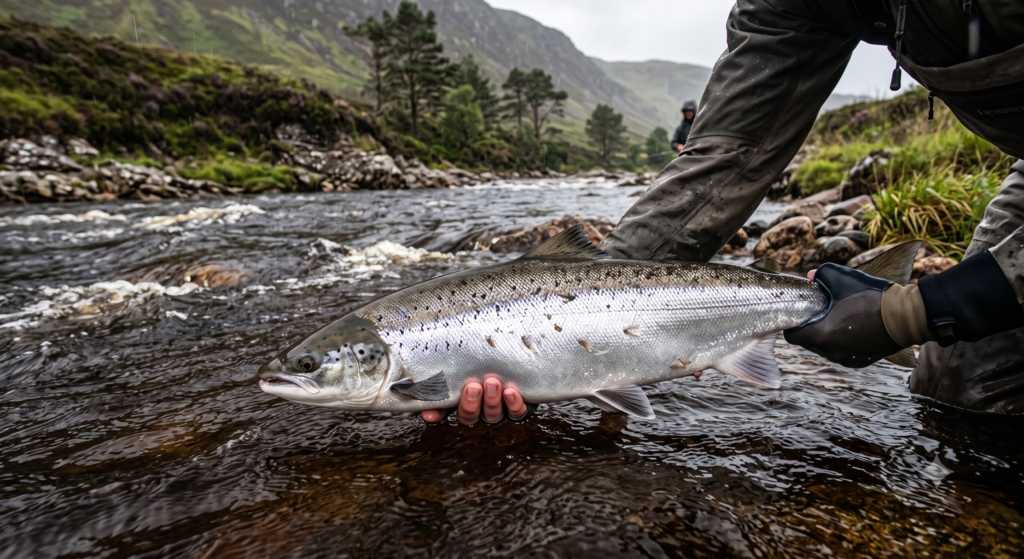
The Atlantic salmon is one of the more visually variable fish in UK waters – its appearance changes dramatically between its fresh-run sea-silver state and the dark, kype-jawed post-spawning condition.
Fresh-run salmon: Bright silver flanks, dark blue-green back, small black spots above the lateral line. Sea lice (small crustacean parasites) may still be present on a fish that has been in freshwater for less than a week. These are usually regarded as a mark of prestige – confirmation that the fish has come straight from the sea. Streamlined, muscular, in prime condition.
Coloured fish (autumn-winter): As spawning approaches, fish darken significantly. Males develop a hooked lower jaw called a kype, which becomes more pronounced as spawning nears. Flanks turn from silver to bronze, red, and brown. Post-spawn fish (kelts) are thin, dark, and exhausted.
Distinction from sea trout: Both species can be silver and spotty, but the salmon has fewer spots, the spots are mostly above the lateral line, and the wrist before the tail fin (the caudal peduncle) is narrower. Sea trout typically have more spots that extend below the lateral line, and the tail fin is less forked than salmon.
Distinction from large brown trout: River fish with red spots are almost certainly brown trout. Salmon lack red spots.
Life Cycle
The Atlantic salmon has one of the most complex life cycles of any UK fish:
Eggs and alevins: Eggs are laid in redds (gravel depressions in clean, well-oxygenated river beds) in November to January. Alevins (larvae with yolk sacs) hatch in spring and remain in the gravel until the yolk is absorbed.
Parr: Young salmon spend 1-4 years as parr in the river, occupying similar habitat to young trout. Parr are heavily spotted with distinctive dark oval marks (parr marks) along the flanks. They are territorial and feed on invertebrates.
Smolts: In spring, parr undergo a transformation (smoltification) – they lose their parr marks, become silvery, and migrate downstream to the sea in groups (smolt runs). This is a critical and vulnerable stage.
Adult sea life: Salmon spend 1-4 years at sea (most UK fish spend 1-2 winters at sea). They feed heavily in the North Atlantic, primarily on sand eels, herring, and capelin, growing from a 15cm smolt to a 4-12kg adult.
Return migration: Salmon return to their natal river (the river they were born in) to spawn. This homing accuracy is extraordinary – tagging studies have shown salmon returning to within metres of their birth redd. They enter rivers in runs from January through to November, with peak timing varying significantly by river and country.
Spawning: Females cut redds in October-January. Males compete for access, with the largest cock fish typically dominant. Most UK salmon die after spawning (their caloric reserves exhausted), though a proportion survive as kelts and return to the sea – a higher proportion in Scotland than England.
Distribution in the UK
Scotland: Scotland holds the most significant salmon populations in the British Isles. The Rivers Tay, Tweed, Dee, Spey, North Esk, South Esk, Helmsdale, Naver, Thurso, and many smaller spate rivers all run salmon. Scotland produces the vast majority of UK rod-caught salmon.
Wales: The Rivers Wye, Usk, Teifi, Dovey, and Conwy all hold salmon runs. Welsh runs have declined significantly and many rivers now operate catch-and-release only or have voluntary no-kill policies.
England: The Exe, Tamar, Torridge, Tyne, Eden, and Test are the main English salmon rivers. Numbers on most English rivers have declined catastrophically compared to historical levels. The chalk rivers of southern England – the Test and Itchen – once had famous spring runs but are now managed almost entirely as catch-and-release operations.
Northern Ireland and Ireland: The Erne, Bann, Foyle, Moy, and numerous spate rivers in the west and north of Ireland hold runs, with Ballina on the Moy particularly noted.
Runs and Timing
Salmon enter rivers in waves – “runs” – that vary by season and river. Understanding which run a river relies on is critical to timing a trip:
Spring salmon (January-May): Large, fresh-run fish entering rivers in winter and spring. Once the most prized and most numerous. Spring fish are typically larger than summer or autumn fish. Numbers have declined dramatically on most rivers.
Summer grilse (June-August): Grilse are salmon that have spent only one winter at sea – typically smaller (2-4kg) than multi-sea-winter fish. Summer runs vary significantly with rainfall.
Autumn salmon (September-November): The most accessible run on many rivers. Fish enter in September-November, often in large numbers on spate rivers following rainfall events.
Spate rivers vs. holding rivers: On spate rivers (smaller rivers in the west and highlands that rely on rainfall to bring fish in), fish move rapidly through and must be met on their migration. On larger holding rivers like the Tay or Wye, fish rest in pools and can be targeted over extended periods.
Fishing Methods
Fly fishing
Fly fishing is the most traditional and widely used salmon method. A weighted or weighted-free fly is cast across and slightly upstream, swings across the current on a tight line (the “swing”), and is retrieved as it reaches the dangle below the angler. Takes are typically decisive and violent.
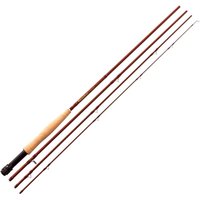
Double-handed (spey) rod: The standard salmon fly rod is a double-handed rod, 13-16ft (most commonly 14-15ft), allowing long casts across wide rivers without backcast room. Spey casting (roll casts that do not require backcast space) is the primary technique.
Single-handed rod: On smaller rivers and for close-range work, a single-handed rod of 9-10ft can be used. Common on smaller Scottish spate rivers and some Welsh rivers.
Fly selection: Flies for salmon range from large tube flies and waddingtons (weighted, designed to fish in high water) to small Cascade, Ally’s Shrimp, and Willie Gunn patterns in low summer water. The principle is to match fly size to water height and colour. A salmon on the fly is not feeding and takes out of aggression, curiosity, or some reflex not fully understood.
Spinning
Spinning with a Devon Minnow, Toby spoon, Flying Condom, or soft plastic lure produces salmon and is often more effective than fly in high, coloured water conditions when fly presentation is impractical. A spinning rod (9-10ft, 10-30g lure weight) is used with a fixed-spool or multiplier reel.
Spinning is widely permitted on Scottish and Welsh rivers, though some beats are fly-only.
Prawning and worming
Prawn and worm fishing for salmon is effective and legal on many rivers. However, many beats and clubs now prohibit these baits on welfare grounds – a salmon hooked deeply on prawn or worm has a much lower chance of survival if released than a fish hooked on a fly in the scissors (corner of the jaw).
Check the rules of any beat before using bait.
Salmon in Decline: What the Angler Needs to Know
Atlantic salmon stocks across the UK have declined significantly since the 1970s. The causes are multiple and incompletely understood: sea survival has fallen dramatically (likely due to prey availability changes in the North Atlantic), estuarine netting, river habitat degradation, sea lice from salmon farms, and low river flows.
The current position (2026):
– Most UK rivers operate mandatory or voluntary catch-and-release from early in the season
– Spring fish are particularly vulnerable and many rivers close or impose C&R before spring runs complete
– The IUCN classifies Atlantic salmon as Endangered in parts of its range
– The UK government, SNH/NatureScot, and Natural Resources Wales have all implemented or consulted on restrictions
Practical implications for anglers:
– Check the current rules for any river you intend to fish – they change regularly
– Many rivers now require mandatory catch-and-release for all or part of the season
– Handle fish quickly and carefully in water – the standard UK guidance is barbless hooks, no out-of-water photography, wet hands before touching
– Consider joining the Salmon and Trout Conservation charity, which campaigns for salmon habitat protection
Size and British Records
Atlantic salmon can reach large sizes. The British record is held by Miss Ballantyne with a fish of 64lb (29kg) caught on the River Tay at Caputh in 1922 – a record that has stood for over a century and is very unlikely to be broken.
Modern UK rod-caught salmon typically run 4-12kg (9-26lb) for multi-sea-winter fish and 2-4kg (4-9lb) for grilse. A fish over 20lb is a significant achievement anywhere in the UK today.
Verify current British records with the BRFC.
Regulations
Rod licence: EA rod licence required for salmon fishing in England and Wales (a salmon and sea trout licence at a higher cost than the standard coarse licence). In Scotland, no national rod licence is required, though river permission is required from the riparian owner.
Season: Salmon seasons vary by river. Most Scottish rivers open February-October. Welsh and English rivers have specific statutory opening and closing dates. Check with the EA, NRW, or NatureScot for current seasons.
Catch-and-release: Many rivers now have mandatory or voluntary C&R. On some rivers, killing a salmon requires a specific licence condition or may only be permitted during a limited window when stock assessments allow.
River permission: Salmon fishing is almost entirely privately controlled in the UK. Beats are leased or owned by estates, fishing associations, or hotels. There is no public right to salmon fish on UK rivers. Beat costs range from £50/day on modest rivers to £2,000+/day on the best Tweed or Dee beats.

Gear that fits this
For anyone buying with this in mind, a few sensible picks.
On the fly lines side, Wychwood Connect Series 2 Feather Floater Fly Line #7, Airflo Superflo 40+ Extreme Sinking Fly Line WF8 DI 3 Green/Yellow and Guideline 4 Cast Plus WF #4.
Leaders and tippet: Guideline Tippet Rings 4mm/24kg, Scientific Anglers Mastery Trout Fluorocarbon Tippet 30m 3X (0.20 mm) and SeaGuar Soft-Plus Fluorocarbon 100m Clear 6.6lb 0.165mm.
For reels, Lamson Remix S-Series Smoke 3 Pack Fly Reel, Guideline Aeon Fly Reel- Black/Silver #11/13 and Guideline NOVA Reel Stardust #8/10 are all worth a look.
Rods worth adding: Shakespeare Sigma Supra Fly Rod 10ft #8 4pc, Greys Wing Streamflex Fly Rod 10FT 2WT and Guideline Elevation Single Handed Fly Rod 10' #6.
Frequently Asked Questions
Can I fish for salmon anywhere in the UK?
No. Unlike coarse fishing, salmon fishing is almost entirely on private, permit, or beat water. There is no public right to salmon fish on UK rivers. Access is via day rod rental on a beat, membership of an angling association, or a hotel/lodge package. Costs range significantly by river and season.
What rod and reel do I need for salmon fishing?
A double-handed rod of 13-15ft is the standard choice for most UK salmon rivers. A salmon fly reel with a good disc drag and capacity for 30m of backing behind a floating and intermediate running line is the typical setup. For spinning, a 9-10ft spinning rod rated 10-30g with a fixed-spool or multiplier reel of appropriate size.
Do Atlantic salmon feed in rivers?
No. Salmon returning to freshwater to spawn have stopped actively feeding. Digestion ceases and the gut atrophies during the river migration. They take flies, lures, and baits out of an aggression or reflex response. This is what makes salmon fishing both challenging and, for some anglers, ethically satisfying – the fish is not competing for food with any human interest.
When is the best time to catch a salmon in the UK?
This depends heavily on the river. For Scotland’s major rivers, the Rivers Tay and Tweed fish best in autumn (September-November). For spring fish on Scottish rivers, late March to May. Welsh rivers fish best in autumn. English salmon rivers are now so diminished in stock that timing advice is difficult to give without specific river-by-river knowledge.
Why do salmon jump?
The exact reason is debated. Salmon jump (or roll) most visibly during pauses in their upstream migration. Possible explanations include attempts to dislodge sea lice, assessment of water conditions, or behavioural responses to oxygen levels. Jumping fish are not always catchable fish – a salmon that is actively running upstream is often less likely to take than a fish that has settled in a pool.