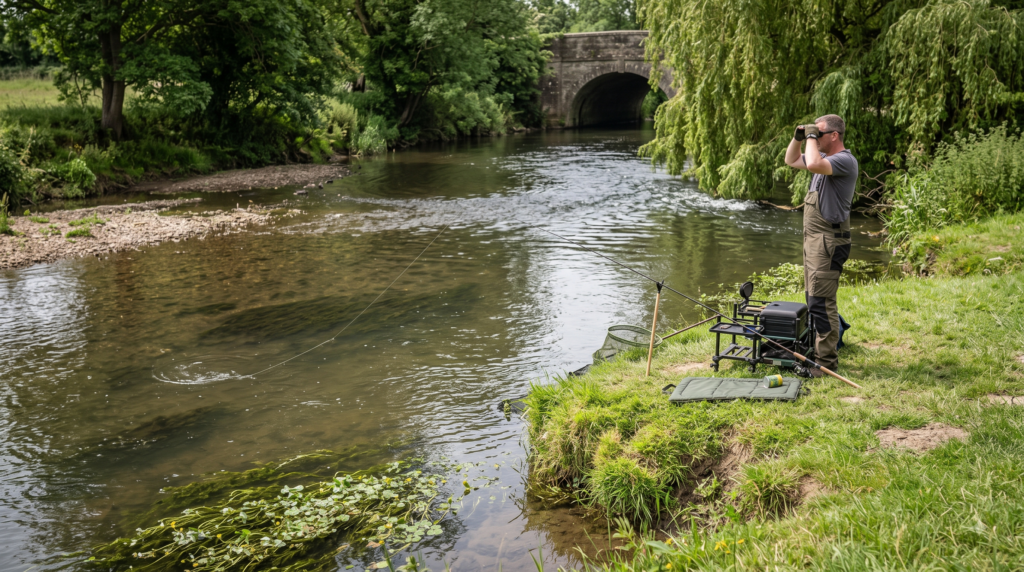
The single skill that separates consistently successful river anglers from those who catch occasionally by accident is the ability to read the water – to look at a stretch of river and understand where the fish are and why they are there.
Most beginners walk to the nearest accessible bank, set up, and cast in. This produces occasional fish. Reading the water means arriving at a stretch you have never fished, spending ten minutes observing it before setting up, and making an informed decision about where the fish will be. It changes fishing from a lottery to a discipline.
This guide covers how rivers work, the features that hold fish, what the water surface tells you about what is below, and how different conditions change where fish position themselves.
How Rivers Work
Before reading specific features, understand the basic physics of how rivers move water:
Current speed is not uniform. The fastest water is on the outside of bends (where centrifugal force pushes the main flow) and in the narrowest sections of the channel. The slowest water is on the inside of bends, behind obstructions, and in any deep depression in the riverbed.
Fish need three things: food, oxygen, and shelter. They position themselves where they can access all three with minimal energy expenditure. This means: close to fast water (which brings food) but in slower water (which requires less effort to hold position), with some form of cover or depth overhead or nearby.
The bed shapes the current. A gravel bar narrows the channel and speeds up the current. A deep pool slows and deepens the flow. Sunken timber and weed beds create local eddies. Reading the surface of the river tells you the shape of the bed beneath.
Reading the Surface
The surface of a river is a map of what is below:
Smooth, glassy water over a fast current. Where water moves very fast, the surface appears glassy and smooth – the friction of the water against itself creates a slick appearance despite the speed. This is the main flow. Few fish hold in the fastest water; they hold in the margins of it.
Broken, rippled water. Turbulence from underwater features – boulders, ledges, depth changes – breaks the surface into ripples. This signals complexity below and often indicates good fish-holding areas.
Eddies. Where the main current meets an obstacle (a bridge pier, a large boulder, a point of land), an eddy forms downstream. The circular current in an eddy brings food around repeatedly and creates a relatively stable holding area. Eddies are among the most reliable fish-holding features in any river.
Boils and upwellings. Where water deflects off a submerged feature and rises to the surface, a boil appears – a swirling, erupting patch of water that rises above the surrounding surface level. This indicates a significant submerged feature directly below.
The crease. Where fast water meets slow water, there is a visible line on the surface – the crease. The downstream end of an island, the edge of a weed bed, or the tail of a pool all create a crease. Fish hold in the crease and on its edges, feeding in the food-rich boundary zone.
Features That Hold Fish
Bends
The inside of a bend (the bank where the current slows) creates slack water and often accumulates silt and weed. Tench, bream, and roach in summer hold on the inside bend, feeding in the margin.
The outside of a bend (where the current runs faster) is typically deeper and has a scoured gravel or clay bed. Chub, barbel, and dace hold in the deeper water on the outside, using the faster current to bring food.
The classic river reading move: on an S-bend, fish the outside of one curve where depth and current suit barbel and chub, or the inside of the next curve where the slack water suits roach and tench.
Pools and Deeper Water
Rivers are not uniform depth. Pools form where the current has scoured the bed – typically below weirs, at the outside of tight bends, and where the river narrows and then widens. Pools are deeper, slower, and typically hold a larger biomass of fish per unit area than shallow runs.
In summer, pools are midday refuges – fish shelter from the bright light and human activity in the depth. At dawn and dusk they move out to feed.
In winter, pools are the primary holding areas. Cold-water fish seek depth for thermal stability; the largest, heaviest fish tend to occupy the deepest, most sheltered pools.
Weirs and Sluices
Weirs are among the most productive fish-holding features on any river. They create:
– Oxygenated water from the turbulence of the falling water
– Depth in the pool below the sill
– A crease between the turbulent water and the slack edges
– Concentration of baitfish that attract predators
Specifically: the sides of a weir pool (the slack edges where the main flow creates eddies) hold predators like perch and pike. The crease at the downstream end of the pool holds barbel, chub, and roach. The downstream tail of the pool – where depth gives way to a shallower run – holds roach and dace.
Gravel Runs
A shallow gravel run between two deeper pools is a feeding and spawning area. Fish move up from pools into runs to feed, particularly at dawn and dusk. Roach, dace, and chub in particular use shallow gravel runs as feeding areas.
A run with ranunculus (water crowfoot) weed growing from the gravel is among the most productive barbel and chub habitat in chalk streams. The weed provides cover and holds the invertebrate food supply; the fish lie in the weed channels.
Bankside Cover and Trees
Overhanging trees, trailing willow branches, and undercut banks are reliable chub, perch, and in some rivers, barbel habitat. The cover provides shade and overhead protection; food falls from the vegetation. The deeper, undercut water of an eroded bank creates a physical refuge.
Identify these features before fishing: they are typically more productive than open bank fishing, but they require different presentation (shorter casts, different float or rig choice) to fish effectively.
Bridge Arches and Structures
Any manmade structure in a river – bridge piers, lock gates, moored boats – alters the flow and creates fish-holding features. Bridge piers create eddies on their downstream side; the bridge arch creates a shaded tunnel of slow water. Both attract fish, particularly chub and perch, year-round.
How Conditions Change Fish Location
After heavy rain (rising, coloured river): Fish move to the margins. The main current is too strong and too coloured for efficient feeding; fish hug the bank where current is slower and food is concentrated by the edge effects. Barbel in particular move to the slack margins on a rising river. Fish the nearside bank and the upstream ends of bays and bends where current is deflected.
In a big flood: Fish may shelter in ditches, backwaters, and any connected still water adjoining the river. On the main river, any slack water out of the main current holds fish. Extreme floods push fish into very unusual places.
In low, clear summer conditions: Fish become cautious and seek cover. Weed beds, deeper pools, and areas of overhead cover hold fish during the day. Dawn and dusk are when fish move out to feed in the open. Approach carefully on the bank – a careless footstep on a gravel bar in low water spooks fish 30 metres away.
In winter, after a freeze: Fish seek the deepest, most stable water available. Look for the deepest section of any pool. Bends with undercut banks in deep water hold fish; open, shallow, exposed areas will be empty.
Polarising Glasses
Polarised sunglasses are the most useful single piece of equipment for reading rivers. They cut the surface glare and allow you to see:
- The depth and colour of the bottom (brown = silt, white/grey = gravel)
- Weed beds and their extent
- Individual fish and shoals when light is right
- Current boundaries and eddies below the surface
Good polarised lenses make river reading dramatically more effective. Amber or yellow lenses for bright conditions; dark lenses for overcast or bright overhead light.
A Practical Approach
When arriving at a new river stretch:
Observe first. Do not set up immediately. Walk the bank for 200-300 metres. Note the bends, the pools, the weed beds, the features. Wear your polarised glasses.
Look for signs of fish: dimples on the surface, weed moving from below, tail flicks in shallow runs.
Identify three or four likely features – a bend with willow cover, the tail of a weir pool, a gravel run below a bridge.
Choose your first spot based on the feature most likely to hold your target species in the current conditions.
Fish the feature confidently with the appropriate method. If you get no bites in 45-60 minutes, consider the second feature.
Frequently Asked Questions
Why do fish sit in the same places every visit?
Fish are largely territorial and habit-forming. A large chub that uses a particular undercut bank as a daytime refuge in July will use the same location in September if conditions are similar. The features that make a spot productive – cover, food access, oxygen, depth – are consistent, so fish return to them. Once you identify a productive feature on a river, it will produce fish regularly across many seasons.
How does weather affect where fish are?
Falling barometric pressure (an approaching low-pressure system, often bringing wind and rain) tends to trigger feeding activity. Rising pressure after a frontal system has passed tends to suppress feeding, particularly in clear water. In clear, low water in high pressure, fish are at their most cautious and hold tight to cover. In overcast, mild conditions with a light breeze, fish feed more confidently across a wider area.
Do I need to be quiet on the bank?
Yes, significantly. Sound travels efficiently through water, and vibration from heavy footsteps on a bank transmits through the substrate into the water. On a clear chalk stream in summer, stamping footsteps on the bank will spook fish 20-30 metres away. Approach bankside features quietly, keep movement low, and avoid sudden shadows across the water.
How important is time of day?
Very important on rivers, particularly in summer. Dawn (first light to two hours after) is the single most productive period on most UK rivers. Fish that have been sheltering during the day move into feeding positions as light drops. Evening (the last two hours of light) is the second most productive. In autumn and winter, feeding activity becomes more spread through the day as temperatures stabilise.
How do I find fish in a river I’ve never fished before?
Walk the bank before setting up, using polarised glasses. Look for the features described in this guide: bends, pools, weirs, bridge arches, overhanging trees. On a completely unfamiliar river with no time to explore, the tail of any pool (where it shallows into a run) is the most reliably productive starting point for most species.
← Back to From the Bank – UK Fishing Articles, Tips and Stories