The River Wye rises on Plynlimon in mid-Wales and flows 134 miles southeast through Rhayader, Builth Wells, Hay-on-Wye, Hereford, and Ross-on-Wye before joining the Severn estuary at Chepstow. It is one of England and Wales’s finest rivers – a large, powerful waterway that holds world-class barbel, excellent chub, significant grayling populations, and a once-famous salmon run that remains a conservation priority.
This guide covers the coarse and game fishing character of the Wye from its Welsh headwaters to the tidal estuary, the species that make it a destination fishery, and the clubs and access arrangements that govern fishing on this river.
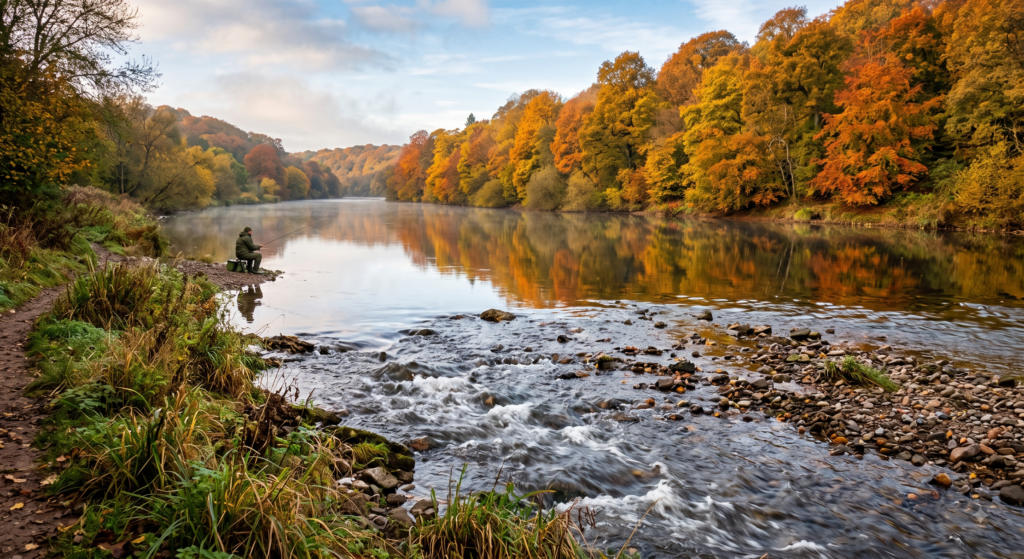
The Wye’s Character
The Wye is a spate river – its level and colour change dramatically with rainfall in the Welsh headwaters. After heavy rain in the hills, the Wye can rise several metres in 24 hours and run red-brown with peat stain. As it clears, conditions for barbel, chub, and salmon can be exceptional.
Understanding the Wye’s level and condition is central to fishing it successfully. The Wye & Usk Foundation (WUF) publishes river level data, and the National River Authority gauges at various points give real-time height readings. Arriving on the river after it has dropped and is clearing from a flood is often the most productive time.
Upper Wye (Plynlimon to Hay-on-Wye)
Character
The upper Wye in Wales is primarily a game fishing river – fast, stony, cold, and acid in its upper reaches. Brown trout and grayling dominate above Builth Wells. Salmon and sea trout pass through on their way to spawning grounds.
Builth Wells and the Middle Welsh Wye
Builth Wells marks the transition zone where coarse fish (barbel, chub, dace) become significant. The Wye at Builth runs over spectacular bedrock and deep pools – some of the best late-summer barbel fishing in Wales occurs here.
Irfon confluence: The River Irfon joins the Wye at Builth from the west. This confluence area is a recognised salmon and barbel holding area.
Access: Several Builth Wells local clubs and day ticket stretches. Enquire locally.
Middle Wye (Hay-on-Wye to Hereford)
Character
The middle Wye from Hay downstream to Hereford is the heart of the river’s barbel fishing. Deep pools, fast gravel runs, and dramatic rocky ledges alternate with long, smooth glides. This is the section most often referenced by barbel anglers when they speak of the Wye.
Hay-on-Wye
The Wye at Hay runs fast over gravel and limestone bedrock. Barbel hold in the deep pools below the fast runs. Good chub throughout. Grayling are present in the faster, shallower sections.
The Golden Valley Angling Association holds significant stretches in this area, with day tickets available.
Whitney-on-Wye and Bredwardine
Two important Wye fishing locations. The Wye at Whitney passes through the Bycross Farm complex, which offers day ticket fishing on excellent barbel water. Bredwardine (where the River Dore joins) is a prime autumn barbel location.
Hereford
The Wye at Hereford is accessible and productive. Several clubs control city stretches, and the river here holds good barbel, chub, bream, and pike. The Wye Salmon Fishing Association (WSFA) also has interests in this section.
Lower Wye (Hereford to Chepstow)
Character
Below Hereford, the Wye becomes progressively slower, deeper, and more meandering. Ross-on-Wye, Symonds Yat, Monmouth, and the gorge sections all fish differently and hold different species mixes.
Symonds Yat
One of the most famous and spectacular sections of the Wye. The river here cuts through a dramatic limestone gorge with cliffs rising steeply from the water. The gorge section holds salmon (historic), barbel, chub, and pike. Some of the most scenic river fishing in Britain.
Access at Symonds Yat is controlled by several clubs and riparian owners. Goodrich Castle area has some accessible stretches.
Ross-on-Wye
The Wye at Ross is a popular and accessible section. Several clubs including Ross-on-Wye Angling Club control waters with day tickets available. Chub and barbel are the main targets, with pike in the deeper pools in winter.
Monmouth and the Lower River
Below Monmouth the Wye runs toward the Severn estuary. Tidal influence begins at Bigsweir Bridge, below which the river experiences tidal fluctuation. The tidal Wye holds mullet (in summer) and flounder (year-round), as well as large pike and occasional large chub.
The Wye Valley (AONB)
Much of the lower Wye and its gorge is within the Wye Valley Area of Outstanding Natural Beauty. Fishing access in the gorge sections requires specific club membership or day tickets from the relevant clubs.
Target Species
Barbel
The Wye is one of England and Wales’s finest barbel rivers. Double-figure fish are caught regularly, particularly in the autumn and through winter flood conditions. The best barbel fishing correlates with flood events – a 24-48 hour rise and fall, with the river clearing to a slight colour, can produce outstanding barbel fishing at Hay, Whitney, Bredwardine, and Hereford.
Tactics: Rolled meat, static boilie in settled conditions. The Wye’s strong current means leads of 2-4oz are necessary in high water. Hemp as loose feed on gravel runs.
Chub
Chub are distributed throughout the Wye from the upper river to the tidal section. Large chub (4-6lb) are present in good numbers, particularly in the deep, slow sections at Hereford and Ross. Cheesebaiting from the bank to visible chub in clear summer conditions is spectacular fishing.
Salmon
The Wye was once England’s finest salmon river. Runs have declined dramatically in recent decades due to environmental issues (estuary netsman removal, habitat degradation, disease), but the river retains a salmon run and remains a priority for restoration by the Wye & Usk Foundation.
Current salmon fishing is subject to strict voluntary catch-and-release on most beats. The traditional spring salmon fishing on the lower and middle Wye is not what it was, but autumn runs continue.
Salmon fishing on the Wye requires specific game fishing permits and, on the best beats, considerable expense.
Grayling
Grayling are present throughout the Wye but most concentrated in the faster, gravellier upper sections from the Welsh reaches down to around Hay. The middle Wye (Hay to Hereford) also holds grayling in suitable habitat. Winter trotting for Wye grayling on the upper river is underrated compared to the chalk stream and Yorkshire river options.
Dace
Dace are abundant in the fast, shallow sections of the upper and middle Wye. They provide excellent stick float and trotting fishing and are numerous enough to make for productive match-style sessions.
Pike
The lower Wye below Monmouth holds significant pike, particularly in the wide, deep pools toward the estuary. Pike deadbaiting from a boat or the bank in winter is the main approach.
Access and Permits
The Wye is broadly divided between:
Welsh Wye (above Hay): Fishing is controlled by a combination of Welsh fishing clubs (Golden Valley AA, Builth Wells AA, others) with day tickets available.
English Wye (Hay to Chepstow): Fishing is controlled by a large number of clubs, estate fisheries, and private riparian owners. The Wye is not typically a river where large sections are publicly accessible without a permit.
Key clubs on the English Wye:
– Ross-on-Wye Angling Club (day tickets on some sections)
– Golden Valley Angling Association (Hay area)
– Hereford Angling Club
– Various private day ticket fisheries (Whitney Farm, Bycross Farm, others)
Local tackle shops in Hereford, Ross-on-Wye, and Hay-on-Wye are the most reliable source of current access information and which clubs are selling day tickets.
Wye & Usk Foundation: Manages environmental aspects of the Wye and Usk fisheries. Not a fishing club but a useful source of river condition reports and conservation information. Their website carries real-time river level and condition data.
Frequently Asked Questions
What is the best time to fish the River Wye for barbel?
Late summer and autumn (August to November) produce the best Wye barbel fishing, particularly in the period after a flood when the river is clearing. A spate event followed by 24-48 hours of dropping, clearing water creates the classic Wye barbel condition. The river also fishes well in winter for chub and in spring for early season barbel.
Where is the best part of the River Wye for fishing?
The middle Wye from Hay-on-Wye to Hereford is generally considered the prime barbel section. The stretch from Builth Wells to Hay has excellent grayling and barbel. The lower river (Ross to Monmouth) is good for chub and pike. Each section has its merits depending on the target species.
Is the Wye salmon run recovering?
The Wye & Usk Foundation and other bodies have been working on habitat restoration and reducing fishing pressure. There are some signs of gradual improvement but the run remains well below historic levels. Voluntary catch-and-release is in place on most beats. Salmon fishing on the Wye is available but should not be considered a guaranteed success.
Do I need a special licence to fish the Wye?
A standard Environment Agency rod licence covers the English sections of the Wye for coarse fishing. For salmon and sea trout fishing, you need the salmon and sea trout endorsement on your licence. On the Welsh sections of the Wye above the border, Natural Resources Wales (NRW) issues rod licences – check whether your EA licence covers the specific section you intend to fish.
Can I wild camp or bivvy on the Wye?
Overnight camping on the River Wye is not permitted without the landowner’s permission. Some club waters allow overnight fishing from the bank with a bivvy where specifically permitted. The Wye, unlike some rivers, does not have established wild camping rights on its banks.