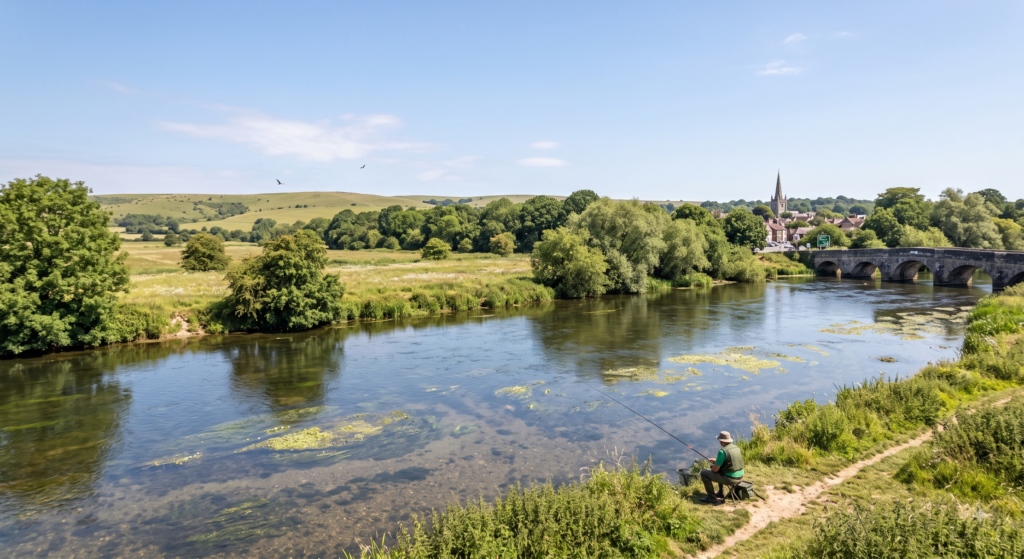
The Hampshire Avon is one of England’s great chalk stream rivers and one of the finest barbel and chub rivers in the country. Rising in the Vale of Pewsey in Wiltshire and running south through Salisbury, Ringwood, and Fordingbridge to meet the sea at Christchurch Harbour, it flows approximately 60 miles through chalk downland and passes through a range of habitats – from fast, clear headwater chalk stream to a broader, more powerful lower river where double-figure barbel and big pike are a realistic expectation.
The Hampshire Avon holds an exceptional range of species: barbel, chub, roach, bream, dace, grayling, pike, perch, brown trout, sea trout, and salmon. This mix of game and coarse fish across different sections makes it one of the most diverse river fishing destinations in England, with species and methods available across every season.
Overview
The Avon is a chalk-fed river with a character that reflects this: the water is exceptionally clear in normal conditions, the river is rich in aquatic invertebrates, and the weed growth is lush through summer. This makes it both productive and demanding – clear water means fish can see the angler and the tackle as easily as the angler can see the fish.
The river has suffered significantly from water abstraction and agricultural run-off over recent decades, and chalk stream conservation is a sensitive issue on the Avon. Many stretches are in private or syndicate ownership, and the most productive fishing comes through club membership or day ticket bookings at commercial fisheries – speculative bank access is not typical on this river.
Upper Avon (Pewsey to Salisbury)
The upper river from its source in the Vale of Pewsey down through Upavon, Amesbury, and into Salisbury is a classic chalk stream – narrow, clear, fast, weed-rich, and full of brown trout and grayling.
Character: Fast, relatively narrow, clear chalk stream. Weed growth heavy through summer. Fly fishing for wild brown trout and grayling is the primary activity here.
Key species: Brown trout, grayling, dace.
Access: Primarily private or fly fishing club water. Very limited coarse fishing access on the upper river. The Salisbury and District Angling Club has some water; day ticket access is rare.
Trout season: Most upper Avon trout beats open in April or May and close 30 September or 14 October. Check individual fishery dates.
Middle Avon (Salisbury to Ringwood)
The river through and below Salisbury becomes a proper coarse fishing river while retaining its chalk stream character. This is the stretch most associated with exceptional barbel, chub, and roach fishing.
Salisbury: The river through Salisbury city centre and the Harnham area holds excellent coarse fish, including quality barbel and chub. Salisbury and District Angling Club holds significant water in and around the city.
Fordingbridge: One of the most celebrated barbel stretches on the Avon. The river around Fordingbridge through to Ringwood is the heartland of Hampshire Avon barbel fishing. Specialist barbel anglers from across the country come to this stretch.
Key species in the middle river: Barbel (the star species), chub, roach, dace, pike, perch, grayling. Sea trout and salmon pass through on their upstream migration.
Access: Salisbury and District AC, Christchurch Angling Club, and various syndicates control much of the productive middle river. Day ticket access is available at some venues; an annual club membership is required for consistent access to the best water.
Lower Avon (Ringwood to Christchurch Harbour)
Below Ringwood, the Avon broadens and slows as it approaches the sea. The tidal influence begins at Christchurch and affects the lowest reaches.
Ringwood: The town and upstream stretches around Ringwood are among the most accessible fishing on the entire river. Christchurch Angling Club has extensive water here.
Ibsley: The Ibsley stretch downstream of Ringwood is one of the best-known big barbel locations on the Avon, with a consistent record of producing fish over 14lb.
Christchurch: The final stretch through to Christchurch Harbour becomes increasingly tidal and holds a wider species mix including mullet (which enter the lower river in summer), flounder, and occasional sea bass alongside the freshwater species.
Key species in the lower river: Barbel, chub, pike, bream, roach, sea trout, salmon (seasonal), mullet (tidal sections), flounder.
Barbel Fishing on the Hampshire Avon
The Hampshire Avon is one of the most revered barbel rivers in England. Several features make it exceptional:
- Clear chalk water that allows observation of barbel in their habitat
- Rich invertebrate life that feeds a large natural population
- A combination of fast gravel runs and deeper pools that provides the full range of barbel habitat
- A history of producing very large fish – doubles are a realistic target on the best stretches
Best tactics:
The clear water demands a delicate approach compared to coloured rivers like the Trent or Severn. The standard Avon barbel approach is:
- Light, unobtrusive tackle – 10-12lb mono hooklink, no heavy lead trace rig
- Freeline luncheon meat or hemp and tares in low-clear summer conditions
- Short-link feeder with pellet and boilie in normal conditions
- Rolling meat (luncheon meat tumbled through streamy water) is the traditional method and still highly effective
Best periods: September to November produces the largest Avon barbel. The river fishes well through autumn after the first spates and into winter. Summer fishing in clear, low conditions is more demanding.
Chub Fishing
The Avon is also outstanding for chub. Large chub (5-7lb fish are not uncommon) occupy the same streamy habitat as barbel and respond to many of the same methods.
Summer: Surface chub fishing with floating bread crust in overhanging bankside cover is highly visual and very effective. Stalking chub with a free-lined bait (bread, meat, or cheese paste) is one of the most enjoyable forms of river fishing on the Avon.
Autumn and winter: Cheesefast and bread paste are the classic winter Avon chub baits. Legered in deep pools or cast to holding lies under fallen trees and ledges.
Roach Fishing
The Hampshire Avon was, historically, one of the finest roach rivers in England – a reputation built in the 1950s-70s when exceptional catches of 1lb-plus roach were common. Roach populations declined significantly from the 1980s onward, and while the fish are recovering in some stretches, the numbers and sizes of previous decades have not returned consistently.
The best roach fishing now tends to be in the slower, deeper glides and backwaters of the lower river. Traditional stick float fishing with maggot and caster, long trotting with a float, or a slow-sinking bread flake presentation on a fine hooklink produces roach from the better stretches.
Access and Permissions
Christchurch Angling Club (CAC): One of the most important clubs for access on the lower and middle Avon. Membership provides access to substantial stretches of the middle and lower Avon through Ringwood and downstream. Annual membership is the primary route to consistent access.
Salisbury and District Angling Club: Covers stretches in and around Salisbury on the upper and middle river.
Avon Roach Project: A conservation initiative focused on roach recovery, which has done habitat and stocking work on the river. The project website has information on river access and conservation.
Private stretches and syndicates: Much of the prime Avon fishing is in private hands or let to small syndicates. These are not accessible without specific membership or permission.
A rod licence from the Environment Agency is required. The Avon is principally in England (Hampshire and Wiltshire) for angling purposes.
Close Season
The statutory coarse fish close season applies to the Hampshire Avon as a river: fishing for coarse species is prohibited between 15 March and 15 June inclusive. The river reopens 16 June.
Game fish (brown trout, sea trout, salmon) are covered by separate game fish byelaws and season dates. Most trout fishing above Salisbury opens in April or May; salmon and sea trout seasons vary by section.
Frequently Asked Questions
Is the Hampshire Avon a chalk stream?
Yes. The Hampshire Avon is a classic southern chalk stream, fed by groundwater from the chalk aquifer of Wiltshire and Hampshire. This gives it its characteristic clear water, stable temperature, and rich invertebrate life. Like other chalk streams (the Test, Itchen, and Kennet), it requires careful water management to maintain its quality against abstraction and run-off pressures.
What is the best stretch of the Hampshire Avon for barbel?
The Fordingbridge to Ringwood stretch (middle to lower Avon) is generally regarded as the finest barbel fishing on the river. The Ibsley beat downstream of Ringwood is particularly well known for large fish. Access is primarily through Christchurch Angling Club membership.
Can you catch salmon on the Hampshire Avon?
Yes. The Hampshire Avon is a designated salmon river and has a meaningful salmon run, primarily in spring and summer. Salmon fishing on the Avon is regulated by the appropriate season dates and is available on some stretches through fly fishing club membership or private beat booking. The salmon population has declined from historic levels but remains a component of the river.
Is there free fishing on the Hampshire Avon?
Very little. The Avon is predominantly in private or club ownership along its fishable length. Some short stretches may have EA or public access but consistently productive free fishing does not exist on this river in the way it does on some other rivers. Club membership is the practical route to regular access.
What tackle do I need for Avon barbel?
A 1.5-1.75lb TC barbel rod, 3000-4000 size reel, 10-12lb mono or 20-25lb braid with a 12-15lb mono hooklink. Running lead or in-line feeder, size 10-14 hook on the hooklink. In low clear conditions, lighter tackle and a careful approach to bankside disturbance makes a significant difference on the Avon compared to coloured rivers.