Understanding the rules that govern freshwater fishing in England and Wales is not optional – it is part of being a responsible angler. The law covers who can fish, what fish can be taken, when rivers are closed, and what happens to those who break the rules. This guide brings the main regulations together in one place.
Note: fishing law is administered separately in Scotland and Northern Ireland. Some details in this guide (close seasons, licences, EA authority) apply specifically to England and Wales. Where Scotland or Northern Ireland differ significantly, this is noted.
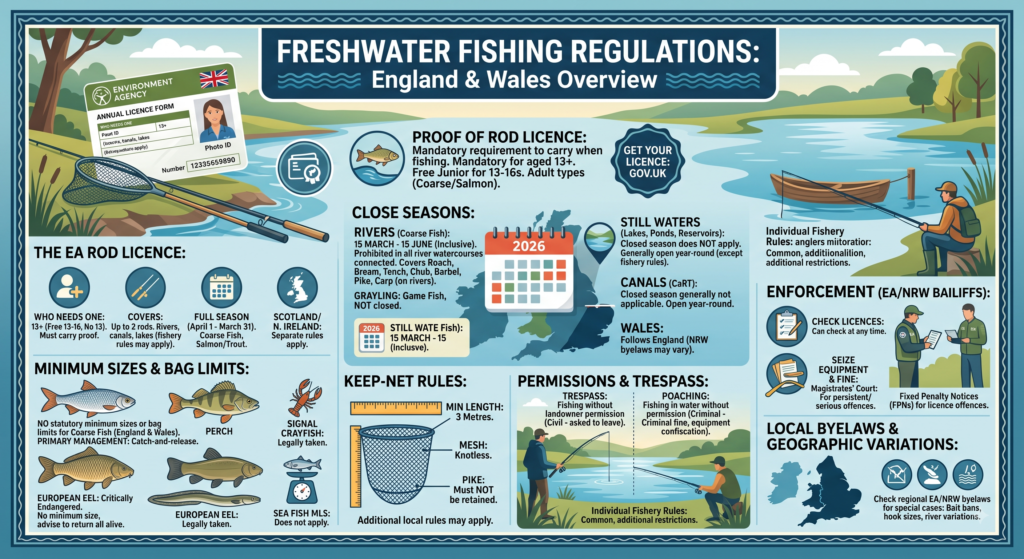
The EA Rod Licence
Who needs one: Anyone aged 13 or over fishing with a rod and line in England and Wales must hold a valid EA rod fishing licence. Children under 13 do not need a licence. Children aged 13-16 can apply for a free junior licence.
What it covers: The EA rod licence allows fishing with up to two rods simultaneously on all legal freshwaters (rivers, canals, lakes, and reservoirs, unless the individual fishery adds further restrictions).
Annual vs short-term: Licences are available as 1-day, 8-day, or full season (12-month) licences. The season runs from April 1 to March 31. A full season licence covering two rods is significantly cheaper per session than buying short-term licences.
Trout and coarse: A standard coarse fish licence covers non-migratory trout, coarse fish, and eels. A separate salmon and migratory trout licence is required for those species (salmon, sea trout, migratory char). These can be combined in a single licence covering all species.
Where to buy: Gov.uk fishing licence service, Post Offices, and some tackle shops. The licence is electronic – keep the confirmation email or letter as proof.
Carrying proof: Anglers must be able to produce proof of their licence to an EA Bailiff or police officer on demand. Fishing without a licence is an offence.
Scottish and Northern Irish licences: Scotland does not have a national rod licence requirement. Northern Ireland has a separate licensing system administered by the DAERA Inland Fisheries unit.
Close Seasons
Rivers (England and Wales)
The freshwater close season on rivers applies from March 15 to June 15 inclusive in England and Wales. During this period, anglers may not fish for coarse fish in any river, stream, drain, or any watercourse connected to a river.
What this means in practice:
– All rivers and streams: no coarse fishing from March 15 to June 15
– This covers coarse species including: roach, dace, chub, barbel, carp, bream, tench, perch, pike, crucian carp, gudgeon, bleak, and all other coarse species
– The close season does not apply to game fish (salmon, trout, grayling) on rivers – these are governed by separate EA byelaws and may have different season dates
– Grayling are a game fish and are specifically exempt from the coarse close season
Still waters: The river close season does not apply to still waters (lakes, ponds, reservoirs, gravel pits). Still water coarse fishing is legal year-round unless a specific water’s own rules state otherwise.
Canals: CaRT canals are generally excluded from the river close season and are open year-round for coarse fishing, subject to EA rod licence and CaRT Gold Licence requirements.
EA Byelaws and Local Variations
The Environment Agency operates regional byelaws that can vary close seasons for specific rivers or localities. Always check the EA’s fisheries byelaws for your specific area if fishing near the close season dates.
Wales
Wales closely follows the England pattern for the close season but is administered by Natural Resources Wales (NRW) rather than the EA. Some Welsh rivers have specific byelaws. Always check NRW guidance for Welsh rivers.
Minimum Sizes
Freshwater coarse fish
There are no statutory minimum sizes for the main UK coarse freshwater species (roach, perch, tench, bream, carp) in England and Wales. The primary management tool for freshwater coarse fish is catch-and-release, and the legal position does not require anglers to return fish of any specific size.
However, some fisheries impose their own minimum sizes as part of their fishery rules. These are conditions of access rather than statutory law.
Eels: European eel (Anguilla anguilla) is a critically endangered species. While there is no statutory minimum size for rod-caught eels, the advice from fisheries authorities is to return all eels alive. Commercial eel fishing requires specific licensing.
Sea fish minimum landing sizes (freshwater context)
This does not apply to standard freshwater fishing. For sea fishing MLS rules, see the minimum size limits article.
Bag Limits and Retention
Freshwater coarse fish
There are no statutory bag limits for most freshwater coarse species in England and Wales. Anglers may return fish immediately (catch-and-release) or may retain fish in a keepnet during a session.
Keepnets: Legal but subject to conditions. The main rules on keepnets:
– Minimum keepnet length: 3 metres
– Mesh must be knotless to avoid scale and fin damage
– Pike must not be retained in keepnets (they suffocate and sustain injury)
– Many match fisheries and club waters impose additional keepnet rules
Taking fish home: Removing fish from a fishery for consumption is legal for most coarse species but is controlled by fishery rules on most club waters. Check fishery rules. Very few UK anglers eat freshwater coarse fish; it is culturally uncommon. Crayfish (signal crayfish) can be taken if caught legally.
Number of Rods
The EA rod licence covers up to two rods simultaneously for non-migratory freshwater fishing. The licence does not specify a minimum rod number. However:
- Individual fishery rules may restrict to one rod only (common on trout fisheries and some carp venues)
- Night fishing often requires specific permission from the fishery
- Some waters charge per rod (second rod premium)
What Constitutes “Fishing”
The Salmon and Freshwater Fisheries Act 1975 (as amended by subsequent legislation) is the primary statute. “Fishing” for the purposes of requiring a licence includes any attempt to take fish with rod and line, including fishing with no bait at all (dry fly casting, for example, still requires a licence).
Fishing Without Permission: Trespass vs Poaching
Trespass: Fishing on land where you do not have the landowner’s permission is trespass (a civil rather than criminal matter in most cases). You can be asked to leave. Persistent trespass can lead to civil court action.
Poaching: Fishing in water where you do not have permission to fish is a criminal offence under the Salmon and Freshwater Fisheries Act. This is distinct from trespass on the bank. Poaching carries fines and potentially confiscation of equipment.
Night fishing: Fishing at night in a fishery that does not allow night fishing is usually a trespass issue (civil) rather than a poaching issue, depending on the specific terms of the fishery.
Environment Agency Bailiffs
The EA employs Fisheries Enforcement Officers (often called “bailiffs”) with powers to check licences, seize equipment used in offences, and issue fixed penalty notices. Police officers can also check licences. Resistance to a bailiff checking your licence can escalate to obstruction charges.
Fixed Penalty Notices (FPNs) are issued for licence offences. Persistent offences and more serious poaching go to magistrates’ court.
Byelaws: What Local Rules Look Like
In addition to national regulations, the EA and NRW operate area-specific byelaws covering:
– Additional close seasons on specific rivers (e.g., salmon rivers with different rules)
– Gear restrictions (size of hooks, use of certain lures)
– Species-specific restrictions
– Bait bans on some chalk streams (ova bans, live bait bans)
Always check the EA’s or NRW’s current fisheries byelaws for your region. These are available free on Gov.uk and naturalresourceswales.gov.uk.
Frequently Asked Questions
Do I need a licence for catch-and-release fishing?
Yes. A rod licence is required regardless of whether you intend to keep or return fish. The licence covers the act of fishing, not the retention of fish.
Can children fish for free?
Children under 13 do not need any licence. Children aged 13-16 can get a free junior licence. Adults (17 and over) must purchase a standard licence.
What happens if I am caught fishing without a licence?
A Fisheries Enforcement Officer can issue a Fixed Penalty Notice. The standard FPN for unlicensed fishing is £350. Failure to pay leads to a court summons and a fine that can exceed £2,500. Equipment can be seized.
Is it legal to fish rivers at night?
Night fishing on rivers is legal as long as you have permission from the relevant authority or fishery owner, hold a valid rod licence, and the river is not in the close season. Many clubs allow night fishing; some prohibit it. Check your fishery’s rules.
Does the same licence cover fishing in Wales?
Yes. The EA rod licence covers England and Wales. Wales has additional NRW byelaws for specific rivers, but the licence requirement is the same rod licence purchased through Gov.uk.