Fishing etiquette is the set of unwritten (and sometimes written) rules that govern how anglers treat each other, the fishery, and the public around them. Some of these rules are enforced by law or fishery conditions. Most are social conventions that experienced anglers follow as a matter of course, and that new anglers need to learn – typically by watching what others do and sometimes by getting it wrong.
This guide covers the main etiquette points that UK coarse anglers need to know: at the water, when arriving, during fishing, and when leaving.
Choosing and Occupying a Peg
Don’t crowd other anglers. On a commercial fishery with defined pegs, this is straightforward – take a numbered peg. On club or open bank water with no pegs, anglers spread out and give each other space. The generally accepted minimum distance between anglers on an open bank is roughly 20-30 metres, though this varies with the width of the water and number of people present. If the bank is busy, closer is unavoidable.
Check if a peg is occupied before setting up. If gear is on the bank (seat box, rod bag, bait bucket) but the angler is absent, the peg is occupied. Don’t set up in a peg where gear is visible. If uncertain, ask other anglers.
Ask about match fixtures. If you arrive at a venue and find pegged markers or signs of a match being set up, check with the bailiff or fishery office. Commercial fisheries often have sections reserved for matches that are unavailable for pleasure fishing on match days.
Respect the peg rule. On many commercial fisheries, pegs are allocated for the day. Once you have drawn or taken a peg, that is your fishing area. Anglers who move repeatedly and search for fish in multiple pegs disrupt others.
Noise and Disturbance
Keep noise to a minimum. Fish are sensitive to vibration and sound transmitted through the ground and water. Heavy footsteps along the bank, loud conversations, banging tackle, and radios at volume all disturb fish. Most experienced anglers move quietly and speak quietly near the water.
Tell other anglers if you are passing behind them. When walking behind a fishing angler, say “mind your back” or similar to let them know you are passing. This avoids being hit by a casting rod or colliding with extended equipment.
Don’t walk between an angler and the water. If an angler has their rod extended over the water, walk behind them (on the landward side), not between the rod and the bank edge.
Switch phone to silent on the bank. Loud ringtones and speakerphone conversations are poor form on a quiet fishing bank. Most anglers appreciate silence and consideration for others.
Peg Space and Feeding
Don’t feed into another angler’s peg. On still waters and canals particularly, throwing groundbait, firing a catapult, or directing loose feed into the area another angler is fishing is a serious breach of etiquette and potentially a source of conflict. Feed your own swim.
Don’t cast over or through another angler’s line. On still waters, casting at an angle to avoid overlap with neighbouring anglers is expected. If you need to cast toward a feature that another angler is fishing, talk to them first.
Match fishing has separate rules. In a competition, anglers fish their allocated pegs exactly as drawn. Feeding into a neighbouring peg, casting over another angler’s lines, and deliberately disturbing a competitor’s swim are all serious violations of match rules and may result in disqualification.
Bailiffs and Club Rules
Respect the bailiff. A fishery bailiff has the authority to check licences, enforce rules, and remove anglers who are breaking conditions of access. When a bailiff approaches, greet them normally and produce your rod licence if requested. Cooperating with bailiff checks is normal and expected.
Know the rules before you start. Each fishery has its own rules – barbless hooks, keepnet sizes, groundbait restrictions, species rules, photography rules, maximum rod numbers. Not knowing the rules is not an excuse. Most fisheries post rules on a notice board at the entrance or include them with the day ticket.
Report illegal fishing. If you see another angler fishing without a licence, using prohibited methods, or taking fish from a water where fishing is not permitted, you can report this to the Environment Agency (0800 807060 in England) or the fishery. This is not “grassing” – it protects the fishery for everyone.
Bank and Environmental Responsibilities
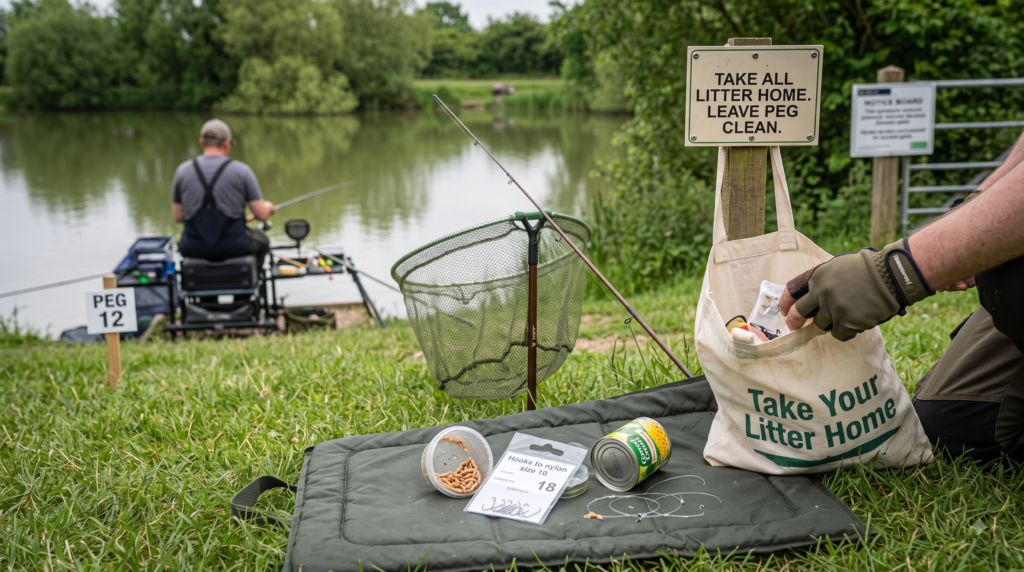
Take all litter home. Fishing-specific litter (bait bags, tin foil, line, packaging) is visible and ugly on the bank. All litter must leave with you. Discarded fishing line is particularly dangerous to wildlife – birds and otters become entangled in it. Cut old line into short lengths or take it to a monofilament recycling point (many tackle shops have these).
Don’t leave groundbait on the bank. Used groundbait left on the bank attracts rats, creates smell, and is environmentally inconsiderate. Take leftover groundbait home or dispose of it responsibly.
Leave gates as you found them. Many fishing venues have gates across field access tracks. Leave them exactly as you found them – open if open, closed if closed. Incorrect gate etiquette can destroy a club’s relationship with a landowner overnight.
Don’t damage vegetation. Cutting or clearing reeds, vegetation, or bankside cover without permission from the landowner or club is potentially illegal under the Wildlife and Countryside Act and will cause conflict. If access requires clearing, speak to the fishery management first.
Parking and Access
Don’t block farmer’s tracks or field entrances. When parking to access a fishery, even for just one session, blocking a field gate or track can be catastrophic if a farmer needs access urgently with a tractor. Always park completely clear of any gate or track.
Don’t park on double yellow lines or verges in a way that causes obstruction. Angler parking near busy fishing rivers can already be a source of local friction. Park considerately.
Close and secure access gates behind you. If the access to a fishery is through a farmer’s land via a gate, close it securely behind you – both on entry and exit. Livestock escaping because an angler left a gate open has ended access agreements on many UK fisheries.
When Things Go Wrong
Don’t confront aggressively. If another angler is doing something wrong – encroaching on your peg, making excessive noise, fishing out of bounds – speak to them calmly first. Most situations resolve with a polite word. If the angler is aggressive or will not cooperate, speak to a bailiff rather than escalating.
Don’t take the law into your own hands with licence checks. You cannot demand to see another angler’s rod licence – only a bailiff or Environment Agency officer has that authority. If you suspect someone is fishing without a licence, report it to the EA.
Match Fishing Specific
Match fishing operates under stricter rules than pleasure fishing. In a match:
- Stay within your draw peg limits at all times
- Set up and start fishing at the correct time (the “all-in” signal)
- Stop fishing immediately when the match ends (the “all-out” signal)
- Do not communicate tactics or bait information to other competitors during the match
- Weigh-in honestly – no inflating weights or misrepresenting catch
- Return all fish immediately and correctly after weigh-in
In a match, most clubs appoint a marshal or secretary who adjudicates disputes. Raise any query with them rather than arguing with another competitor.
Frequently Asked Questions
Can I fish anywhere on a canal towpath?
Not without the correct permits. You need a rod licence plus either a CaRT Gold Licence or a club ticket for the specific stretch. Some stretches are free fishing designated by CaRT but these are limited. Check CaRT’s fishing website for the current position on specific sections.
What should I do if someone else is fishing my favourite spot?
Move on and find another spot. Anglers have no exclusive right to any particular stretch of bank, even if they fish it regularly. “My peg” exists only in a competition context where pegs are formally allocated. On open water, any angler can fish anywhere with the appropriate permission.
Is it rude to ask another angler how many fish they’ve caught?
On some waters and in some situations, sharing catch information is completely normal and friendly. On highly pressured specimen waters where anglers may be secretive about their results, asking directly can seem intrusive. Gauge the situation from how other anglers are presenting themselves – a sociable match atmosphere is different from a focused specimen session.
Can I use another angler’s pole rollers or equipment?
No. Never touch or use another angler’s equipment without explicit permission. Even something as minor as resting your pole on someone else’s pole roller without asking is not acceptable.
What is the correct way to leave a fishing peg?
Leave the peg in the same or better condition than you found it. Take all litter. Fill in any holes or ruts in the bank you have made. Flatten any grass you have bent down. If you have used groundbait, take leftover mix home. Move quietly when leaving to avoid disturbing other anglers.
← Back to From the Bank – UK Fishing Articles, Tips and Stories