The canal network of England and Wales is one of the most underrated fishing resources in the country. Over 2,000 miles of navigable waterways, managed primarily by the Canal and River Trust (CaRT), run through the heart of England, connecting major towns and cities and providing fishing access to millions of people who are never more than a few miles from a canal bank.
Canal fishing is the everyday reality of coarse fishing for many UK anglers. It is not glamorous. The fish are not huge – canal roach, perch, and skimmers rarely exceed a pound. But canal fishing is immediate, sociable, accessible (canals are typically public towpath), and at its best on the right day – a perfect summer morning on a clear Midlands canal with roach rising to feed on the surface – as satisfying as fishing anywhere.
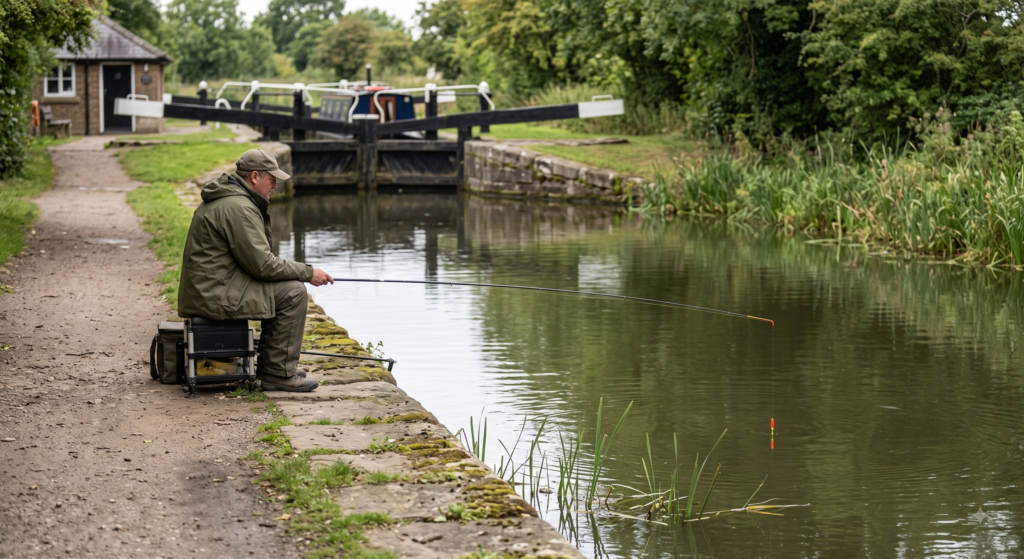
Why Canal Fishing Is Different
Canals are artificial, engineered waterways. This gives them characteristics that distinguish them from rivers and still waters:
Consistent depth: Most UK navigable canals maintain a consistent channel depth of 1.2-1.8m (4-6ft) throughout their length. This was the operational requirement for narrowboat traffic. The depth is relatively uniform – unlike rivers where depth varies dramatically.
Flat, clear water: Canals are slow-moving or still (between locks). Water clarity varies by canal and season but is typically clearer than many rivers. This means fish can be more cautious.
Near bank and far bank: The standard canal fishing presentation is either short-pole fishing to the near margin (0.5-2m) or presenting at the far bank (opposite towpath, often 8-12m). The deepest water on most canals runs down the centre channel.
Boat traffic: On navigated canals, narrowboats pass regularly. Boat traffic stirs up the bottom, colours the water, and creates a wave that affects float presentation. After a boat passes, fish often feed actively in the coloured water.
Towpath access: CaRT towpaths are public rights of way. You can access canal fishing without a club ticket on most CaRT navigations – with a valid rod licence.
Rod Licences and CaRT Fishing
Rod licence: An EA rod licence is required for all canal fishing in England and Wales for anglers aged 13 and over. Junior licence (13-16) is free. Adult licences start from approximately £35/year for coarse fish.
CaRT and club tickets: Most CaRT canal fishing requires both:
1. A valid EA rod licence
2. Either a CaRT Gold Licence (an annual permit covering all CaRT canals) or membership of a club that has a CaRT licence agreement for a specific stretch
The CaRT Gold Licence covers most navigable canal fishing in England and Wales. It is sold via the Angling Trust as the “Canal and River Trust Angling Gold Licence”. Without this permit or a club ticket for the specific canal, fishing CaRT waters is technically without permission even with a rod licence.
Some canals (particularly in the North West) are not CaRT water and are managed by the Environment Agency or local councils under different permit systems. Check before fishing.
Free fishing stretches: A limited number of canal stretches have no additional permit requirement beyond the rod licence – these are designated as free fishing by CaRT and include some urban stretches where access is specifically open. These are listed on the CaRT fishing website.
Canal Species
Roach: The most abundant and sought-after canal fish. Present on virtually every canal in England. Canal roach average 2-8oz, with fish to 1lb+ present on well-managed canals. On the Grand Union, Oxford Canal, and Kennet and Avon, quality roach over 1lb are caught regularly.
Perch: Present throughout UK canals in good numbers. Canal perch to 2lb+ are not uncommon on quality waters. Perch respond to worm, caster, and small lures (drop-shot fishing has transformed canal perch fishing in recent years).
Bream: On wider, deeper canals (Trent and Mersey, parts of the Shropshire Union), skimmers (small bream) and full bream are caught on feeder and groundbait tactics.
Chub: Less common but present on some canals, particularly where canals run through or near river catchments with chub populations. The Kennet and Avon holds chub.
Pike: Canal pike to double figures are common, particularly on wide, deep canals. Very large pike to 20lb+ exist on some canals where forage fish populations are high.
Carp: Many urban canals now hold carp, introduced or escaped from nearby fisheries. Carp to 20lb+ have been caught from urban canals in the Midlands and London. Canal carp fishing is growing in popularity.
Tench: Some wider canals with good weed growth hold tench. Less common than on still waters but present.
Gudgeon: Prolific on sandy-bottomed canals. Often caught in quantity on a running waggler or pole rig.
Essential Canal Fishing Gear
Pole: The most effective canal fishing tool. A 9-11m pole fishes both the near margin and the far bank on a standard narrow canal. You do not need a long match pole for casual canal fishing – a second-hand 9-10m pole is adequate.
Float rod (waggler): A 12-13ft waggler rod with 2-3lb line and a small straight or insert waggler. Used when fishing at range with a reel for larger species.
Short canal pole (whip): A 4-5m fixed-line pole (no reel or elastic) for very close-range roach fishing on the near bank. Fast and simple. Effective for small fish in quantity.
Floats: Small straight wagglers (2-3BB) for rod-and-reel fishing. Small pole floats (0.1-0.5g) for pole fishing. A selection of 5-6 floats covers most canal situations.
Hooklinks and hooks: Fine lines (0.08-0.12mm) and small hooks (18-22) for roach. Slightly heavier (0.14mm, size 14-16) for perch and bream. Never heavy tackle on a canal.
Seat box: Pole fishing on a canal requires a proper seat box – you need to be at the right height and close enough to the water to manage the pole correctly. A bank stick and basket is not ideal.
Canal Fishing Techniques
Short pole fishing (near bank)
Fish a float at 1-2m range on a 4-5m whip or 9-11m pole shipped in. The near bank on the towpath side of a canal is often an excellent roach peg – fish patrol the margin searching for food. Feed small amounts of maggot regularly (every 30-60 seconds) directly over the float.
This is the fastest, most efficient canal approach for roach in summer.
Far bank fishing with pole
Ship out to 9-11m to fish the far bank margin. The far bank is often undisturbed (no boats tie on the far side) and can produce larger fish than the near bank, particularly for perch.
Feed a small ball of groundbait with maggots or casters compressed inside to kick and release particles near the far bank.
Running line float fishing
A straight waggler at 8-12m range, fished on a rod and line rather than a pole. Allows quicker feeding of a wider area via catapult. Effective for roach and bream at range and useful when a long pole is not available or practical.
Drop-shot for canal perch
Light spinning rod, 4-6lb fluorocarbon or braid, 3-5g drop-shot weight, size 6-8 drop-shot hook with a small soft plastic (2-3 inch minnow or worm). Work the lure vertically alongside boats, bridge abutments, and any structure. Canal perch respond very well to drop-shot fishing and this is now the standard approach for specimen canal perch.
Reading a Canal
Good pegs: Any feature is a good peg on a canal.
– Lock gates and pound entrances: fish hold here for food brought down by lock operation
– Bridges: shade, structure, baitfish shelter
– Mooring rings and pontoons: attached algae, shelter, baitfish
– Inlet streams: oxygenation, food
– Wide bays or offside armwidenings: often deeper, fish rest here
Worst pegs: Long, straight, featureless mid-canal sections with high boat traffic and shallow water. These produce the smallest fish in the smallest numbers.
Time of day: First thing in the morning before boats start moving produces the best canal fishing. Early morning in summer, once boats begin moving at 8-9am, disrupts presentation. Fish the first 2 hours of daylight.
Canal-Specific Rules
Most CaRT canals operate additional rules beyond the rod licence:
- Barbless or micro-barbed hooks required on most CaRT waters
- No groundbait mixing on the bank in some designated urban stretches (environmental conditions)
- No bivvies or overnight camping on towpaths (not a fishing regulation – CaRT property)
- Keep nets: Minimum 2.5m, knotless mesh only – same as EA rules
- Don’t obstruct the towpath with tackle spread across the walking space – other users have right of way
Top UK Canals for Fishing
Grand Union Canal (Midlands to London): 100+ miles of excellent roach and bream fishing. The Leicester Arm produces good skimmers. Urban London stretches hold carp.
Shropshire Union Canal: One of the finest canal match venues in England. Roach, perch, and bream throughout. The Middlewich and Barbridge areas are particularly noted.
Trent and Mersey Canal: Wide, well-established coarse fish populations. Bream and roach on feeder tactics at range. Good perch throughout.
Leeds and Liverpool Canal: 127 miles from Liverpool to Leeds. Good match fishing throughout. Noted for roach and perch.
Kennet and Avon Canal: Wider and more river-like than most canals. Good roach, tench, bream, and chub. The section between Reading and Newbury is well regarded.
Oxford Canal: A beautiful, narrow, winding canal through typical English rural landscape. Excellent small-fish canal fishing. Roach, perch, gudgeon, and some chub.
Frequently Asked Questions
Do I need a permit to fish a canal in England?
Yes. You need an EA rod licence AND either a CaRT Gold Licence or a club ticket for the specific canal. The rod licence alone is not enough for most CaRT canals. Purchase the CaRT Gold Licence through the Angling Trust website.
Are canals good for beginners?
Excellent. Canals offer reliable access (public towpath), consistent fish populations, shallow, forgiving water to practice float fishing, and the ability to move pegs easily if one area is not fishing. The fish are not huge but the action can be fast, which keeps beginners engaged.
Can I fish a canal without a pole?
Yes. A rod-and-reel setup with a straight waggler is effective on canals, particularly for fishing at range. Many match anglers use a combination of pole and rod depending on the session. For absolute beginners, a rod, reel, and small waggler is a perfectly viable starting setup.
What baits work best on canals?
White or red maggot is the most reliable canal bait for roach and perch in most conditions. Caster (a chrysalis stage maggot) produces better quality fish in summer. Bread punch (a small disc of bread on a tiny hook) is excellent for canal roach in winter. Worm on a size 14-16 hook is consistently good for perch throughout the year.
Do canals have a close season?
Canals are classified as “still waters” for close season purposes on most CaRT designations. This means no statutory close season applies (the 15 March to 15 June close season applies to rivers, not canals). However, some specific canal sections may have fishery-imposed rest periods – check the CaRT or club rules for your specific canal.