Carp fishing has developed an extensive and sometimes bewildering catalogue of rigs. Walk into a UK tackle shop and the rig display will contain dozens of components, pre-tied variations, and specialist setups. For someone starting out, or returning to carp fishing after years away, the sheer number of options is confusing.
This guide focuses on the rigs that matter most – the ones that produce the majority of carp caught in UK fisheries. Understanding why each rig works and when to use it is more valuable than knowing every variation.
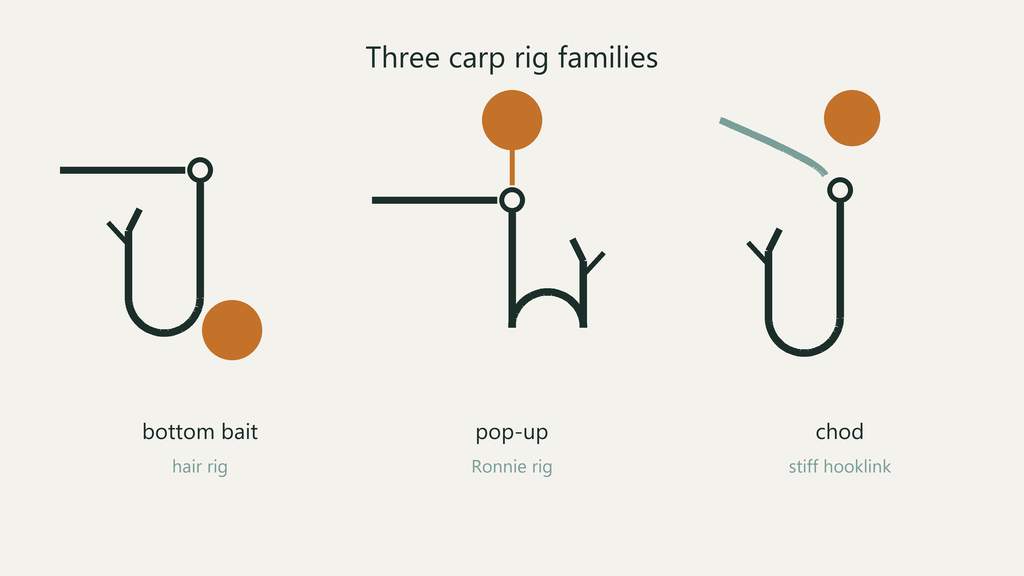
The Hair Rig (Foundation of Modern Carp Fishing)
Every serious carp rig begins with the hair rig principle. Invented by Kevin Maddocks and Len Middleton in the 1970s, the hair rig places the hookbait on a short length of line (the “hair”) extending from the hook bend rather than directly on the hook. This allows carp to pick up the bait without immediately feeling the hook, giving them time to draw it into their mouth properly before the hook can take hold.
Why it works: Carp are intelligent, tactile feeders. When they pick up a bait that has a hook directly through it, they feel the metal immediately and eject the bait. A bait on a hair feels like a loose particle. By the time the carp realises anything is wrong, the hook is already inside the mouth.
The knotless knot: The standard method for attaching a hook to a hair rig. The hair is formed from the tag end of the hooklink, and the hooklink material is wound around the hook shank and through the eye in a specific way that automatically angles the hook point away from the shank (chodlink style) for better hooking.
Variants: – Bottom bait hair rig: Sinking boilie, pellet, or other hookbait on the hair, presented flat on the lake bed. The most versatile setup. – Pop-up hair rig: A buoyant (pop-up) boilie on the hair, with a sufficient weight on the hooklink (or the lead weight balanced to sink the hook) to counterbalance the buoyancy. The hookbait sits a centimetre or two above the lake bed.
The Semi-Fixed Bolt Rig
The bolt rig is the most commonly used carp rig system in the UK. The principle: when a carp picks up the hookbait and moves away, the lead (which is semi-fixed to the mainline via a swivel and rubber tubing) applies resistance. The carp bolts in response to the resistance, and the hook sets against the weight of the lead.
Components: – A lead (typically 2-4oz depending on distance and resistance needed) – A lead clip (or inline lead) that holds the lead semi-fixed – A tail rubber over the lead clip to prevent the lead ejecting until sufficient force is applied – A swivel and hooklink
Safety: The bolt rig is designed to eject the lead on a break or snag – the rubber tail separates from the lead clip when sufficient force is applied. This prevents carp being tethered to a fixed lead if the line breaks.
When to use: The bolt rig is the default carp rig for still water fishing on hard clear lakebeds, gravel, and sand. It is the go-to rig for the majority of UK day-ticket and commercial carp fishing.
The Chod Rig
The chod rig is a specialised setup for fishing over weed, soft silt, and debris-covered lake beds where a conventional bottom rig would become buried or masked. It consists of:
- A short (2-4 inch) stiff hooklink (fluorocarbon or stiff coated braid)
- A pop-up hookbait
- A flying back-lead or helicopter-style lead that runs on the mainline rather than being attached to the end of the hooklink
How it works: The lead sinks through any debris or soft weed to the lake bed. The chod rig slides up the mainline to wherever the debris becomes firm enough to support the hookbait. The pop-up then sits above the weed, presented in the clear zone just above the bottom debris.
When to use: On weedy or silty lakes where you know fish are feeding but standard rigs keep coming back masked with weed. Also effective over Canadian pond weed and light blanket weed.
The Stiff Link Rig (D-Rig / Ronnie Rig)
The Ronnie rig (also called the spinner rig) uses a swivel at the hook bend to allow the hookbait to rotate freely on a D-shaped ring running around the hook bend. The pop-up can present in any orientation and the hook is particularly aggressive at turning and finding purchase in the carp’s mouth.
When to use: Over clean or semi-clean lake beds with a pop-up hookbait. Very popular for gravel pit fishing where the lake bed is firmer and a small pop-up presented on a Ronnie rig in a clean area is extremely effective.
The German Rig (Hinged Stiff Link)
A two-section hooklink combining a stiff section nearest the hook and a supple section connecting to the swivel. The stiff section (typically fluorocarbon) holds the hook in a specific orientation relative to the hookbait (typically a pop-up) that causes the hook to turn and set very quickly on the take.
The Slip-D Rig
A bottom bait rig variation of the D-rig principle. The hookbait is presented on a slip-D (a small ring or sliding piece of coated braid at the hook bend) that allows the hookbait to be fished lower than with a standard hair, effectively creating a low-lying bottom bait that sits tighter to the bottom.
Lead Systems
All the above rigs connect to the mainline via a lead system. The main options:
Lead clip: The most common. A clip holds the lead by a small peg in the clip body. Under significant pressure (snag, break), the rubber tail slips, releasing the lead. Suitable for most still water fishing.
Inline lead: The mainline runs through a hole in the lead. Used with a run ring or semi-fixed plug. Creates a bolt effect without a separate swivel. Mandated by some fisheries that require inline leads for safety.
Safety bolt: A specific bolt rig mechanism on a swivel with a larger safety mechanism. Used on some specimen waters.
Which Rig For Which Situation?
| Situation | Recommended Rig |
|---|---|
| Clean gravel or hard bottom | Semi-fixed bolt rig + bottom bait hair rig |
| Soft silt or heavy weed | Chod rig with pop-up |
| Light weed, presentations needed to be above bottom | Ronnie rig with small pop-up |
| Commercial fishery (method feeder water) | Method feeder rig (not a bolt rig) |
| Over particle bait spread | Semi-fixed bolt rig with matching bottom bait |
Frequently Asked Questions
What is the most effective carp rig for beginners?
A simple semi-fixed bolt rig with a hair rig (size 6-8 wide-gape hook, 10-12 inch fluorocarbon or coated braid hooklink, 3oz lead on a lead clip) and a 15mm bottom bait boilie covers almost every commercial fishery situation. Master this before adding complexity.
Do I need expensive rigs to catch carp?
No. The bolt rig with a hair rig has been catching carp since the 1980s and is still the most-used rig in UK carp fishing. Components cost a few pence per rig. Pre-tied rigs from packets work, but learning to tie your own is better because you can inspect every component.
What is a knotless knot and why is it important?
The knotless knot is the standard method for tying a hair rig – it combines attaching the hooklink to the hook and forming the hair in a single step. It is called “knotless” because the hair exits the hook without a separate knot. It creates a mechanically strong, correctly angled hair rig and is the foundational knot for all UK carp fishing.
When should I use a pop-up boilie vs a bottom bait?
Use a pop-up when the lake bed is soft, weedy, or debris-covered (so the hookbait sits clear of the bottom and is visible). Use a bottom bait on clean, hard lake beds where the boilie sitting flat on the bottom is natural. Pop-ups are also used when presenting a bright, visually distinct hookbait is a strategy (pop-up in a contrasting colour to the free offerings).
How long should my carp hooklink be?
For most UK still water carp fishing, hooklinks of 8-15 inches (20-38cm) cover most situations. Shorter hooklinks (6-8 inches) are more suited to hard, smooth lake beds. Longer hooklinks (15-18 inches) work better on soft silt or weed where a longer link allows the hookbait to move more naturally. Method feeder rigs use hooklinks of only 4-6 inches.