Rivers give you current lines, bends, and features you can see from the bank. Lakes give you an apparently featureless expanse of open water, and the fish can be anywhere within it. Learning to read a lake – to identify which areas hold fish and why – is one of the most transferable skills in coarse fishing and makes the difference between fishing the right place and fishing the wrong place with the best possible technique.
The fish are never randomly distributed across a stillwater. They respond to temperature, oxygen, food availability, light, pressure, and cover. Understanding what drives fish location at different times of year allows you to work out where they should be before you start fishing – and to move confidently when they are not where you expected them.
Start by Looking, Not Fishing
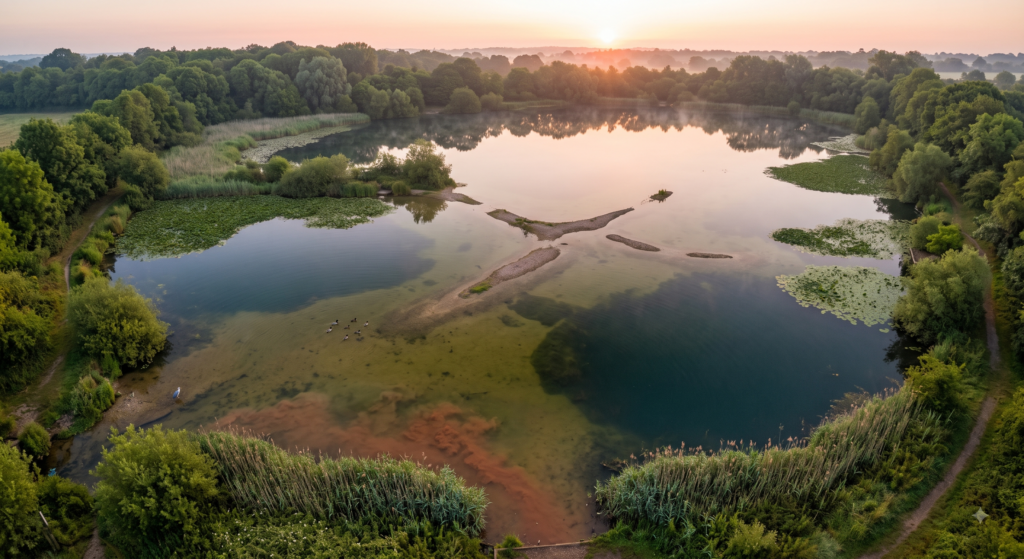
The single most important habit in stillwater fishing is to walk the perimeter of any new water before setting up. A circuit of the lake at dawn or on arrival reveals where the fish are, which margins are active, and where the significant features are. Many experienced coarse anglers spend 30-60 minutes walking before committing to a swim.
What to look for:
Surface activity. Carp and bream show themselves by rolling and crashing at the surface, particularly at dawn and dusk. The direction and location of surface shows reveals where the main groups of fish are holding.
Colour variations in the water. Different depths reflect light differently. Dark blue-green areas typically indicate deep water; lighter, olive-tinged or tea-coloured areas indicate shallow water, often with a soft silt bottom. Reddish-brown discolouration in the margins indicates fish feeding in the shallows – bottom-feeding fish stir up silt and create visible turbidity.
Bird activity. Diving ducks (tufted duck, pochard) concentrate over mussel and invertebrate beds in shallow water. Cormorants fishing in specific areas indicate fish concentrations. Kingfishers hunting along specific margins reveal fry concentrations.
Insects. A hatch of midges, buzzers, or sedges over a specific area in the evening is a reliable indicator of feeding fish beneath – particularly trout and perch, which feed actively on emerging pupae.
Water Temperature and Fish Location
Temperature is the primary driver of fish location across all seasons in stillwaters.
Spring
As winter ends and water temperatures begin rising, fish move from deep winter holding areas toward the shallows. The southern-facing (north bank) and shallowest margins warm first and soonest. In April and May:
- Shallow, south-facing bays and margins are the first productive areas
- Dark-bottomed silty areas absorb heat faster than sandy or gravel margins
- Morning sessions on the shallow margins often produce fish that have moved in overnight to feed in the warming water
Summer
In high summer, the surface layers warm rapidly and the water temperature stratifies – a warm upper layer (the epilimnion), a sharp temperature boundary (the thermocline), and colder water below (the hypolimnion). Fish position themselves based on which zone is most comfortable:
- Carp and bream: Often in the upper-warm layer, visible on the surface or just below. In very hot weather (above 22°C air temperature), they may become torpid and lie near the surface in shade.
- Perch and pike: Hunt at various depths, but are most active where temperature is in the comfortable range (10-16°C for perch).
- Tench: Typically in shallow, weedy margins in early morning, moving to deeper water as temperatures rise through the day.
At night, the upper layer cools, temperature stratification reduces, and many species move more freely through the depth range.
Autumn
Temperature cooling in autumn concentrates food items as aquatic vegetation dies back and invertebrate populations peak. Fish feed heavily to build reserves:
- Tench feed well into October in many UK waters
- Bream move into deeper water as temperatures fall, but feed actively on mild autumn days
- Carp feed heavily in September and October before becoming less active as temperatures drop below 10°C
Winter
Fish in cold UK stillwaters concentrate in the deepest available water where temperature is most stable. Activity is reduced but not absent – perch, pike, and some bream continue feeding through winter. Tench and carp are effectively dormant below 5°C.
- Target the deepest areas of the lake in winter
- Overcast, mild days with stable temperatures produce more activity than sunny, cold days
- Sessions at midday (the warmest part of the day) are more productive than early morning in winter
Wind and Feeding Fish
Wind drives surface water and creates circulation patterns within a stillwater. These patterns concentrate food items – and where food accumulates, fish follow.
The downwind end. Surface debris, hatching insects, and floating food items are blown to the downwind end of a lake. On any day with a meaningful wind, the downwind margins and shallows are worth investigating first for feeding fish.
Wind lanes. A steady wind over a long fetch of water creates visible streaks of surface debris running with the wind direction. Floating food items accumulate in these lanes – and fish (particularly surface-feeding carp) patrol them.
The upwind end. In very rough conditions, fish may actually retreat to the calmer upwind end, where the surface is less disturbed and food items have accumulated as the wind direction has shifted. On multi-day winds, the pattern can reverse as the bottom currents catch up with the surface drift.
Features in Stillwaters
Features concentrate fish. On any stillwater, a specific combination of depth variation, food availability, and cover produces the most consistent fishing:
Lily beds: Carp, tench, and bream all use lily beds as daytime cover. Fish hold tight to the stems and pads in warm weather. Fishing tight to the edge of a lily bed (within 30-60cm) is the standard approach; fishing into the gap in a lily bed (a clear channel through the pads) can produce exceptional results.
Weed beds (sub-surface): Milfoil, Canadian pondweed, and hornwort beds are rich in invertebrates and provide cover. Fish the edges of sub-surface weed beds in the same way as lily beds.
Reed beds: The roots of reeds create complex underwater habitat used by tench, perch, and carp. Fish tight to the reed stems in spring and early summer when fish push into the shallowest margins.
Sunken trees and woody debris: Perch, pike, and big bream associate strongly with woody underwater structures. Any sunken branch, pile of logs, or old tree fallen into the lake is worth targeting.
Gravel bars and bars in general: A bar (a raised underwater feature) concentrates food items rolling down its slope and creates a visible line where depth changes. Many commercial carp fisheries have man-made bars for this reason. In natural lakes, bars of gravel, clay, or compacted silt create similar features.
Inlet streams: Where a feeder stream enters a lake, it brings oxygenated water, food, and in spring, juvenile fish. The inlet area is a productive feeding spot in spring and after heavy rain.
Island margins: If a stillwater has islands, the far side of an island from the main bank creates a sheltered, quieter area that often holds fish. The ends of islands (where currents and food items concentrate) are particularly good.
Bridges and jetties: Wooden structures (fishing jetties, old piers, boat moorings) create shade and complex habitat. Perch hold tight to vertical structures; carp and bream use the cover in summer.
Depth and Features: How to Map a Stillwater
On any new water, building a depth map is worthwhile over time. Methods:
Plumbing with float tackle: A plummet on a float hooklink, cast to different areas, reveals depth quickly and accurately. Walk the margins plumbing in progressive strips to build up a picture of the depth variation.
Marker float system (carp fishing): A marker rod with a large marker float and lead are cast to different areas; the lead bumps across the bottom revealing bottom texture (hard drag = gravel; soft pull = silt; distinctive thud = clay), and the float is run up the line to measure depth.
Polaroid glasses: Polaroid sunglasses cut surface glare and allow direct visual observation of bottom texture and depth variation in water up to 2-3m deep on sunny days. Invaluable for feature spotting in clear-water lakes.
Practical Approach to a New Water
- Walk the entire perimeter before committing to a swim
- Note all visible fish activity – surface shows, coloured water, birds, weed
- Identify the wind direction and check the downwind end
- Select the swim with the best combination of fish activity and physical features
- Plumb or map the depth before setting rigs
- Fish the nearest feature first before casting to open water
Frequently Asked Questions
Why can’t I find fish on a lake I’ve never been to before?
On any new water, fish are in locations you have not yet identified as productive. Walk the lake on arrival before setting up, look for surface activity, coloured water (feeding fish in the margins), and structural features. Spend 20-30 minutes finding fish before choosing a swim rather than defaulting to the most popular pegs.
Should I follow the wind when lake fishing?
As a starting point, yes. Food items are blown to the downwind end, and this concentrates fish. On a bright summer day with a steady wind, the rippled downwind end will often be more productive than the calm upwind bank. In rough conditions, however, fish may move to calmer areas, so the rule has exceptions.
How do I find the deep water in a lake?
The simplest method is plumbing with a float and plummet across the lake in a systematic pattern. On large waters, many fisheries publish depth maps. Polaroid glasses allow you to see depth variation in water up to 2-3 metres deep on calm, sunny days – areas that appear darker than the surroundings are typically deeper.
What time of day are fish most active in a stillwater?
Dawn is the most consistently productive period across all UK seasons. The overnight temperature of shallow water is warmer than daytime in spring and autumn, and calmer in summer, which concentrates feeding fish in the margins. Evening is also reliable, particularly for carp surface feeding and tench in summer. Midday is least productive in summer but most productive in winter.
Is it worth fishing in winter on a lake?
Yes, but the approach changes. Target the deepest water in the lake – fish concentrate in the warmest, most stable zone. Use smaller baits and reduced quantities. Overcast, mild winter days with stable temperatures produce more activity than bright, cold days. Perch on drop shot, pike on deadbait, and slow-fished worm for bream are the most reliable winter stillwater methods.
← Back to From the Bank – UK Fishing Articles, Tips and Stories