The Lake District is one of the most scenically spectacular fishing destinations in England and offers a genuinely different fishing experience from the commercial stillwaters and lowland rivers that dominate most UK coarse angling. Here, the fishing is wilder, the scenery extraordinary, and the species in large part distinct from those found in warmer, lower-altitude waters.
This guide covers the main fishing opportunities in the Lake District – the lakes (or “meres” in Cumbrian tradition), the Cumbrian rivers, the target species, and the access arrangements that govern fishing in the National Park.
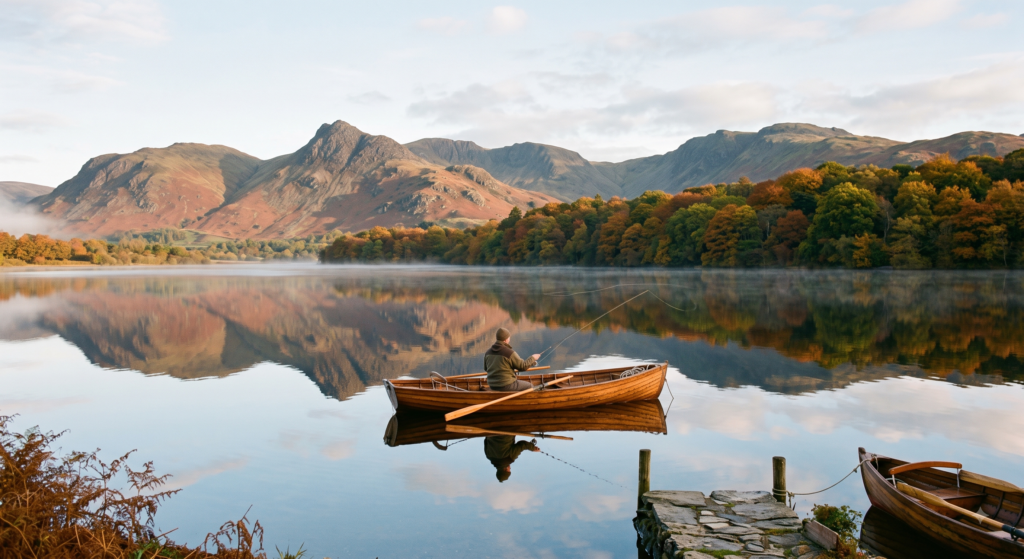
The Lake District’s Fishing Character
The Lake District is fundamentally different from most of England’s fishing geography:
Geology: The lakes sit in ancient rock (Borrowdale Volcanics, Skiddaw Slate) that is low in calcium. This produces soft, nutrient-poor water – the opposite of the productive chalk streams or lowland river systems. Soft, acid water grows fish slowly. A 5lb perch in Esthwaite Water is a much older and rarer fish than a 5lb perch from a managed commercial lake in the Midlands.
Altitude: Many Lake District waters are at significant altitude. Thirlmere (the reservoir supplying Manchester) is 178m above sea level. These high-altitude waters are cold year-round, have short growing seasons, and hold species adapted to cold, oligotrophic (nutrient-poor) conditions.
Species mix: The native species of the Lake District include Arctic charr (a true glacial relict species in Windermere, Coniston, Ennerdale, Wastwater, and Buttermere), vendace (critically rare, present in Bassenthwaite and formerly Derwentwater), schelly (a whitefish relative in Haweswater, Ullswater, and Brothers Water), and brown trout. Perch and pike are the main predator species.
Conservation sensitivity: Several Lake District fish species are of significant conservation concern. The vendace (Coregonus albula) is found in only two UK locations (Bassenthwaite Lake, and formerly Derwentwater where it has not been recorded since the early 2000s). The schelly (Coregonus lavaretus) is vulnerable. Fishing regulations in the Lake District reflect this sensitivity.
The Main Lakes
Windermere
England’s largest natural lake at 10.5 miles long and up to 67m deep. Windermere offers the most accessible Lake District fishing and a range of boat and bank fishing.
Species:
– Pike: Windermere holds good pike populations, particularly in the shallow southern end and the bays around the margins. Bank fishing for pike with deadbaits or lures from the shore is accessible at several points. Boat fishing gives access to the mid-lake structure.
– Perch: Large perch (up to 3-4lb) are present in Windermere, particularly around the jetties, piers, and submerged structure of the lake margins. Jig fishing with soft plastics from a boat is an effective approach.
– Arctic charr: Windermere supports a native Arctic charr population (one of the best-known in England). Traditionally fished for by trolling at depth (charr inhabit the deepest, coldest water layers in the thermocline). Charr fishing on Windermere is managed and requires specific permits.
– Brown trout: Present throughout, particularly in the northern arm and the inflow rivers. Fly fishing for wild brown trout is the traditional method.
– Roach and bream: The southern end of Windermere and the River Leven outlet hold roach and bream, more typical coarse fishing species.
Access: Several boat hire operators provide rowing boats and motor boats. Bank access is available at Fell Foot (National Trust), Waterhead, and at several public access points along the B5285. Fishing permits are required – contact the Windermere, Ambleside and District Angling Association (WADAA) which controls much of the fishing.
Ullswater
England’s second-largest lake (7.4 miles long, up to 62m deep). A more remote and less developed lake than Windermere, with exceptional scenery.
Species:
– Schelly: Ullswater is one of only four lakes in England holding schelly, a cold-water coregonid fish related to the whitefish. Schelly are not a practical fishing target for most anglers – they are present but specific techniques and extensive local knowledge are required.
– Pike and perch: Ullswater holds good pike and perch, fished similarly to Windermere.
– Brown trout: The rivers feeding Ullswater (particularly Goldrill Beck) hold wild brown trout.
Access: Boats available at Pooley Bridge and Glenridding. Ullswater Trout Association manages much of the fishing.
Coniston Water
A 5-mile lake on the southern edge of the fells. Known for the water speed record attempts of Donald Campbell. Fishing character similar to Windermere.
Species: Pike, perch, Arctic charr, brown trout.
Access: Coniston Boating Centre provides boat hire. Coniston and Torver Angling Club manages the fishing.
Thirlmere
A reservoir rather than a natural lake, owned by United Utilities. Largely inaccessible for fishing except on managed beats.
Bassenthwaite Lake
The only natural lake in the Lake District (Windermere, Ullswater etc. are technically “meres” or “waters” – Bassenthwaite is the only one officially called a “lake” in its name). Bassenthwaite is of outstanding conservation significance as one of only two locations in the UK where vendace are recorded.
Species:
– Vendace: Present but critically rare and not a target species. Any vendace caught accidentally must be handled with extreme care and returned immediately.
– Pike: Bassenthwaite holds pike and these are the main fishing interest for most visiting anglers.
– Roach and perch: Present in the shallower areas.
Access: Bassenthwaite Lake Angling Association controls much of the fishing. The lake has significant wildlife designations (SSSI, SAC) and access restrictions.
Esthwaite Water
A smaller, more productive lake near Hawkshead. Esthwaite is significantly more eutrophic (nutrient-rich) than the other Lake District lakes, and this shows in its fish productivity.
Species:
– Trout: Esthwaite Trout Fishery is a popular fly fishing venue stocked with rainbow and brown trout.
– Pike: Esthwaite holds excellent pike and is known for producing large specimens.
– Perch: Large perch present, particularly around the margins and reed beds.
– Roach and bream: More typical coarse species due to higher nutrient levels.
Access: Esthwaite Water Trout Fishery manages the fishing. Day tickets available for both trout and coarse fishing.
The Cumbrian Rivers
River Eden
The Eden drains east Cumbria and flows north through Penrith to the Solway Firth. It is one of England’s finest salmon and sea trout rivers, with a significant coarse fish population in its lower reaches.
Species:
– Salmon and sea trout: The Eden runs significant salmon and sea trout. Salmon fishing is managed by the Eden Rivers Trust and a number of private clubs.
– Grayling: The Eden holds excellent grayling, particularly in the middle Eden around Appleby and Lazonby.
– Brown trout: Throughout the river in suitable habitat.
– Coarse fish (lower Eden): Roach, dace, chub, and perch in the lower river approaching Carlisle.
River Kent
A fast, spate river draining south from the Howgills through Kentmere and Staveley to Morecambe Bay. A brown trout and sea trout river with limited coarse fishing.
River Derwent (Cumbrian)
The Cumbrian Derwent (not the Yorkshire Derwent) drains Derwentwater and flows west through Cockermouth to the coast. It holds salmon, sea trout, and grayling in its upper sections.
Practical Access Information
Lake District fishing is primarily accessed through:
Local angling clubs: Most lake and river fishing is controlled by angling clubs that offer day tickets and season permits. Key clubs include WADAA (Windermere area), Ullswater Trout Association, Eden Rivers Trust (river management and permits), and numerous smaller local clubs.
National Trust properties: Some National Trust shoreline gives basic fishing access, but always check specific permit requirements.
Environment Agency rod licence: Required for all freshwater fishing as in the rest of England.
Boat hire: On the larger lakes, boat fishing gives access to deep water fishing for pike, perch, and charr that bank fishing cannot reach.
Species of Conservation Concern
Lake District anglers should be aware:
Vendace: Protected under Schedule 5 of the Wildlife and Countryside Act. Do not target. If accidentally caught, return immediately with minimum handling.
Schelly: Protected under the Habitats Regulations. Do not target specifically.
Arctic charr: Not legally protected but subject to voluntary conservation agreements on most Cumbrian lakes. Check specific fishery rules before targeting.
Frequently Asked Questions
Can I fish the Lake District lakes without a boat?
Yes, on most lakes there are accessible bank fishing spots, particularly around the southern ends and in bays. However, on the larger, deeper lakes (Windermere, Ullswater, Coniston), boat fishing significantly improves your ability to locate fish and reach productive depths. For pike and perch in particular, a boat opens up midlake structure that bank fishing cannot reach.
Is fly fishing the only option in the Lake District?
No, though fly fishing is the primary method on many beats. The lakes offer pike and perch fishing on lures, deadbaits, and float-fished worm that are coarse fishing methods. Esthwaite Water has a managed coarse fishery with day tickets. The lower Eden and its tributaries offer trotted float fishing for grayling and dace. It is not exclusively a fly fishing destination.
Are there any fish I should not target in the Lake District?
Vendace and schelly are protected and should not be targeted. Arctic charr fishing requires specific permits and is restricted on most Cumbrian lakes. Always ask the controlling club or fishery about species-specific rules before fishing.
What is the best Lake District lake for pike fishing?
Windermere and Esthwaite Water are generally considered the most productive Lake District venues for pike. Windermere’s size and depth means pike reach large sizes; Esthwaite’s more productive water means there are more fish. Both can be fished from the bank or boat, and both require permits from the managing club or fishery.
Is there coarse fishing for roach and bream in the Lake District?
The nutrient-poor geology of most Lake District lakes means roach and bream populations are limited. Esthwaite Water (the most productive lake) and the lower River Eden and Carlisle area are the most viable options for typical coarse fishing species. The Lake District is primarily a brown trout, pike, perch, and specialist species destination.