The FG knot has become the standard braid-to-leader connection for serious UK lure anglers, valued for being both exceptionally strong and remarkably thin – it passes through rod guides during a cast almost as smoothly as the braid itself, unlike bulkier knots that can catch or reduce casting distance.
Why Anglers Rely on the FG Knot
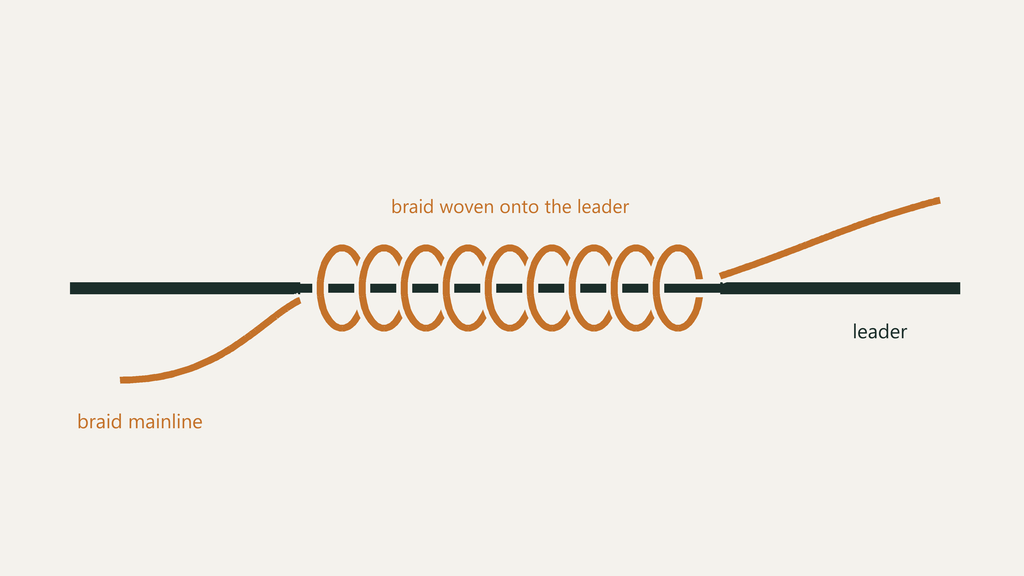
Unlike knots built from loops and tucks, the FG knot is formed by wrapping the braid tightly around the leader under tension, creating a connection that grips harder the more pressure is applied to it. This gives it genuinely excellent breaking strain retention alongside its low-profile, guide-friendly finish – the two qualities that have made it the default choice for pike, perch, and general lure anglers fishing braid mainline with a mono or fluorocarbon leader.
What You Need
A length of braid mainline, a leader section (mono or fluorocarbon, typically heavier breaking strain than the braid), and ideally something to anchor the leader under light tension while you work – many anglers loop the leader around a fixed point (a rod butt, a hook on a nearby rod, or a helper’s finger) while tying.
Step by Step
- Anchor the leader under light tension, holding roughly 20-30cm of the tag end free to work with.
- Take the braid and begin wrapping it tightly around the leader, alternating over and under with each wrap, keeping every wrap snug against the last with no gaps.
- Continue for 15-20 tight wraps – more wraps generally means more strength, though this needs balancing against a knot that becomes too bulky.
- Once the wraps are complete, secure them with a series of half-hitches using the braid tag end around the combined leader and mainline, working back over the wraps you’ve just made.
- Add 3-4 further half-hitches beyond the first set for extra security, particularly important given how thin and otherwise slippery this connection can be if under-secured.
- Trim both tag ends close, leaving 2-3mm.
Common Mistakes
Loose or uneven wraps are the most common failure point – each wrap needs to sit tight against the one before it, with genuine tension maintained throughout, or the finished knot won’t grip properly under load. Rushing the half-hitch locking stage is the second common issue; under-securing the wraps leaves a knot that can slip under sustained pressure even if the initial wrapping was done well.
Practice Before You Need It
The FG knot has a genuinely steeper learning curve than knots like the Palomar knot, precisely because it relies on wrapping technique rather than familiar loops and tucks. It’s worth practising at home, ideally several times, before relying on it for a session – a poorly-tied FG knot under pressure on the bank is a lost fish and a lost leader, not just an inconvenience. Once it clicks, most anglers find it becomes quick to tie reliably. See our lure fishing for pike guide for where this connection fits into a wider braid and leader lure setup.