Line thru lures look like something from another sport. They’re large, realistic soft-bodied fish with a three-dimensional shape and detailed paint, and they arrive with hooks that don’t seem attached to anything. They divide opinion, so here’s how they work and when I’d use one.
Some product links in this post are affiliate links to Total Fishing Tackle and Fishing Tackle & Bait. If you buy through one we may earn a commission at no extra cost to you. How that works.
How a line thru lure works
With a jig-head shad, the hook is fixed to the lure. With a line thru lure, the line (via the trace) runs through a channel in the body and the hooks hang from a separate rig, usually a pair of trebles on a wire section. The body can slide up the line independently of the hooks.
That design has two practical effects. When a pike is hooked, the lure slides up the trace away from the fish, so the body can’t be used as a lever to throw the hooks. And because the hooks sit on a loose rig, you can usually place them on the belly or the back, which changes how the lure sits in the water. Savage Gear, which makes the best-known range, fits an attachment ring on the chin so you can adjust the running depth.
The cost is more parts. More parts means more to check for wear after each fish, and you need to be careful with the trebles when you unhook.
Trout, perch and bream patterns
The patterns are named for the fish they imitate. That isn’t a statement about which species the lure targets. It tells you what the pike might be eating.
- Trout patterns make sense on waters where trout are stocked or where pike regularly eat them. Our Rutland Water guide and Grafham Water guide both cover waters where trout and pike share the same water.
- Perch patterns suit any water where perch are a main prey fish, which covers a lot of canals, rivers and gravel pits. The stripes and orange fins on the Savage Gear 4D Line Thru Perch 23cm copy a fish that big pike target heavily.
- Bream patterns imitate a deep, slab-sided fish and make sense on stillwaters with large bream shoals. The Savage Gear 3D Line Thru Pulsetail in the bream colour, 16cm is a cheaper way to try one than committing to a 25cm lure.
Match the pattern to the main prey fish where you know it. Where you don’t, a perch pattern in clear water and a trout pattern elsewhere are sensible starting points.
Sizes
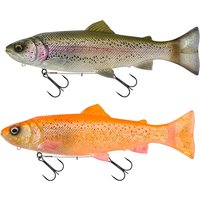
The trout range covers small to very large. Commonly stocked sizes are around 15cm (35g), 20cm (98g), 25cm (180g) and 30cm (290g), though exact weights vary by version and sink rate, so check the packet. The newer 4D versions follow the same basic idea.
The lure sizes post covers size choice in general. For line thru lures specifically:
- 15 to 16cm: casts on a medium rod and is a sensible way to learn the system.
- 20 to 25cm: needs a heavy rod, strong braid and a wire trace rated well above the fish you expect.
- 30cm: a specialist lure for big-fish waters. It needs a heavy rod and a lot of patience.
The 4D Line Thru Trout 15cm and the 25cm version mark the practical range for most UK anglers.
How to fish them
Most line thru lures are slow sinkers. The usual approach is a slow, steady retrieve with the odd pause to let the lure drop. In cold water, slower is better. In clear water, fish them close to the margin, because pike often follow lures right up to the rod tip.
Finish every retrieve with a figure of eight. Push the rod tip into the water at the end of the cast and sweep the lure in a wide eight beside the bank. A pike that followed all the way in will sometimes commit at that last moment.

What you need to fish them
Line thru lures from 20 to 30cm need proper gear. A rod rated up to 120g, like the Fox Rage Warrior Pike Spin, will cast them. Use a reel with a strong drag, 30 to 50lb braid, and a good wire trace. Later posts in this series cover traces and braid.
Are they worth the money?
A line thru lure costs more than a basic shad and you’ll lose some to snags. A plain shad will catch the same pike on most days, so I wouldn’t call them essential. Where they stand out is on waters with big pike, where a large, realistic profile can turn a follow into a take. I’d start with one 15 to 16cm lure and see whether you like fishing them.
Gear that fits this
If you’re kitting out for this, these fit.
Bait-side picks: Fox Rage Predator Oil and Air Kit, Fox Rage Predator Float Trace and Allcock Pike Slider float.
On the reel side, Savage Gear Thoriz C3000, Fox Rage Prism X Baitcast and Penn Battle IV 3000.
Rods: Fox Rage Warrior Shad and Spin and Fox Rage Prism X Pike Cast.

Questions anglers ask
What is a line thru lure?
A lure where the line runs through a channel in the body to a separate hook rig. When a fish is hooked, the body slides up the line.
Which line thru colour is best for pike?
Match the main prey in the water. Perch patterns suit most clear UK waters, trout patterns suit reservoirs with stocked trout, and bream patterns suit waters with big bream shoals.
Do line thru lures need a wire trace?
Yes. Many are supplied with a steel leader, but check it and replace it if it’s kinked or nicked, because pike teeth cut ordinary line quickly.

Rob Hadley grew up fishing the rivers and drains of the Norfolk Broads, and it was inevitable that pike would become his species of choice. He’s been targeting predators seriously for over 20 years – starting on dead baits, moving through live bait rigs, and eventually landing on lure fishing as his preferred method about eight years ago.
These days he fishes the Broads through winter, travels to Chew Valley Lake each spring for its outsized fish, and spends the warmer months working soft plastics on rivers across the East Midlands for perch and zander. He’s had pike to 31lb and perch to 3lb 9oz, and reckons both records are beatable on the right day with the right set-up.
At The River Bend, Rob writes the predator species guides, lure fishing technique articles, and most of the winter fishing content.
Covers: Pike, perch, zander, lure fishing, winter fishing, predator rigs