If I had to pick a single type of lure for someone new to pike, it’d be a soft shad on a jig head. They’re forgiving, they catch fish in most conditions, and the retrieve is easy to learn. A rubber lure also costs a few pounds, so losing one to a snag stings less than losing a hard plug.
Some product links in this post are affiliate links to Total Fishing Tackle and Fishing Tackle & Bait. If you buy through one we may earn a commission at no extra cost to you. How that works.
Shad or paddle tail?
The two names overlap. A shad usually has a flat, fish-shaped body and a tail that wobbles on the retrieve. A paddle tail has a flatter, paddle-shaped tail that kicks from side to side and gives the lure strong vibration. For pike, both work. A paddle tail makes more disturbance, which helps in coloured water or at dusk. A slimmer shad is subtler and can be better when fish are following but not committing.
You’ll also see jointed shads, which have a hinge in the body for a wider swimming action. The Fox Rage Pro Shad Jointed 14cm is one of those, sold ready-rigged with a belly-weighted harness. If you want something in a bigger size, the Super Slick Shad 18cm is a good next step, and the Abu Garcia Pike Kit is a cheap way to try a mix of soft lures before you commit to a favourite.
Loaded or unloaded?
“Loaded” simply means the lure arrives with a jig head or weighted hook already fitted, so it’s ready to cast. It’s convenient and sensible when you’re learning. “Unloaded” lures give you the flexibility to choose your own head weight and hook, which matters once you know what you want.
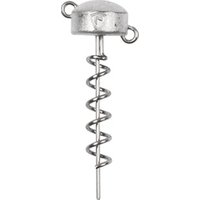
Choosing a jig head
The jig head sets how fast the lure sinks and where it swims. As a rough guide:
- Light heads (about 10 to 15g): shallow water, weedy margins, slow retrieves.
- Medium heads (about 15 to 25g): the default for most still waters and canals at 1 to 3m deep.
- Heavy heads (25g and above): deep water, flowing rivers or windy days when you need to get down and keep contact.
Those figures are starting points, and they shift with lure size. A 12cm shad with a 30g head will drop like a stone, while an 18cm lure may need that weight just to swim properly. Something like the Fox Rage Super Screw Bullet jig heads in 20g is a decent all-round weight to carry, and the Savage Gear Swim EWG jig head gives you a different shape if you want a more upright swimming action.
The retrieves
You only need three, and you can learn all of them in an afternoon.
Straight retrieve. Cast out, let it sink to your chosen depth, then wind slowly and steadily. The lure swims at a constant depth. It’s a good way to cover water and a good way to find out whether fish are present.
Sink and draw. Cast, let the lure sink, then lift the rod tip slowly to pull it upwards, then drop the tip and wind in the slack as the lure falls. Repeat. Many bites come as the lure drops, so watch the line for a twitch or a sudden slackening.
Stop-start. A steady retrieve with pauses of one or two seconds. The pause makes the lure look like a fish that has stopped to think, and pike often hit as it moves off again.
For all three, the key is to stay in contact with the lure. If the line goes slack for no reason, strike.

Short takes and stingers
Pike sometimes nip the tail of a long shad and miss the single hook at the front. That’s a short take, and it’s frustrating. A stinger, which is a small trace with a treble hook attached to the main hook and positioned near the tail, picks up those fish. Fox Rage Strike Point Stingers are made for this job. They also add a bit of weight at the back of the lure, so check how it swims after you fit one.
Whatever you fish, use a wire trace. A fluorocarbon leader alone won’t survive pike teeth, and that’s the subject of a later post.
Colours
I don’t spend long on this. In clear water I’ll go with a natural pattern, such as roach, perch or bleak. In coloured water or low light, something bright or high-contrast like firetiger or chartreuse tends to be easier for a pike to see. Carry two or three patterns and change when you’ve fished a swim thoroughly with the first.
What to fish them on
A 2.4m rod with a 20 to 60g casting range, like the Fox Rage Warrior Shad and Spin, suits most 12 to 16cm shads with medium heads. If you’re fishing 18cm and larger or heavier heads, step up to something like the Warrior Pike Spin rated to 120g. Our rod test curve guide explains how ratings work, and the types of lures page puts shads in context alongside everything else.
Gear that fits this
Here is gear that suits what this post covers, by type.
For deadbait and float work, Fox Rage Kwik Change Paternoster Trace, PikePro Dumpy Slider float and Westin Pike Float Kit.
Reels that handle pike: Daiwa BG 4500A, Okuma Revenger 4000A and Okuma Revenger 6000A.
On rods, Fox Rage Predator Elite Pro Deadbait.

Questions anglers ask
What jig head weight should I use for pike?
For most UK stillwaters and canals, 15 to 25g works as a starting point with a 12 to 16cm shad. Go lighter for shallow weedy water and heavier for deep or flowing water.
Are paddle tails better than normal shads for pike?
Neither is better in all conditions. Paddle tails produce stronger vibration, which helps in coloured water or low light. Slimmer shads are subtler and can work better in clear water.
Do I need a stinger hook?
You don’t need one every time, but if you’re getting short takes where pike nip the tail without hooking up, a stinger often solves the problem.

Rob Hadley grew up fishing the rivers and drains of the Norfolk Broads, and it was inevitable that pike would become his species of choice. He’s been targeting predators seriously for over 20 years – starting on dead baits, moving through live bait rigs, and eventually landing on lure fishing as his preferred method about eight years ago.
These days he fishes the Broads through winter, travels to Chew Valley Lake each spring for its outsized fish, and spends the warmer months working soft plastics on rivers across the East Midlands for perch and zander. He’s had pike to 31lb and perch to 3lb 9oz, and reckons both records are beatable on the right day with the right set-up.
At The River Bend, Rob writes the predator species guides, lure fishing technique articles, and most of the winter fishing content.
Covers: Pike, perch, zander, lure fishing, winter fishing, predator rigs