Rainbow trout (Oncorhynchus mykiss) are the most widely fished trout in the UK and the primary species in most commercial stillwater trout fisheries. They are a non-native species, originating from the Pacific coast of North America, introduced to UK waters from the late 19th century onward. Today they are stocked into thousands of fisheries from large reservoirs to small day-ticket lakes across England, Wales, and Scotland.
The rainbow’s combination of aggressive feeding behaviour, willingness to take a wide range of lures and flies, and commercial availability through trout hatcheries has made it the practical choice for put-and-take fishing. Wild-origin rainbow populations that self-sustain by natural reproduction are rare in UK rivers (some chalk stream tributaries have small populations), but virtually every stocked fishery in the country holds rainbows as its primary species.
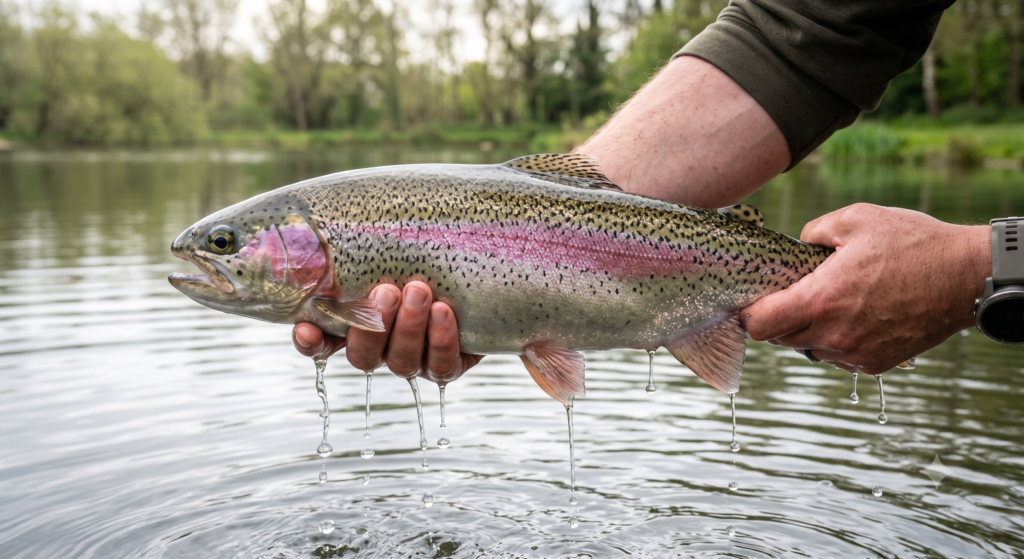
Identification
The key feature: A pink to crimson stripe running along the lateral line from the gill plate to the tail. This band is absent in brown trout and is the primary identification feature that separates the two species.
Spotting: Black spots, sometimes with a blue-grey halo, on the back, flanks, fins, and tail. The spots are predominantly black (unlike brown trout which have both black spots and red/orange spots).
Coloration: Silver-green to olive on the back, silver flanks that take on a pinkish wash along the lateral line, white to cream belly. In good condition, the flanks have an almost metallic quality.
Adipose fin: Present (confirming salmonid family); often with a few small spots in rainbow trout.
Tail: More strongly forked than brown trout.
Wild vs stocked: Stocked rainbow trout (from hatchery) tend to have more uniform silver coloration, rounder body shape, and worn fin edges from the hatchery tank environment. Fish that have been in the water for a season develop more vivid colouration and better fin condition.
Distribution
Rainbow trout in the UK are almost entirely dependent on continued stocking. The species does not establish self-sustaining wild populations in most UK waters:
Reservoirs: Rutland Water, Grafham Water, Farmoor, Draycote Water, and major storage reservoirs throughout England are stocked with rainbow trout for fly fishing.
Commercial stillwater fisheries: Thousands of small to medium-sized day-ticket trout fisheries operate throughout England, Wales, and Scotland, stocked with rainbow trout as their primary species.
Rivers: Some chalk stream tributaries hold small wild or semi-wild rainbow populations following escapes from upstream stocking. Feral rainbows are present in the upper River Kennet in places. These are not the focus of managed fisheries.
Habitat
In managed UK fisheries, rainbow trout are stocked into prepared environments. Their natural habitat preferences are:
- Cold, highly oxygenated water (similar requirements to brown trout)
- Temperatures 10-18°C optimal; tolerant to around 22°C (slightly higher than brown trout)
- Clear, well-oxygenated water
- Varied depth: reservoir fish move freely between depth zones in response to temperature and feeding opportunity
Rainbow trout tolerate slightly warmer water than brown trout, which allows them to be stocked into lowland fisheries where brown trout would struggle in summer.
Seasonal Behaviour
In UK stillwater fisheries, rainbow trout behaviour shifts with water temperature:
Spring (March to May): Active and feeding well as water temperature rises from winter levels. Takes are aggressive; buzzers, nymphs, and lures all work.
Summer (June to August): As surface temperatures rise, rainbows drop to the thermocline where temperature is more comfortable. Deep-fished lures and long leaders with small nymphs are needed. Evening fishing as temperatures drop produces surface activity.
Autumn (September to November): Excellent fishing as temperatures cool. Rainbows feed aggressively, taking large lures, minkie-type streamers, and nymphs. The best reservoir fishing is often in October.
Winter (December to February): Good fishing at quality fisheries through winter. Cold water slows metabolism but rainbows continue feeding. Slow-retrieved lures and small nymphs on long leaders.
Size and British Record
The British record for rainbow trout from a river is 24lb 1oz. Records for still water differ – very large rainbows come from specialist stocked fisheries where individual fish are retained for many years. Check brfc.org for the current ratified records, which separate river and stillwater categories.
In typical day-ticket stillwater fisheries:
– Standard stocked fish: 1-3lb
– Quality stocked fish: 3-6lb
– Large stocked specimens: 6-10lb+
– “Tiger” or specimen fish: some fisheries retain individual fish of exceptional size (10-30lb+) for specimen anglers
Methods for Rainbow Trout
Dry Fly
A floating fly on the surface, representing emerging or adult insects. Particularly effective when there is surface activity (rises visible). Classic dry fly patterns: elk hair caddis, E/C caddis, CDC dun, F-fly, parachute adams.
Nymph
The most consistently productive method across all seasons. A weighted artificial nymph presented at the right depth, on a floating or intermediate line. Key patterns: buzzer (chironomid pupa) in various sizes and colours (black, red, olive), hare’s ear nymph, PTN (pheasant tail nymph), corixa.
Buzzers under an indicator: A team of 2-3 buzzers on a long leader, suspended under a floating indicator at a set depth. The standard method for stillwater nymph fishing. Takes register as the indicator dips or slides sideways.
Lure Fishing
Lures (large-profile artificial flies, 5-15cm) are the most commonly used method at commercial stillwater fisheries. Effective when rainbows are not rising and nymphs are being ignored:
- Fritz and hot-head patterns: Highly visible, UV-enhanced materials that attract attention in coloured or murky water
- Cats whisker: Classic white/yellow lure; one of the most widely used rainbow trout patterns in UK reservoirs
- Minkie: A streamer-style pattern with rabbit fur wing
- Sunburst and green patterns: In summer and clear water conditions
Lures are typically retrieved on an intermediate or sinking line at varying speeds. The “figure of eight” retrieve (a continuous slow retrieve using both hands) is the standard; a twitch-and-pause retrieve can trigger takes from following fish.
Dry Fly – Daddy Long Legs
In late summer and early autumn, daddy long legs (crane flies) fall onto the water surface in large numbers. A floating imitation fished in the surface film is one of the most visual and exciting methods for rainbow trout in September and October.
UK Fisheries for Rainbow Trout
Rutland Water (Leicestershire): One of the largest fly fishing reservoirs in Europe. Boat and bank fishing; stocked with both rainbow and brown trout. Bank fishing productive in spring and autumn.
Grafham Water (Cambridgeshire): Major reservoir fishery; excellent rainbow fishing and one of the best sites for large perch in England as well.
Farmoor Reservoir (Oxfordshire): Good-quality day-ticket reservoir fishing close to Oxford.
Bewl Water (Kent): Largest reservoir in South-East England; stocked rainbow trout, boat and bank.
Day-ticket stillwater fisheries: Thousands of small to medium fisheries throughout the UK. Quality varies significantly; local tackle shop recommendations and fishery review sites give current fishing conditions.
Regulations
- Rainbow trout are game fish covered by game fish byelaws, not the coarse fish close season
- Season dates on rivers vary by region and fishery
- Rod licence required in England and Wales
- Bag limits at commercial fisheries are set by the fishery – typically 2-4 fish per session at most day-ticket venues
- Return policies vary: some fisheries allow all fish to be returned; others require killing fish above a minimum number; check fishery rules

Gear that fits this
If you’re kitting out for this, these fit.
For fly lines, Airflo Sixth Sense 2 Sinking Fly Line WF 5/6 Sink 3 3.0ips, Scientific Anglers Volantis Integrated Floating/Intermediate Weight and Greys Platinum Fly Line WF4F Floating are all worth a look.
Leaders and tippet worth adding: Fulling Mill Masterclass Fluorocarbon 50M 5.03lb 5x, Fulling Mill World Class Fluorocarbon V2 50m 20lb and Scientific Anglers Mastery Trout Tippet 30m 3X (0.20 mm).
On the reels side, Guideline Aeon Fly Reel- Black/Silver #9/11, Lamson Liquid S-Series Smoke Fly Reel and Lamson Liquid Max Tidal Fly Reel.
Rods: Guideline Embrace Fly Rod and Reel Kit #7 9', Guideline NT11 Lake & Anadrome Fly Rod 10' #6 and Sharpes of Aberdeen Ajax Fly Rod 9' #9 4pc.
Frequently Asked Questions
Can rainbow trout survive in UK rivers without stocking?
Very rarely. Rainbow trout do not establish self-sustaining wild populations in most UK rivers because they require specific cool, well-oxygenated headwater conditions for successful spawning, and the natural winter flooding patterns of many UK rivers dislodge eggs from redds. Some isolated chalk stream headwaters have self-sustaining populations; most rainbows in UK rivers are recent escapees from upstream stocking.
What is the difference between rainbow and brown trout?
The primary difference is the pink or crimson lateral stripe on a rainbow trout, which is absent in brown trout. Brown trout have both black and red/orange spots; rainbows have black spots only. Rainbow trout tolerate slightly warmer water. In UK fishing, rainbows dominate commercial stillwater fisheries while wild brown trout are the species of chalk streams and upland rivers.
Do I need a fly rod for rainbow trout?
On most managed trout fisheries and reservoirs, fly fishing is either mandatory or the standard method. Spinning and worm fishing are permitted on some rivers. Most commercial still water trout fisheries specify fly fishing only.
What size fly should I use for rainbow trout?
This depends heavily on the season and conditions. Smaller hooks (size 14-18) for buzzer and nymph fishing in clear conditions; larger hooks (size 8-12) for lures and large nymph patterns. As a general guide, start with size 12-14 buzzer or nymph on a day-ticket stillwater and adjust based on what the fish are taking.
Is rainbow trout good to eat?
Rainbow trout is excellent eating – mild, pink-fleshed, and versatile. Most commercial fisheries that allow fish to be kept provide cleaning facilities. Fish kept for the table should be dispatched cleanly and immediately on removal from the water using a priest (a weighted club) to the back of the head.