Brown trout (Salmo trutta) are the native freshwater trout of the British Isles and one of the most important fish in British fishing culture. They have been pursued by fly fishers on chalk streams and upland rivers for centuries, generating an entire tradition of technique, etiquette, and craft that remains central to UK game fishing today.
In their wild form, in a clear chalk stream or a rocky Highland burn, brown trout are among the most beautiful fish in British waters. Their spotted flanks, golden coloration in clean chalk water or silver in cold Highland rivers, and the intelligence they display in selective surface feeding – rising to a specific insect pattern and refusing a poorly presented imitation – place them in a category of angling challenge that is entirely their own.
Identification
Brown trout are variable in appearance, which reflects their adaptability and the wide range of habitats they occupy. However, several features are consistent:
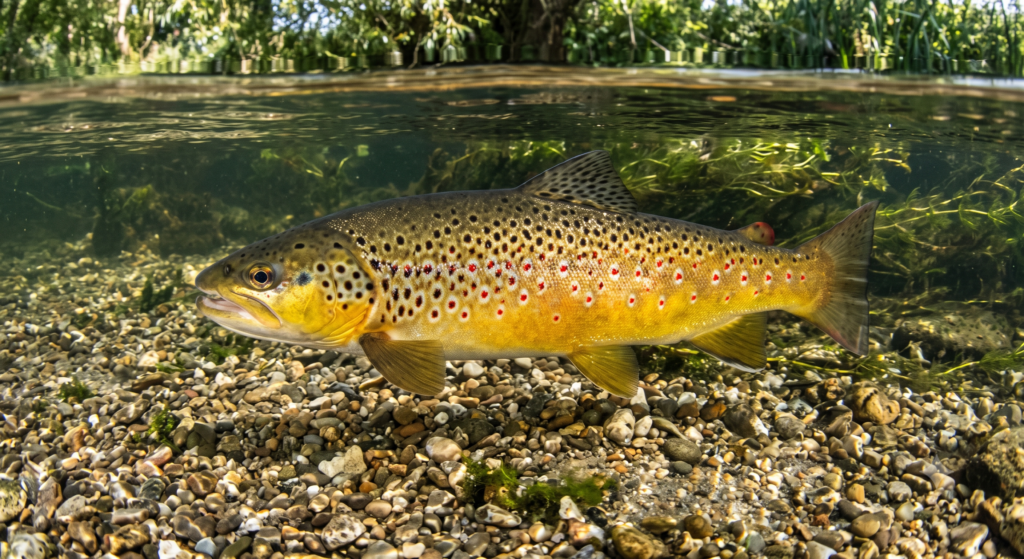
Coloration: Variable but typically olive-brown to golden-bronze on the back and flanks, fading to cream or white on the belly. The characteristic spotting pattern consists of dark black or dark brown spots on the back and upper flanks, with red or orange spots (often surrounded by pale halos) on the flanks and gill cover. The combination of black and red spots on a golden-brown background is the definitive adult brown trout pattern. In clean chalk streams, fish are often exceptionally golden; in peat-stained upland rivers, they may be darker or more silver.
Absence of the adipose fin coloration used by non-native salmonids: Brown trout have a small fleshy adipose fin between the dorsal and tail fins, but unlike rainbow trout, the adipose fin of a brown trout is typically unspotted or lightly spotted.
Tail: Slightly forked or squared, with larger spots near the tail base. Rainbow trout have a more strongly forked tail and a distinctive pink/red lateral band absent in brown trout.
Key distinction from rainbow trout:
– Brown trout: black and red spots, no pink lateral stripe
– Rainbow trout: black spots predominantly (no red), a pink or crimson stripe along the lateral line
Sea trout are migratory brown trout (Salmo trutta trutta) that spend part of their life at sea. Fresh-run sea trout are bright silver with few markings – they are effectively chrome-silver fish when they return from the sea and can be confused with salmon. As they spend time in freshwater, the silver fades and brown trout characteristics emerge.
Distribution
Wild brown trout are distributed throughout the British Isles wherever suitable habitat exists:
England: Primarily upland rivers of the north and west (Yorkshire Dales, Lake District, Dartmoor, Exmoor) and chalk streams of the south (Test, Itchen, Kennet, Avon, Wylye). Brown trout are absent from most lowland rivers where water temperatures, flow, and chemistry are unsuitable.
Wales: Most upland Welsh rivers (Usk, Wye headwaters, Conwy, and smaller mountain streams) hold wild brown trout. Wales has some of the finest wild trout fishing in the British Isles.
Scotland: Wild brown trout are present in virtually every loch, river, and burn in Scotland. Scottish lochs (Leven, Lomond, Rannoch, and many Highland lochs) hold wild brownies of varying sizes.
Northern Ireland: Lough Neagh and many river and lough systems hold wild brown trout.
Habitat
Brown trout are particularly demanding in their habitat requirements:
Cold, highly oxygenated water. Brown trout require water temperatures below 20°C for comfortable survival and below 15°C for optimal health. They are most comfortable in the 8-15°C range. This restricts them to cold upland rivers, spring-fed chalk streams where groundwater temperature remains constant at 10-12°C year-round, and large, deep lowland lakes where temperature stratification provides a cold refuge.
Clean, well-oxygenated water. Brown trout are highly sensitive to oxygen levels and water quality. Pollution, agricultural runoff, and sewage discharges all harm trout populations. They are used as biological indicator species for water quality assessments.
Gravel and cobble substrate. Wild brown trout spawn on clean gravel in fast, shallow water. The availability of suitable spawning gravel is a primary constraint on wild population density.
Varied habitat structure. Fast riffles (for feeding on aquatic invertebrates), deeper pools (for resting and shelter), undercut banks and large boulders (for cover from aerial and terrestrial predators), and overhanging bankside vegetation (which provides terrestrial insect food and shade) are all components of productive trout habitat.
Seasonal Behaviour
Spring (March to June): The trout season on most rivers opens in March or April (season dates vary by river and region – check local fishery rules). Spring trout are lean after winter and are feeding actively as water temperatures rise and insect hatches begin. The March brown, large dark olive, and olive hatches of spring are the first significant dry fly opportunities of the year.
Summer (June to August): High summer is the main dry fly season. Evening hatches of blue-winged olive, pale watery, and caenis produce selective surface feeding from larger fish. During the day, trout feed on subsurface nymphs and terrestrial insects (ants, beetles, grasshoppers) that fall from bankside vegetation. Midday is often slow in hot weather as trout retire to shade and depth.
Autumn (September to October): The season ends on most rivers in September or October. Pre-spawn brown trout become more aggressive in September – males develop a hooked jaw (kype) and bright spawning coloration. Dry fly continues to work; large wet flies and streamers can produce aggressive takes from large fish. On many chalk streams, the season closes on 30 September.
Winter (November to February): Brown trout are protected by the river close season on most UK waters during the spawning period. Spawning occurs from October to January.
Spawning
Brown trout spawn in autumn and early winter – typically October to January. They seek clean gravel redds (spawning beds) in fast, shallow water, where the female excavates a depression by fanning with her tail and deposits eggs that the male fertilises. Spawning trout develop bright colours in males (orange fins, vivid flanks) and are vulnerable to disturbance. Most rivers prohibit fishing well before spawning begins to protect pre-spawn fish.
Eggs hatch in late winter or early spring (January to March depending on temperature). Young trout feed initially on invertebrates and grow rapidly in productive chalk streams; growth is slower in nutrient-poor upland rivers.
Size and British Record
The current British record brown trout stands at 31lb 12oz (14.4kg), though the authenticity and exact details of some large brown trout records are disputed within the angling community. Check brfc.org for the current ratified record.
Most wild river brown trout are considerably smaller:
– Chalk streams: Wild fish of 1-3lb are typical; 4-6lb fish are very good; fish over 8lb exist but are exceptional
– Upland rivers: Wild fish of 0.5-1lb are typical; 2lb+ fish are notable
– Scottish lochs: Ferox trout (the deep-water piscivorous form) can reach 20lb+ in large Highland lochs
Wild river trout over 5lb are genuinely exceptional catches anywhere in England.
Regulations
Brown trout in rivers are covered by game fish legislation and local fishery byelaws rather than the coarse fish close season. Season dates vary by fishery and region:
Most chalk streams (Hampshire Avon, Test, Itchen, Kennet): Season from April or May to 30 September or 14 October. Check individual fishery rules.
Northern rivers: Seasons vary from March through to September or October.
Scotland: Season dates are set by the relevant District Salmon Fishery Board. Most Scottish rivers have a trout season from March or April to September or October, but vary significantly.
A rod licence is required for all trout fishing in England and Wales. In Scotland, you need the landowner’s permission but a national rod licence is not required for trout.
Bag limits and minimum sizes vary considerably by fishery. Wild fish minimum sizes on chalk streams are often higher than the legal minimum; fishery rules should be checked on the day.
Catch and release: On many chalk streams, catch and release of wild brown trout is mandatory or strongly encouraged. Where killing is permitted, limits are typically 1-2 fish per day on wild fisheries.
Baits and Methods
Dry Fly
The definitive brown trout method on chalk streams. Presenting an artificial dry fly – designed to resemble a specific natural insect – to a rising trout in a way that appears natural (the correct pattern, the correct size, a natural drift with no drag) is the highest form of trout fishing technique.
The approach:
– Position downstream of the rising fish, observe which insects it is taking
– Select the closest imitation from your box (olive, pale watery, BWO, CDC patterns)
– Cast the fly upstream of the fish so it drifts naturally over the rise position
– The fly must float without drag (the pull of the current on the line making the fly skate unnaturally)
– Strike gently at the rise
Success with dry fly on chalk streams requires accurate casting, good knot confidence, and the ability to read and match a hatch – skills that take seasons to develop.
Nymph Fishing
Trout spend most of their feeding time sub-surface, eating nymphs, larvae, and pupae of aquatic insects. Nymph fishing presents artificial nymphs at the trout’s feeding depth.
Traditional nymph: A single weighted nymph (pheasant tail, hare’s ear) cast upstream and allowed to sink and drift naturally. A yarn indicator, a greased leader butt, or the angler’s visual observation detects takes.
Czech/French nymph: Tight-line technique using multiple weighted nymphs in fast water, now widely used on upland rivers where the traditional indicator nymph approach is difficult in turbulent water.
Upstream spider: Soft hackled wet flies (partridge and orange, snipe and purple) fished upstream and across on the point and dropper, covering mid-water. Traditional and still effective.
Wet Fly
Traditional wet flies (March brown, Greenwell’s glory, Butcher) fished downstream and across, swung through the current on a sunk tip or floating line. The classic approach for upland rivers. Takes are often aggressive pulls as the flies swing.
Spinning and Worm
On rivers where it is permitted (not on chalk streams or fly-only rivers), spinning with a small spinner (Mepps, Ondex, Abu Toby) and worm fishing with a lob or worm on a float are effective trout methods in flood water and coloured conditions. Permitted on many club rivers; prohibited on most chalk streams and private fisheries.
UK Rivers for Brown Trout
River Test (Hampshire): The most famous chalk stream in the world for brown trout. The Test through Stockbridge and Romsey is the benchmark for dry fly fishing on English chalk streams. Extremely expensive private access; some day ticket water available.
River Itchen (Hampshire): Arguably the finest single chalk stream reach for wild brownies. The Itchen through Winchester to Twyford is legendary. Costly private access.
River Avon (Hampshire): Less exclusively focused on trout than the Test/Itchen but holds excellent fish. Some club access.
River Wharfe (Yorkshire): One of the finest wild trout rivers in northern England. Club and day ticket access available; fish are wild and require skill to catch consistently.
River Usk (Wales): One of the most productive wild brown trout rivers in Wales, also famous for salmon. Club and beat access available through the Usk Valley Fishery Owners Association.
River Tweed (Scottish Borders): Famous primarily for salmon but holds excellent wild brown trout throughout its length.
Scottish Highland lochs: Fishing for wild brownies on remote Highland lochs (Rannoch, Ba, Fada, and many unnamed waters) is the most accessible quality wild trout fishing in the British Isles, often requiring only the landowner’s permission.
Conservation
Wild brown trout populations are under pressure across much of England from:
– Water quality: Agricultural runoff, sewage, and reduced dissolved oxygen on chalk streams
– Water abstraction: Reduced flow from chalk streams reduces spawning habitat and raises summer temperatures
– Cormorant predation: Cormorants take significant numbers of both adult and juvenile trout on chalk streams and lowland rivers
– Non-native species: Rainbow trout stocked in chalk stream headwaters escape and compete with wild brownies; signal crayfish destroy spawning gravel
Wild brown trout on English chalk streams are increasingly managed on a catch-and-release basis as the evidence builds that wild fish are difficult to replace. Many chalk stream beats have moved to mandatory C&R for wild fish, allowing only hatchery-stocked rainbows to be killed.
Gear that fits this
For anyone buying with this in mind, a few sensible picks.
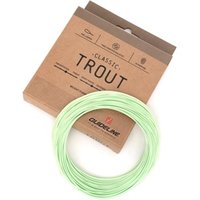
On the fly lines side, Guideline Classic Trout Floating Fly Line #6, Airflo Delta Taper Camo Clear Fly Line WF5 Fast Inter 1.5" and Scientific Anglers Volantis Integrated Floating Weight Forward Fly Line.
Leaders and tippet: Airflo Sightfree G3 Fluorocarbon 50m 8lb 0.21mm, Frog Hair 100% Flourocarbon 25m Spool 2X/10.0lb and Orvis Mirage Flurocarbon Tippet 2x 9.5lb 30m.
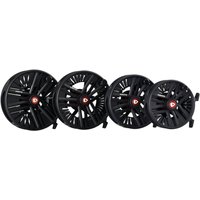
For reels, Lamson Remix S-Series Smoke Fly Reel, Lamson Remix S-Series Smoke 3 Pack Fly Reel and Guideline Aeon Fly Reel- Black/Silver #11/13 are all worth a look.
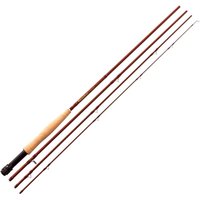
Rods worth adding: Daiwa Silvercreek X Fly Rod 9'6'' #8, Guideline Elevation Nymph Single Handed Fly Rods 10'6'' #3 and Guideline Embrace Salmon Fly Rod and Reel Kit #8/9 13'.
Frequently Asked Questions
What is the difference between wild and stocked brown trout?
Wild brown trout are born in the river, grow naturally on invertebrates and small fish, and develop the natural spotted and golden coloration associated with the species. Stocked brown trout are hatchery-raised fish released into rivers to supplement wild populations or provide put-and-take fishing. Stocked fish are typically more rounded in body shape, less brightly coloured, and easier to catch (less cautious) than wild fish. Many fisheries distinguish clearly between wild and stocked fish in their rules.
Can I fish for brown trout without a fly rod?
On many rivers, yes – spinning and worm fishing are permitted where the fishery rules allow. On chalk streams and most private beat fisheries, fly only is the rule. On club waters and public rivers, check the specific rules for the stretch you intend to fish.
Do I need a fishing licence for trout?
In England and Wales, a rod licence from the Environment Agency is required for trout fishing as for all other species. In Scotland, no national licence is required for freshwater fishing, but the landowner’s permission is mandatory.
When is the best time of day for brown trout?
Evening is the most reliable period for dry fly, particularly in summer. Evening hatches of blue-winged olive (BWO) and caenis in June to September produce the most consistent surface feeding. Morning sessions are also productive on chalk streams before heat suppresses daytime activity. In spring and autumn, trout feed more freely throughout the day.
Are brown trout hard to catch?
Wild brown trout on chalk streams are among the most technically demanding UK freshwater fish to catch consistently. They are highly selective, cautious, and respond to errors in casting, presentation, and fly selection. Stocked fish are considerably easier. Upland river brownies are somewhere between the two – wild and selective but not as technically demanding as chalk stream fish.