A pike’s mouth is lined with sharp teeth, and they’ll cut through monofilament, fluorocarbon and braid without effort. A wire or titanium trace between your main line and the lure or bait is not optional. If you fish for pike without one, you’ll lose the lure on the first take, and the fish may be left with a length of line trailing from its mouth.
Some product links in this post are affiliate links to Total Fishing Tackle and Fishing Tackle & Bait. If you buy through one we may earn a commission at no extra cost to you. How that works.
Wire, titanium or fluorocarbon?
Wire is the standard choice. It comes in a few forms:
- Single strand: stiff, very strong for its diameter, but it can kink and a kink is a weak point. Titanium single strand is thin and strong, which suits lure fishing, but it needs careful handling.
- 7-strand: a flexible cable of seven twisted strands. It’s the default for many pike anglers.
- 19-strand and 49-strand: more strands means a softer, more supple wire. It ties more easily and sits more naturally with a lure or bait, though it costs more and often has a nylon coating.
Fluorocarbon is less visible in the water, but it won’t survive pike teeth on its own, so it can’t replace wire. Our fishing line guide covers how the three line types differ.
How strong?
Breaking strain has to sit comfortably above the strength of the rest of your rig, otherwise the trace is the weak link in the wrong way. Traces in the 25 to 40lb range are common for lure fishing, and 28lb is a widely used minimum when you make your own. Our lure fishing for pike guide suggests a 20 to 30lb trace for lure work, and I’d move towards the upper end if you’re fishing weedy water or expect a big fish.
Whatever the number on the packet, wire loses strength when it’s kinked, nicked or corroded. A 40lb trace with a kink is weaker than a fresh 28lb one. On a heavy outfit like the Fox Rage Warrior Pike Spin with a Daiwa BG 4500A, a nicked trace is the weak link in the whole set-up.
How long?
For lures, about 25 to 30cm (10 to 12in) is a normal length. It keeps the lure moving naturally and the trace out of the way of the cast. Deadbait traces tend to be longer, often 45cm to 60cm (18 to 24in), because the bait sits further from the swivel and the extra length gives you more margin for the hooks and any set-up with two trebles. Those are rules of thumb. A shorter trace casts better, and a longer one is easier to hide.
Ready-made or home-made?
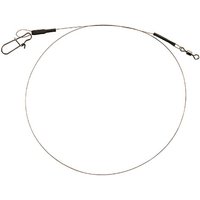
Ready-made traces are fine, they’re consistent, and some come with a swivel and clip already fitted. The Drennan E-SOX Spin Trace 28lb is a straightforward option for lure fishing, and the Fox Rage Strike Point 19 Strand Leader 40cm, 26lb gives you a softer wire. For a single-strand option, the Fox Strike Point Single Strand Titanium Leader, 40cm is a thin, stiff alternative.
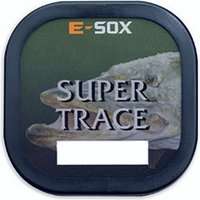
Making your own is cheap and gives you control of the length and strength. You’ll need wire, swivels, clips and hooks, and a crimping tool or the ability to twist wire. A spool such as Drennan E-SOX Super Trace Wire, 28lb or the heavier Fox Rage Predator 49 Strand Coated Steel Wire, 65lb lets you make plenty. Drennan E-SOX Crimping Pliers make neat, secure crimps, and they’re quicker than twisting if you tie a lot of traces.
Joining the trace to the lure
Use a good snap link or clip for lures you want to change quickly, and a proper loop knot or crimp for bait traces. A swivel at the top end of the trace prevents line twist, particularly with spinners and spoons. On a jointed shad like the Fox Rage Pro Shad Jointed 14cm, the trace clips to the nose ring with a tight, neat loop. Don’t overload a small lure with a big clip, because that spoils the action.
Checking the trace
After every fish, run the wire through your fingers and look for:
- Kinks or bends, especially near the lure.
- Frayed strands.
- Bright, shiny scratches where teeth have bitten.
- Rust or discolouration.
If you’re not sure, replace it. A trace costs very little compared with a lost lure or fish.
Match the trace to your main line too, which is the braid or mono question.
Gear that fits this
For anyone buying with this in mind, a few sensible picks.
On the lure side, Abu Garcia Toby Salmo 11cm and Fox Rage Super Slick Shad 18cm.
Baits and bait gear: Holy Mackerel Natural Predator oil, Fox Rage Kwik Change Paternoster Trace and PikePro Dumpy Slider float.
For reels, Daiwa Ninja 3000 and Okuma Revenger 4000A.
Rods that suit: Daiwa Predator-D Pike Deadbait and Drennan E-SOX Apex Predator 10ft.

Questions anglers ask
Do I need a wire trace for pike?
Yes. Pike teeth cut monofilament, fluorocarbon and braid quickly, so a wire or titanium trace is essential whether you fish with lures or bait.
How long should a pike trace be?
About 25 to 30cm suits most lure fishing, while deadbait traces are often longer at 45 to 60cm. These are guidelines rather than rules.
What breaking strain wire is best for pike?
Most anglers use traces of around 28lb or heavier, and go stronger for big fish or weedy water. Check wire regularly, because damage weakens it more than the breaking strain suggests.

Rob Hadley grew up fishing the rivers and drains of the Norfolk Broads, and it was inevitable that pike would become his species of choice. He’s been targeting predators seriously for over 20 years – starting on dead baits, moving through live bait rigs, and eventually landing on lure fishing as his preferred method about eight years ago.
These days he fishes the Broads through winter, travels to Chew Valley Lake each spring for its outsized fish, and spends the warmer months working soft plastics on rivers across the East Midlands for perch and zander. He’s had pike to 31lb and perch to 3lb 9oz, and reckons both records are beatable on the right day with the right set-up.
At The River Bend, Rob writes the predator species guides, lure fishing technique articles, and most of the winter fishing content.
Covers: Pike, perch, zander, lure fishing, winter fishing, predator rigs