The feeder is one of the best winter methods, provided you change how you use it. A big, heavy feeder packed with rich groundbait puts cold fish off. Winter feeder fishing works when the feeder, the feed, the hook and the bait all get smaller.
Some product links in this post are affiliate links to Total Fishing Tackle and Fishing Tackle & Bait. If you buy through one we may earn a commission at no extra cost to you. How that works.
Why scale down
Cold fish eat less. A feeder that drops a pile of groundbait and 200 maggots on the spot will feed them in a minute and then put them off. A smaller feeder with a light mix keeps a few morsels in the swim and leaves them hungry for your hookbait.
Our feeder fishing guide covers the basics, and the principle here is simple: put out enough to attract, never enough to fill.
Feeder choice
For most winter river and canal work, a small open-end or cage feeder is enough. The Preston ICS Inline Maggot Feeder, small 20g holds a few maggots or casters and releases them slowly, which suits cold-water fishing for roach and perch. The Preston ICS Cage Feeder, small 20g works with groundbait when you want a little cloud and crumb at the bottom.
Go as light as the flow allows. In slow or still water you can drop to a light feeder, and in more flow you may need a heavier weight to hold bottom. If the feeder won’t hold, increase weight a little rather than fishing a bigger feeder.

Groundbait for cold water
Use a fine, light groundbait, mixed slightly damp and sticky enough to hold in the feeder. A cold-water mix like Dynamite Baits Swim Stim F1 Cool Water is designed for low temperatures, and a hemp-based mix such as Hinders Hemp N Halibut gives a natural look and smell.
Don’t add much feed. A handful of maggots or casters and a few grains of hemp is plenty. A mixing bowl and riddle like the Maver MV-R groundbait bowl help you get a consistent, fine texture. Our groundbait guide covers mixing in detail.
Rig and hooklength
A simple running or paternoster feeder rig works well. Use a longer hooklength than in summer, 12 to 24 inches, because the fish are wary and a long link lets the bait settle naturally. Keep it fine, 0.10mm to 0.14mm for roach, perch and skimmers, and use a small hook such as a size 16 or 18.
The Guru F1 eyed barbless size 16 is a good all-round choice for maggots and casters. If you target bigger fish on a river, a stronger hooklength and a size 12 is sensible.

The right rod
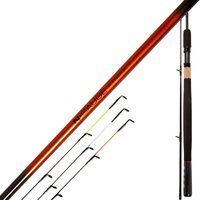
You want a rod with a soft, sensitive tip that shows the smallest knocks. A light feeder rod with a 1oz test curve or less is plenty for most winter work. The Guru N-Gauge Feeder Rod 9ft suits close to medium range, while the Maver Reality Feeder 10ft is a budget-friendly option. Pair either with a smooth reel and a light clutch.
Use a quivertip that matches the flow: a lighter tip for slow water, a heavier one when the current is pushing. Bites in winter are often just a slight tremble or a slow pull round of the tip, so watch it closely and strike at any movement.
| Condition | Feeder | Mix |
|---|---|---|
| Slow river or canal | Small maggot or cage feeder | Fine cold-water groundbait, few maggots |
| Steady river | Small cage, bit more weight | Light mix with hemp |
| Coloured water | Open-end or cage | Slightly stronger mix and bigger hookbait |
Casting and patience
Cast accurately to the same spot every time, using a line clip or a marker on the line. Consistent casting builds a small, tight feed area, which is more effective than a scattered one. Leave the rig for 5 to 10 minutes before reeling in, because cold fish are slow to find the bait.
If nothing happens after 20 minutes, change something small: a longer hooklength, a smaller hookbait or a lighter feeder. A bigger change like a new swim is worth making only after those.
Questions anglers ask
What feeder is best for winter?
A small open-end or cage feeder, around 20g, that holds just enough feed. Increase weight only if the flow demands it.
How much groundbait in winter?
As little as you can. A small, loosely mixed ball or just a light dusting inside the feeder is plenty. Add more only if bites are coming steadily.
Can I use a method feeder in winter?
Yes, on stillwaters and commercials, but use a small one with a tiny amount of bait. Our method feeder guide covers the approach.

Dan Whitfield grew up in Liverpool and started fishing aged seven on the Leeds and Liverpool Canal at the end of his road. He never really stopped. He spent his twenties and thirties on the match circuit – club level rather than national – before deciding he’d rather catch one decent fish than a net of small ones.
These days he mostly fishes the River Dee for barbel and chub (barbel personal best 14lb 2oz, from the Trent on a trip south), the Leeds and Liverpool Canal for roach and skimmers in winter, and the occasional gravel pit when tench are spawning and the surface fishing is too good to miss. He’s a former club secretary and coaches children on Saturday mornings at a junior section of a Liverpool angling club, where most sessions start with a float, a tin of maggots and a lot of patience.
At The River Bend, Dan writes the coarse species guides, river fishing technique articles, and the match and pole content.
Covers: Barbel, bream, roach, tench, carp (coarse context), river fishing, canal fishing, feeder, float, match/pole