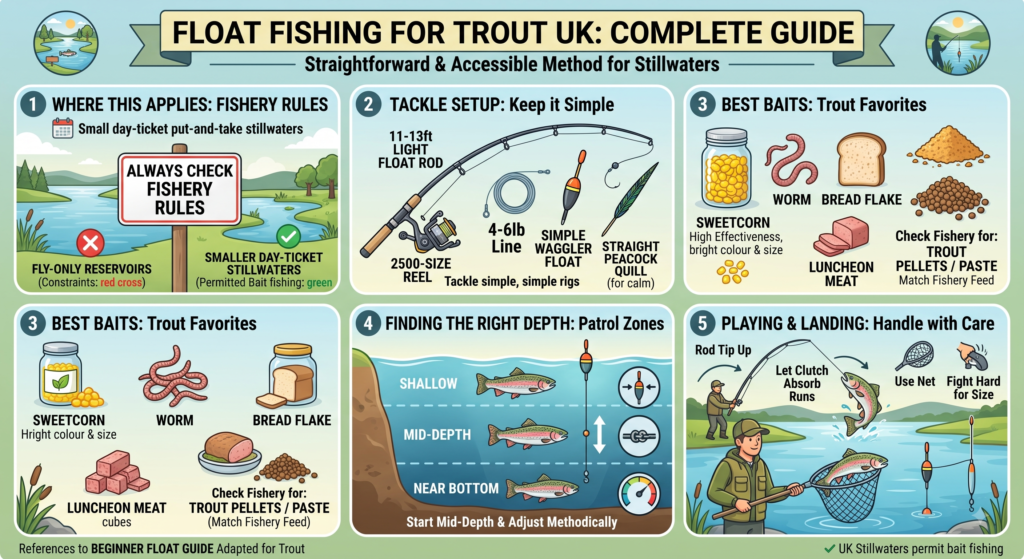
Float fishing for trout is a straightforward, accessible method on the (typically smaller, day-ticket) UK stillwaters that permit bait fishing rather than restricting anglers to fly only. It suits anglers who want a simple, sit-and-watch approach or who are introducing children or beginners to trout fishing.
Where This Applies
Most premium UK trout reservoirs (Rutland Water, Grafham Water, and similar) are fly-only. Float fishing for trout happens mainly on smaller day-ticket put-and-take stillwaters that stock trout specifically for a broader range of angling methods. Always check the specific fishery’s rules – this is not a technique to assume is permitted everywhere.
Tackle Setup
A light float rod (11-13ft) with a 2500-size fixed-spool reel and 4-6lb line is standard. A simple waggler, or a straight peacock quill for calm conditions, set to present bait between mid-depth and just off bottom, covers most situations. Trout are not leader-shy in the way match-conditioned coarse fish can be, so tackle can be kept simple.
Best Baits
Sweetcorn is a highly effective and widely used bait for float-fished trout – the bright colour and size suit trout well. Bread flake, worm, and small pieces of luncheon meat also work. Some day-ticket trout fisheries permit specific trout pellets or paste baits designed to match the fishery’s own feed pellets – check what is allowed before turning up with your own bait.
Finding the Right Depth
Trout in stocked stillwaters often patrol at a specific depth rather than sitting tight to the bottom like many coarse species. Start at mid-depth and adjust methodically – a few feet shallower or deeper – until you find where fish are feeding on the day, rather than assuming bottom fishing will automatically produce.
Playing and Landing
Trout fight hard for their size, with fast runs and jumps that a light hooklength needs to absorb. Keep the rod tip up, let the fish run against a properly set clutch rather than trying to bully it in, and use a net rather than lifting a trout out by the line.
See our guide on float fishing for beginners for the general principles this technique builds on, adapted here specifically for trout.
Gear that fits this
Some options that match this approach, grouped by type.
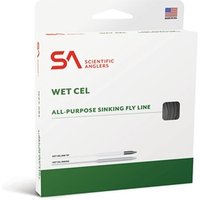
Fly lines worth adding: Scientific Anglers Wet Cel Sink 4 Weight Forward Fly Line #6, Scientific Anglers Mastery Trout GP Floating Fly Line WF-3 and Airflo Superflo 40+ Extreme Sinking Fly Line WF7 DI 3 Green/Yellow.
On the leaders and tippet side, Maxima Ultragreen Line 100m 10lb, Guideline Tippet Rings 4mm/24kg and Scientific Anglers Mastery Trout Fluorocarbon Tippet 30m 3X (0.20 mm).
Reels: Guideline NOVA Cassette Fly Reel #68 Black, Guideline Halo EVO Fly Reel #79 and Lamson Liquid S-Series Daybreak Fly Reel.
For rods, Greys Lance Fly Rod 9FT 5LINE 4PC, Guideline Embrace Fly Rod and Reel Kit #7 9' and Guideline NT11 Lake & Anadrome Fly Rod 10' #6 are all worth a look.