The River Lee (also spelled Lea) rises near Luton in Bedfordshire and flows approximately 42 miles south through Hertfordshire and into Greater London before joining the Thames at Bow Creek, near the Isle of Dogs. For a river that runs through one of Europe’s most densely populated urban areas, it is a surprisingly productive coarse fishery offering accessible sport for millions of anglers within commuting distance of London.
The Lee is managed partly by the Canal and River Trust (for the navigable Lee Navigation and associated canals), partly by the Environment Agency, and for much of its length by the Lee Anglers’ Consortium – a large angling organisation that controls significant fishing rights along the river and its connected waterways.
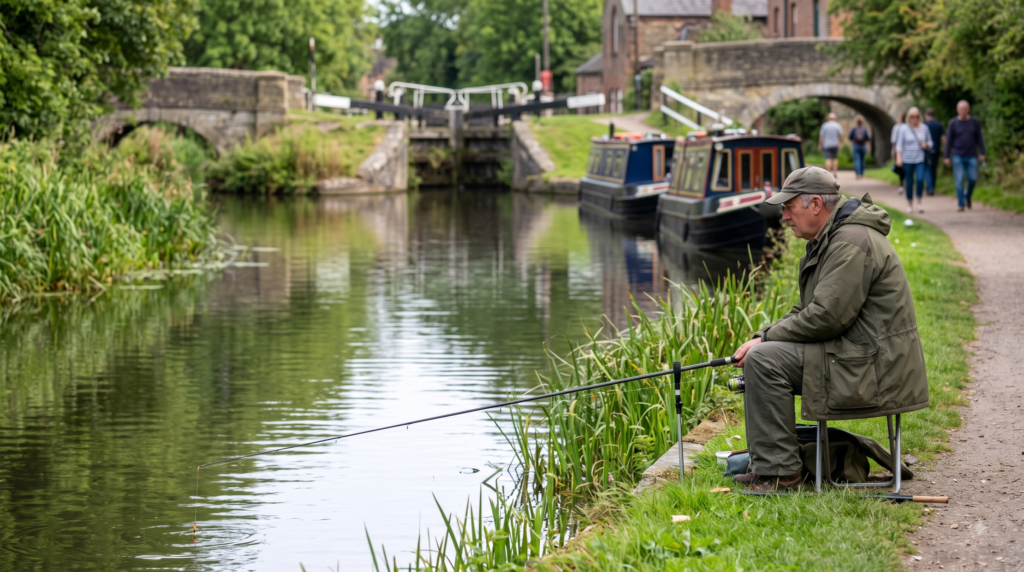
Understanding the Lee System
The Lee is not a single channel throughout its length but a complex navigation system with multiple channels, cuts, reservoirs, and associated stillwaters:
The River Lee (upper): Above Hertford, the Lee is a smaller, more natural river. It holds chub, roach, perch, and some pike. The upper Lee is less well-known for fishing than the navigation below but offers pleasant river fishing.
The Lee Navigation: The main navigable channel from Hertford to the Thames, managed by Canal and River Trust. This is the primary coarse fishing water for most anglers on the Lee. The navigation holds bream, roach, chub, perch, pike, carp, tench, and barbel in its lower reaches.
The Lee Valley Reservoirs: A series of large reservoirs (including King George V, William Girling, Walthamstow Marshes group) in the lower Lee Valley that provide additional fishing, primarily managed by Thames Water and the London Anglers’ Association.
The Hertford and Ware stretches: Particularly popular with London-based anglers for day trips, offering mixed coarse fishing within 30 miles of central London.
Species and Where to Find Them
Bream: The Lee Navigation holds substantial bream shoals, particularly in the Broxbourne, Waltham Abbey, and Cheshunt areas. Bream to 8-9lb have been recorded on the Lee. Feeder fishing with groundbait and worm or corn is the standard approach.
Roach: Present throughout the system. Quality roach (over 1lb) come from the cleaner, deeper navigation sections near Broxbourne and on the upper river above Hertford. Float fishing with caster or maggot.
Chub: Found throughout but more numerous in the upper, more riverine sections. The Lee around Hertford and above provides good chub fishing, particularly in autumn and winter on bread, worm, or lure.
Perch: Good perch fishing across the whole system, particularly in the urban sections. Drop-shot fishing has proven very effective for Lee perch on the navigation stretches.
Pike: Present throughout the navigation and in the reservoirs. The Lee Valley reservoirs hold large pike – 20lb+ fish have been recorded.
Carp: The Lee Navigation in its lower reaches and particularly in the broader sections near Waltham Abbey holds good carp to 20lb+. The commercial carp have spread widely through the navigation from private fisheries.
Barbel: Less common than on classic barbel rivers, but present in the lower Lee where the channel has more flow. Barbel fishing is improving as the river recovers.
Zander: Zander have colonised the lower Lee Navigation and are a target species for lure anglers in the urban sections.
Access and Permits
Fishing the Lee is complicated by the variety of controlling bodies:
Lee Anglers’ Consortium: Controls fishing rights on long stretches of the Lee Navigation and connected waters. Annual membership gives access to the consortium’s waters. Day tickets are available for some stretches.
Canal and River Trust Gold Licence: Required for towpath fishing on CaRT-managed sections of the navigation (in addition to the EA rod licence).
London Anglers’ Association: Controls the Lee Valley reservoirs and some additional stretches.
Free fishing: Some sections of the Lee are free to fish for licence holders. The EA and CaRT publish lists of free fishing areas. Broxbourne and Waltham Abbey areas have some free access sections.
Always check the current permit requirements for your specific target stretch. Enforcement is active on the Lee.
Best Stretches
Hertford and Ware (upper navigation): Quieter, cleaner water, roach and chub dominant. The stretch through Hertford town centre is accessible and holds quality fish.
Broxbourne to Waltham Abbey: The most popular mixed coarse fishing stretch of the Lee. Good bream and roach fishing, some excellent perch, accessible towpath.
Waltham Abbey to Enfield Lock: Productive bream and carp water, more urban. The reservoirs in this area (including the Fishers Green lake complex at Lee Valley Regional Park) provide excellent managed stillwater fishing.
Lee Valley Regional Park: A series of managed lakes and the navigation through the park. Fishers Green, Holyfield Lake, and the other park lakes offer excellent coarse fishing, some managed by the Environment Agency and some by the Lee Valley Regional Park Authority.
Close Season
The River Lee Navigation is a still-water-equivalent for close season purposes in most sections (no 15 March to 15 June close season). The natural upper river sections may be subject to the river close season – check the EA byelaws for your specific stretch. The reservoirs and park lakes have their own rules – check with the relevant controlling authority.
Frequently Asked Questions
Do I need both an EA rod licence and a CaRT Gold Licence for the Lee Navigation?
For most towpath fishing on the Lee Navigation, yes – you need a valid EA rod licence AND a CaRT Gold Licence (available through the Angling Trust) or a permit from the Lee Anglers’ Consortium or other club that controls the specific stretch. On some sections controlled by clubs, a club permit may replace the CaRT licence requirement. Check your specific stretch.
Is there free fishing on the River Lee?
Some sections of the Lee Navigation are free to fish for EA licence holders. The Environment Agency’s fishing section on GOV.UK maintains a list of free freshwater fishing in England. Specific free fishing sections on the Lee change periodically – check before assuming any stretch is free.
What is the best time to fish the Lee Navigation for bream?
Summer and early autumn produce the best bream fishing on the navigation, particularly on warm evenings when bream move onto the shelf. Feeder fishing with groundbait (Belgian-style mix with casters) and worm or corn hookbait produces well. Night sessions can be very productive where permitted.
Can I fish the Lee Valley Regional Park lakes?
Yes, with appropriate permits. Some Lee Valley Regional Park lakes are managed by the Environment Agency (Nazeing Mead is an example). Others are managed by fishing clubs or the Park Authority. Some are accessible on day ticket, others require membership. The Lee Valley Regional Park Authority’s website lists current fishing access.
Are there barbel in the River Lee?
Barbel are present in the Lee but at lower densities than on classic barbel rivers like the Trent or Severn. They are most likely to be found in sections with better flow and gravel substrate. The lower navigation is deeper and slower, less suited to barbel. The upper Lee above Hertford and some of the faster-flowing sections between locks produce occasional barbel.