Yorkshire has some of England’s finest river fishing, and the rivers that flow off the Pennines and Yorkshire Dales into the Vale of York provide a remarkable range of fishing within a compact geography. The Ouse, Wharfe, Swale, Nidd, Derwent, and their many tributaries hold barbel, chub, grayling, dace, roach, bream, and pike – and the region has a rich tradition of river match fishing that continues today on the lower stretches.
This guide covers the principal Yorkshire rivers, their character, the species they hold, and the access arrangements that determine where you can fish.
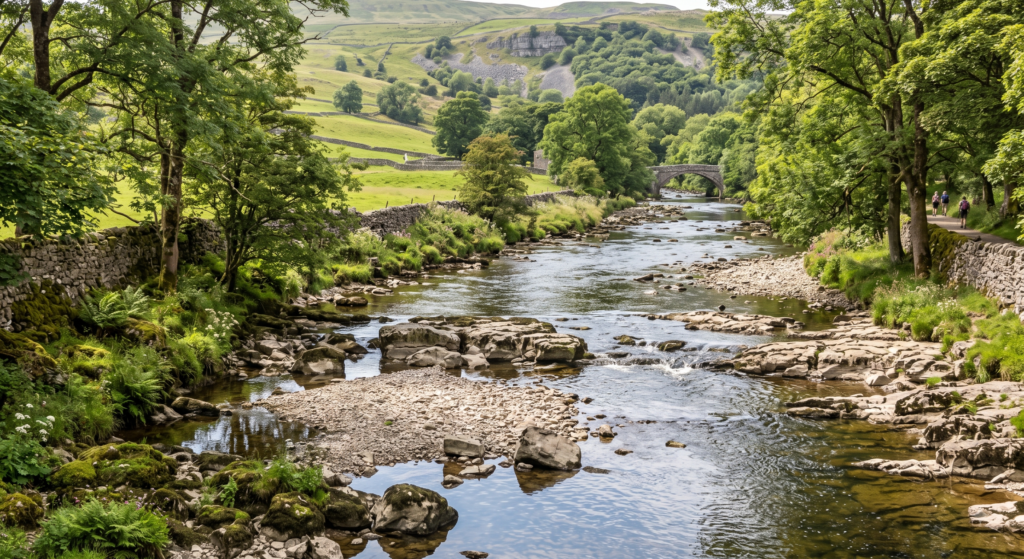
The River Ouse
The Ouse is Yorkshire’s primary river – a large, powerful waterway that flows from Boroughbridge south through York and on toward Selby and the Humber. By the time it reaches York, the Ouse is a substantial river; by Selby and the lower reaches it is tidal and very different in character.
Upper Ouse (Boroughbridge and above)
Above York, the Ouse runs through agricultural land and has a mixed species population dominated by chub and roach in the upper reaches, with barbel present in the swifter runs and grayling in the clear, gravelly sections above Boroughbridge.
The Ure, which becomes the Ouse at Boroughbridge (where the Ure and Swale meet), is an excellent grayling river upstream of this confluence.
Key clubs: Boroughbridge and District Anglers Association holds considerable water on the Ouse and Ure in this section.
York Ouse
The Ouse through York is a popular and accessible stretch, with public fishing available on the riverside paths through the city centre. This is genuinely free fishing on some sections (the Council controls public angling rights on parts of the river through the city). Roach and perch dominate the city centre water; large bream are present in deeper sections; pike are present throughout.
Barbel are found in the more powerful flows below Ouse Bridge and further downstream. The city centre stretch fishes well on a feeder approach in autumn and winter for bream and roach.
Lower Ouse (York to Selby)
Below York, the Ouse broadens and deepens. This is bream and roach country, with large populations of both species that reach matchable weights in autumn and winter. Pike are present in quantity.
Several clubs control this section including York Amalgamation of Anglers (York AA), which has extensive day ticket and permit water on the lower Ouse.
The tidal Ouse below Selby is a specialist environment – large tides with strong flow, sizable bream, eels, and the occasional silver fish shoal, but demanding and not typical coarse fishing.
The River Wharfe
The Wharfe rises in the Yorkshire Dales at Langstrothdale and flows southeast through Grassington, Burnsall, Bolton Abbey, Ilkley, Otley, Wetherby, and Tadcaster before joining the Ouse at Cawood.
Upper Wharfe (Langstrothdale to Grassington)
The upper Wharfe and its Dales tributaries are trout and grayling water. Brown trout predominate; grayling are present throughout. This is fly fishing territory – dry fly and nymph for trout in summer, and winter grayling fishing with nymph or trotted worm is a Dales tradition.
Access: Predominantly club water. Grassington AC and several other clubs hold upper Wharfe permits.
Middle Wharfe (Ilkley to Wetherby)
The middle Wharfe is arguably the finest stretch of river fishing in Yorkshire. This reach holds excellent barbel, chub, grayling, dace, and roach with a long tradition of quality fishing.
Ilkley to Bolton Abbey: Clear, gravelly water over limestone. Barbel in the deeper pools and weir pools. Grayling throughout on the gravel runs. Brown trout are also present but protected by the water authority arrangements on many beats.
Bolton Abbey: The Bolton Abbey Estate holds the fishing rights on extensive Wharfe frontage around the Abbey. Bolton Abbey Estate permits give access to this scenic and productive stretch. Barbel, grayling, and chub are the targets.
Burley-in-Wharfedale and Otley: More accessible water, with Otley AC and several other clubs controlling stretches. Barbel, chub, and dace on the faster runs; bream in the deeper stretches toward Wetherby.
Lower Wharfe (Wetherby to the Ouse)
Below Wetherby the Wharfe becomes a slower, more meandering river with a stronger bream and roach population. Barbel are still present in the faster sections around Tadcaster. The Wharfe joins the Ouse at Cawood.
Wetherby AC and Tadcaster AC hold key stretches on the lower Wharfe.
The River Swale
The Swale is one of England’s fastest-flowing rivers, rising on Birkdale Moor in the North Yorkshire Dales and descending rapidly to Richmond and the Vale of York. The upper Swale above Richmond is a wild, peaty, upland river. The middle and lower Swale, from Richmond to Boroughbridge where it joins the Ure, is an underrated coarse and grayling river.
Upper Swale (above Richmond)
Wild brown trout water in the Swaledale fells. Fly fishing only on most stretches; limited access. Not a coarse fishing destination.
Middle Swale (Richmond to Catterick)
From Richmond downstream, the Swale becomes a fast, gravelly river with improving grayling and barbel populations. This section includes:
- Grayling in the clean, fast runs around Richmond and Brompton-on-Swale
- Barbel in the deeper runs and bends
- Chub throughout
- Dace in the faster, shallower sections
Richmond and District Angling Club holds water in the Richmond area. Further downstream, several other clubs access middle Swale stretches.
Lower Swale (Catterick to Boroughbridge)
The lower Swale from Catterick to Boroughbridge is excellent barbel, chub, and roach water. Less pressured than the Wharfe and with some outstanding late-summer barbel fishing when the river is running coloured after rain.
Northallerton AC and several other clubs hold water on the lower Swale.
The River Nidd
The Nidd rises at Great Whernside in the Dales and flows through Pateley Bridge, Knaresborough, and into the Ouse at Nun Monkton.
Upper Nidd (Pateley Bridge and above)
Trout and grayling water. Several sections accessible via day permit from Pateley Bridge AC and local clubs.
Middle Nidd (Knaresborough)
Knaresborough is a spectacular gorge section where the Nidd cuts through limestone. This is excellent barbel water – the gorge provides deep, powerful water and the barbel population in the Knaresborough area has grown significantly in recent decades.
Lower Nidd (Knaresborough to the Ouse)
The lower Nidd below Knaresborough is good chub, bream, and roach water. Some club and EA-licensed stretches. Less celebrated than the Wharfe or Swale but accessible and productive for general coarse fishing.
The River Derwent
The Derwent rises on the North York Moors and flows south through Helmsley, Malton, and Stamford Bridge before joining the Ouse at Barmby on the Marsh.
Character
The Derwent is a chalk-influenced river for much of its middle course, with clear water and classic coarse fish populations. It holds some of the finest wild grayling fishing in the North of England.
Grayling: The Derwent’s grayling population is exceptional. Sections from Malton upstream are well-regarded for winter grayling fishing on the trot.
Barbel: Barbel are present in the Derwent, particularly in the swifter sections around Malton and Stamford Bridge.
Chub: Chub are widespread throughout the middle and lower Derwent.
Bream and roach: The lower Derwent below Stamford Bridge holds good bream and roach, particularly in the wide, slower sections approaching the Ouse confluence.
Access: Yorkshire Derwent Trust manages fishing on parts of the Derwent. Various local clubs hold stretches. The Derwent is less accessible than the Wharfe or Ouse, but enquiry to local clubs is worthwhile.
Yorkshire River Fishing: Permits and Access
Fishing on Yorkshire rivers is almost entirely controlled by clubs, estates, and private owners. The Environment Agency rod licence (required for all river fishing) permits you to fish – but it does not give access to club or privately controlled water. Access arrangements:
Club day tickets: Many Yorkshire clubs sell day tickets to non-members on their waters. The appropriate club for each river section is listed in local tackle shops and online club directories.
Yorkshire Ure and Swale Fishery Association: An umbrella body covering much of the Ure and parts of the Swale, with a season permit available covering multiple stretches.
York Amalgamation of Anglers (York AA): Holds extensive water around York on the Ouse, Foss, and parts of the Wharfe. Day tickets and annual permits available.
Environment Agency free stretches: Some EA-managed sections of the Ouse provide open access.
Local tackle shops in York, Wetherby, Harrogate, and Malton are the best source of current permit information and up-to-date fish reports.
Frequently Asked Questions
What is the best Yorkshire river for barbel?
The Wharfe between Ilkley and Tadcaster is generally considered Yorkshire’s premier barbel river. The Swale from Richmond to Boroughbridge and the Nidd at Knaresborough are also excellent. All three hold good populations of double-figure barbel.
Where can I fish for grayling in Yorkshire?
The Wharfe (above Ilkley), the Derwent (around Malton), and the Ure (above Boroughbridge) are the principal Yorkshire grayling rivers. The Swale also holds grayling in its faster upper sections. Grayling fishing in these rivers peaks in October to February when the fish are in prime condition and the rivers are running clear after summer weeds have died back.
Is there free fishing on the Yorkshire Ouse?
There are sections of the Ouse through York where council or Environment Agency arrangements provide free or inexpensive access. The City of York Council has historically permitted fishing on the riverside paths through the city. Confirm current arrangements with York AA or the council before assuming access.
Can I fish the Yorkshire Dales rivers for trout?
Most Dales rivers (upper Wharfe, Swaledale, upper Nidd) have trout fishing controlled by game fishing clubs or riparian owners who issue fly-only or specialist permits. These are not typically marketed as day ticket waters for coarse anglers. Some clubs do offer visitor permits and walking in to the upper Wharfe above Grassington is an option on some stretches with prior permit.
What species can I expect on the River Derwent?
The Derwent’s main species are grayling (outstanding, particularly in winter), barbel (present but less prominent than the Wharfe), chub (throughout), dace (faster upper sections), and bream and roach on the lower river. The Derwent’s grayling fishing in winter is arguably the best in Yorkshire.