Correct fish handling is one of the most important skills in UK coarse fishing. The fish you catch are returned to the water in most freshwater fishing, and the care you take from the point of landing to the point of release determines whether that fish swims away in good condition or dies later. Poor handling is the main cause of post-release mortality in catch-and-release fishing.
This guide covers unhooking, handling, and returning coarse fish correctly, from small match fish on a commercial lake to specimen carp and barbel.
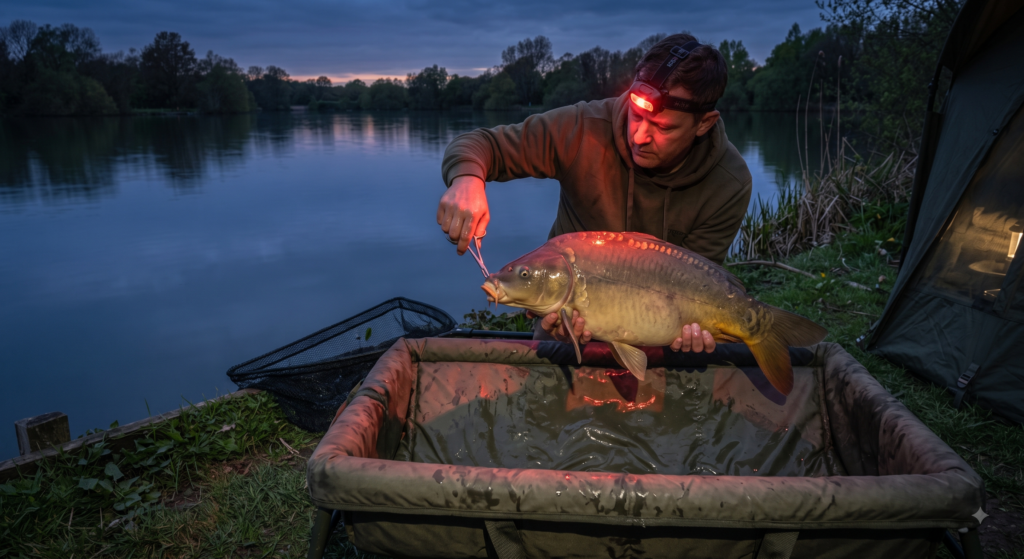
The Basic Principles
Three principles apply to handling every fish, regardless of species or size:
Minimise time out of water. Fish can only breathe oxygen dissolved in water. Out of water, they asphyxiate. Even 60 seconds out of water causes measurable physiological stress. Every second counts.
Keep the fish horizontal. A fish’s internal organs are supported by water. Out of water and held vertically, the weight of the organs compresses and can cause internal damage, particularly to the swim bladder. Always hold fish horizontally.
Wet your hands. Dry hands remove the protective mucus (slime) from a fish’s scales and skin. Mucus protects against infection and parasites. Wet your hands before touching any fish.
Equipment for Safe Handling
Landing net: A knotless mesh landing net is required at virtually all UK commercial fisheries. Knotted nets damage scales and can cause fin damage. Never lift a large fish out of the water by the net alone – support from below.
Disgorger: A thin plastic or metal tool for removing hooks that have been taken into the fish’s throat. Keep one attached to your jacket or bag at all times. An artery forceps (long-nosed forceps) is more versatile and removes both deep hooks and shallow hooks more cleanly.
Unhooking mat: For carp over 3-4lb, an unhooking mat is essential and compulsory on all serious carp fisheries. The mat protects the fish from the hard bank surface and gives a safe work area. Wet the mat before the fish goes on it.
Weigh sling: For weighing specimen fish, a weigh sling supports the fish safely while suspended. Never weigh in the landing net – the mesh can damage fins and scales.
Bucket of water: Keep a bucket of water at the peg. For fish spending any time out of water, dipping the fish briefly in the bucket to rewet the gills reduces stress significantly.
Unhooking Small Fish (Roach, Perch, Chub up to 1lb)
For small fish, unhooking is simple and fast:
- Hold the fish horizontally by folding it gently in the hand, belly-up or sideways. For match fishing, most small fish are unhooked while held in the palm, head toward the wrist.
- Use the thumb to open the mouth gently and locate the hook.
- If the hook is visible in the lip: Push forward along the same angle it entered, then back the point out. With barbless hooks, this is almost instantaneous.
- If the hook is in the throat: Use a thin disgorger. Slide the disgorger down the line to the hook bend, push the hook forward (not back), and lift. A gentle forward push rather than backward pull avoids tearing.
- Return immediately. Place the fish just below the surface and let it swim from your hands. Do not drop it.
Never squeeze small fish. The internal pressure can rupture the swim bladder.
Unhooking Larger Fish (Bream, Tench, Chub 1-3lb)
Slightly more care, same principles:
- Wet your hands before lifting the fish from the net.
- Keep the fish wet and horizontal. Support the body under the belly with one hand, the other hand cradling the head gently if needed.
- Use forceps for hook removal. Grip the hook bend with the forceps and back out along the hook’s entry angle. Do not pull.
- If taking a photo, do it quickly with the fish held low over the water surface. Return before photographing if the removal takes more than 30 seconds.
- Return by placing in the water, not dropping. Support until the fish rights itself and swims away.
Unhooking and Handling Carp
Carp require the most careful handling of any common UK freshwater species:
Before carp reach the bank:
– Have the unhooking mat unrolled and wet before the fish is landed
– Have forceps within reach
– Keep the net in the water – don’t drag a carp across the bank
Lifting from the net:
– Lift the net – do not drag it – so the fish is above the unhooking mat
– Lower the fish onto the mat from no more than a few centimetres
– Never hold a carp by the mouth or lip alone – the jaw can dislocate
On the mat:
– Keep the fish wet throughout – use the bucket of water to wet the body and gills if needed
– Hold the fish firmly but without squeezing – one hand under the belly, one on the back
– Use forceps to remove the hook
– Remove from both sides if the hook is buried
For barbel and tench (delicate species):
– Barbel are particularly oxygen-sensitive and need longer recovery time after a hard fight
– Do not return barbel immediately – hold them in the water (in the landing net or by hand in the current) until they kick and swim under their own power
– Some barbel need 10-20 minutes of support before they can maintain position in current
Returning Fish After Weighing
To weigh: Place the wet weigh sling over the scales hook, zero the scales, then lower the fish (in the net) into the sling. Lift briefly to read the weight. Never hold a large fish by the tail for weighing.
After weighing: Lower the fish back into the net or to the water. For carp, hold gently in the water – facing into any current – until the fish rights itself and begins to breathe normally. Then open your hands and let it swim. Do not chase after it if it tips sideways briefly – this is normal recovery. If it goes belly-up for more than 30 seconds, hold it upright until it stabilises.
Return location: Return fish to the water from the point of landing – not by carrying them along the bank to throw from a bridge or dock. The less distance a fish travels out of water, the better.
Photographing Fish Safely
Fish photography causes unnecessary harm when done carelessly. Safe practice:
- Always have the fish over the unhooking mat or immediately over the water when photographing
- Never hold a fish vertically for a photograph – always horizontal, cradled from below
- Pre-focus the camera before lifting the fish – do not fiddle with settings while the fish is out of water
- One photo, then return. Multiple photos waste time and stress the fish unnecessarily
- Never squeeze or grip tightly to “show the fish off” – hold gently from below
Handling Pike
Pike require specific handling:
– Never hold a pike by the eye sockets or push fingers into the gill covers
– The correct hold: support the body horizontally, one hand under the belly supporting the weight, the thumb and forefinger of the other hand placed behind the pectoral fin to control the head
– For photographing a large pike: have a helper photograph while you hold
– Use large, long-nosed forceps or specialist pike disgorgers for unhooking – pike teeth are sharp
– Return pike gently in the water – always the same side as the peg to minimise distance
UK Legal and Welfare Framework
The Animal Welfare Act 2006 applies to fish in certain circumstances – deliberately causing unnecessary suffering to a fish is an offence. Environment Agency guidelines also set welfare standards for coarse fishing.
Commercial fisheries typically have their own specific welfare rules (unhooking mat mandatory, maximum time in keepnet, minimum net length, no weighing in the net). These are not suggestions – they are conditions of the day ticket or membership.
The Angling Trust’s fish welfare guidelines represent good current practice for UK recreational fishing.
Frequently Asked Questions
Do fish feel pain when hooked?
Fish have nociceptors (pain receptors) and their nervous systems respond to noxious stimuli. The scientific consensus is that fish experience something analogous to pain, though the subjective experience may differ from mammals. This is the basis for welfare-focused handling practices in UK angling.
How long can I keep fish in a keepnet?
A keepnet should not be used for more than the duration of a match session (typically 5 hours maximum). The EA minimum size for keepnets is 2.5m. Many fisheries further restrict keepnet use or ban it entirely for large fish (carp, barbel). Change the net position regularly during a session to ensure the fish have clean, oxygenated water. Never use a keepnet in very hot or very low oxygen conditions.
Can I return a fish that has gone belly-up?
Sometimes yes. A fish that goes belly-up in the net immediately after being landed is often simply stunned from the fight. Hold it upright in the water, facing into any current, supporting gently under the belly. Most fish right themselves within 5-10 minutes. If a fish does not right itself after 20 minutes of supported recovery, it may be critically injured – do not forcibly throw it back.
Should I wet my hands before handling fish?
Yes, always. Dry hands remove the fish’s protective mucus (slime), which protects against infection. Wet your hands before touching any fish. Cold water is better than warm – warm hands are more damaging than cold.
What do I do if a fish swallows the hook?
For a barbless hook swallowed deeply: cut the line as close to the hook as possible and return the fish. The hook will rust out in 1-4 weeks from body fluids and does less damage than deep extraction. For a barbed hook swallowed deeply: attempt removal with a thin disgorger if the hook is visible, but if it is not visible and removal risks tearing the throat, cutting the line is the less harmful option.
← Back to From the Bank – UK Fishing Articles, Tips and Stories