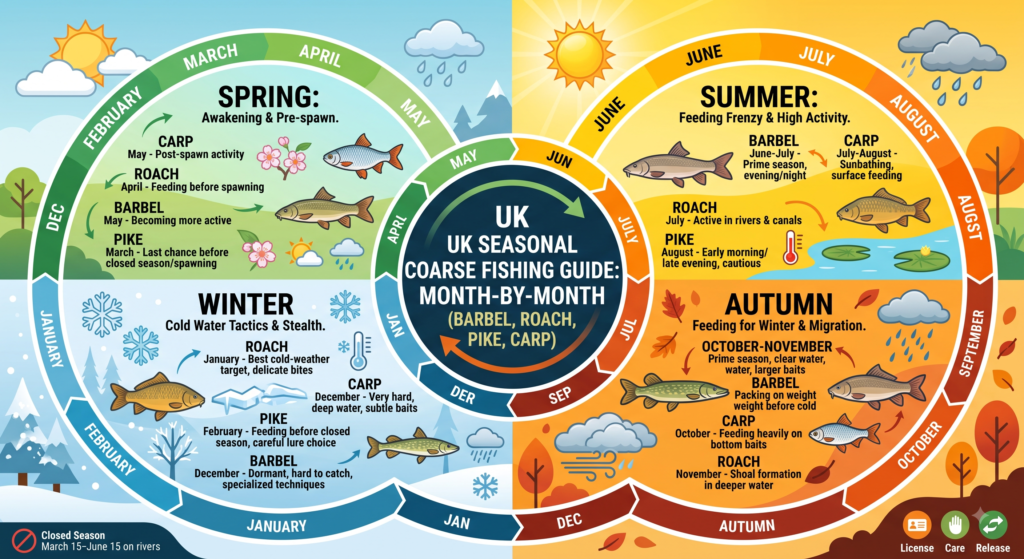
UK fishing changes dramatically through the year. The same river that holds torpid, uncatchable barbel in February can be fishing at its peak in September. A carp lake that shuts down completely in a cold December snap comes alive in May with fish cruising just below the surface. Planning sessions around the season – not just the species – is one of the most reliable ways to put fish on the bank.
This guide covers what is happening in UK freshwater fishing in each season, which species are catchable and why, and the tactical adjustments that make the difference when water temperature and fish behaviour shift.
Understanding Water Temperature
Fish are cold-blooded – their body temperature matches the water, and their metabolism (and therefore appetite and activity) rises and falls with temperature. UK stillwater and river temperatures typically follow this pattern:
| Temperature | Fish Behaviour |
|---|---|
| Below 4°C | Most species near dormant. Only roach, pike, perch (in rivers), and hardy species catchable |
| 4-8°C | Slow, selective feeding. Small baits, patient approach, reduced quantities |
| 8-12°C | Spring transition. Fish become more active. Feeding windows widen |
| 12-18°C | Prime coarse fishing temperatures. Most species feed confidently |
| 18-22°C | Summer peak. Carp, bream, tench most active. Dawn and dusk prime times |
| Above 22°C | Stress zone. Fish are lethargic; dissolved oxygen falls. Dawn only viable |
All seasonal advice that follows is ultimately rooted in these temperature ranges. The dates are approximate – a cold March extends winter conditions; a mild February can trigger early spring feeding.
Spring (March to May)
Close Season (15 March to 15 June)
The statutory coarse fish river close season applies from 15 March to 15 June in England and Wales. This covers all running water (rivers, streams, drains with flow). Fishing these waters for any species is prohibited during this period.
Still waters have no statutory close season. Commercial fisheries, club lakes, and reservoirs remain open. Check if the specific fishery imposes a voluntary close season – some do on environmentally sensitive venues.
Scotland has no statutory coarse fish close season.
What happens in spring
Water temperatures rise through spring from winter lows to the 10-14°C range by late May. This progression triggers a cascade of biological events:
- Roach and bream spawn in late April to May on still and slow-moving waters. Post-spawn fish are temporarily thin and often slow to feed, but recover quickly.
- Tench become active from late April onwards on warming still waters. Early morning tench sessions – “tench fishing at dawn” – are a UK spring tradition.
- Carp begin active feeding from May as temperatures climb past 12°C. Surface activity begins. Pre-spawn carp in May are often at their hungriest.
- Still water species generally: river close season pushes anglers to lakes and commercials in spring, and stocked commercial fisheries can fish very well from March onwards.
Spring tactics
Tench: Dawn sessions on lily beds and reed bed margins. Redworm on a size 10 hook fished under a waggler or lift method float. Feed sparingly at first – tench in May are not yet fully into summer feeding mode.
Still water bream: Method feeder with fishmeal groundbait and sweetcorn on commercials. Traditional groundbait swimfeeder for big bream on gravel pits.
Carp on commercials: Maggots, sweetcorn, and pellets on a waggler or light feeder rod. Surface fishing becomes viable from mid-May if fish are showing on top.
Summer (June to August)
The Peak Season
Summer is the best time to be on the bank for most UK coarse species. The river season reopens on 16 June (after the statutory close season ends on 15 June), and the returning river angler finds fish in prime condition.
What happens in summer
- Barbel are at their most active and feed aggressively on warm summer nights. The Trent, Severn, Hampshire Avon, Wye, and Yorkshire Ouse are in peak condition.
- Chub hold in fast, oxygenated water (weir pools, streamer weed runs) and respond to surface bread in warm conditions.
- Carp are most active at dawn and dusk. Surface fishing (dog biscuits, bread crust) is viable throughout the summer and produces some of the most visual carp fishing of the year.
- Tench reach peak feeding activity in June and July. Early morning sessions on clear stillwaters are productive until mid-morning.
- Perch are active and catchable across both rivers and still waters. Lures and worms work well.
- Pike are on a feeding hiatus in warm conditions – water above 18-20°C stresses pike, and many fisheries and conservation guidelines recommend avoiding pike fishing in summer.
Summer tactics
Barbel: Rolling meat or pellets in daylight; large boilie or paste on a hair rig after dark. Pre-bait the swim with hemp and feed during the day before a night session.
Surface carp: Walk the margins and observe. Feed steadily to build confidence. Cast the hookbait only when fish are taking free offerings regularly.
River chub: Surface bread crust under overhanging trees is classic July chub fishing. Light stalking approach – polarised glasses essential.
Early morning tench: Float fished redworm over a bed of groundbait in the margins before 9am. Most tench action is over by 10am on warm summer days.
Summer cautions
Dawn and dusk fishing: In hot weather (air temperature above 25°C), dawn fishing (4-7am) is typically more productive than afternoon or midday. Fish are stressed in high temperatures and feed most confidently when the water is coolest.
Hook removal: In summer, unhooking mats are essential for large fish. Never leave a fish on dry ground or in the sun.
Autumn (September to November)
The Other Peak Season
Autumn is arguably the most productive season for UK coarse fishing overall. Temperature is falling from the summer peak into the ideal 12-16°C range, fish are feeding heavily before winter, and river conditions (clearing from summer algal blooms, with first spates) become excellent.
What happens in autumn
- Barbel continue feeding strongly into October and, in mild autumns, into November. A flood followed by clearing conditions is the prime barbel window on most rivers.
- Pike come into prime condition as water temperature falls below 14°C. Pike are actively feeding and at their most catchable from October through to February. Autumn is the beginning of the most productive pike season.
- Chub move into deeper, slower water as temperature drops and take large baits (cheese paste, slugs, big worms) more readily.
- Roach feed confidently in autumn and early winter – often the most consistent roach fishing of the year is in October and November on both rivers and canals.
- Carp continue feeding through September and October, reducing in November. A mild October can produce excellent carp fishing; a cold snap in November switches fish off quickly.
- Grayling (on rivers where they are present) reach prime condition in autumn and winter. Grayling are not covered by the coarse fish close season, so rivers holding grayling can be fished during the close season months (with written permission on most waters).
Autumn tactics
Barbel after a spate: Rolling meat, static boilie in settled water, or a large pellet feeder in the first 24-48 hours after a river clears from a flood.
Pike: Deadbaiting with lamprey or sea trout section on a float ledger. Lure fishing with large rubber shads or paddle tail baits in deep, still water.
Roach on rivers: Stick float and maggot or caster in autumn conditions. Feed steadily – autumn roach often respond to a heavier feed rate than summer.
Chub: Cheese paste on a freelined rig cast to visible features (overhanging trees, boulders, bridge arches) in clear water. Size 6-8 hook, 6-8lb line.
Winter (December to February)
The Hard Season
Winter is the most challenging time in UK coarse fishing. Cold, slow fish in cold, slow water require a completely different approach to summer or autumn fishing.
What happens in winter
- Water temperature falls below 5-6°C in cold spells, pushing most coarse fish into deep, slow water where they can conserve energy.
- Roach and perch remain catchable through winter and are the primary targets for many river and canal anglers. Rivers fish best on mild days or after a mild spell; canals can fish well on cold days because of their stable temperature.
- Barbel slow dramatically in very cold water and can be difficult to locate. In mild winters they feed; in cold winters (below 5°C) they become very difficult.
- Carp are largely dormant below 8°C in most still waters, though mild winters and shallower venues can produce carp in December.
- Pike are in prime condition and feed actively. Winter deadbaiting on still waters is among the most reliable pike fishing of the year.
- Zander (where present) feed well in winter conditions, particularly in low-light or coloured water.
Winter tactics
Canal roach: Pole and maggot at 4-8 metres on a light shotting pattern. A single maggot on a size 18 hook. Feed very sparingly – 2-3 maggots every few minutes rather than the summer approach of regular loose feeding.
River perch: Worm section on a size 10 hook under a float or light ledger. Perch hold in slack water (behind bridge supports, in deep bends) in winter.
Pike deadbaiting: Sea deadbaits (smelt, lamprey, mackerel section) on a standard pike trace with float ledger. Still water pike in winter are catchable throughout the day.
Zander: Jigged lures or small deadbaits at dusk and dawn on connected navigations (Fens, Thames tributaries, Wye system).
Winter cautions
Rod tips in ice: On very cold days, rod rings ice up in frost. A ring that ices mid-cast can snap the line on impact. Keep a cloth to clear ice from rings between casts.
Fish welfare: Cold fish are stressed by long fights or handling. Handle quickly and support fully during unhooking. Never leave fish on frozen or frost-covered ground.
Month-by-Month Quick Reference
| Month | River | Still Water | Priority Species |
|---|---|---|---|
| January | Open – hard conditions | Open | Pike, perch, roach, zander |
| February | Open – improving slowly | Open | Pike, perch, roach |
| March | Close season (15 March) | Open | Tench, bream, carp (commercials) |
| April | Close season | Open | Tench, carp, commercial species |
| May | Close season | Open | Tench, carp (surface), bream |
| June | Open from 16 June | Open | Barbel, chub, tench, carp |
| July | Peak river season | Open | Barbel, chub, carp, tench |
| August | Peak | Open | Barbel, carp, perch, bream |
| September | Excellent | Open | Barbel, pike starts, roach, carp |
| October | Autumn peak | Open | Pike, barbel, roach, chub |
| November | Autumn-winter | Open | Pike, chub, roach, grayling |
| December | Winter conditions | Open | Pike, perch, roach, zander |
Frequently Asked Questions
When is the best time to go fishing in the UK?
For river fishing, the period from June to November is the most productive – the season has just opened in June, barbel and chub are active in summer, and autumn produces prime conditions for most species. For still water fishing, May and June (tench, carp starting) and September to October are the peaks.
Can I fish during the close season?
The close season (15 March to 15 June) applies to rivers, streams, and most drains in England and Wales. Still waters (lakes, ponds, reservoirs, gravel pits, commercial fisheries) do not have a statutory close season. Scotland has no coarse fish close season. Always check whether a specific fishery imposes a voluntary close season before fishing.
Why do fish stop feeding in winter?
Fish are cold-blooded, so their metabolism slows with water temperature. In very cold water (below 4°C), the energy cost of digesting food can exceed the energy gained from it. Fish concentrate in deep, slow water and feed only opportunistically. A single large worm or deadbait can work when fine maggot tactics fail in cold conditions because a large food item offers more energy for less digestive effort.
Is summer bad for pike fishing?
Yes, for welfare reasons. Pike are cold-water predators and are physiologically stressed by water temperatures above 18-20°C. At these temperatures dissolved oxygen levels fall and pike are less able to recover from the fight and handling of capture. Most responsible pike anglers avoid pike fishing between June and September, and many pike fishing clubs have a formal summer rest period.
What is the first day of the river season?
16 June. The statutory close season runs from 15 March to 15 June inclusive. 16 June is the first day on which you can legally fish rivers and running water for coarse fish in England and Wales.
Do I need a different licence for different seasons?
No. A standard Environment Agency rod licence covers all legal coarse and game fishing (for which separate game licences apply in some jurisdictions) year-round. The licence is annual (from April to March) or short-term (1 day, 8 days). There is no seasonal variation in the licence requirement.
← Back to From the Bank – UK Fishing Articles, Tips and Stories