The River Trent is England’s third longest river, running 185 miles from its source near Stoke-on-Trent through the East Midlands to the Humber Estuary. It is one of the most important coarse fishing rivers in the country – a river with a long history of producing big barbel, large bream, quality perch, and specimen chub, and one of the most consistently productive rivers in England for the full range of coarse species.
The Trent has changed dramatically over the past 50 years. The industrial pollution that made the lower Trent almost lifeless in the 1960s and 1970s has been addressed, and the river now supports a diverse and increasingly healthy fish population throughout its length. Barbel have expanded their range dramatically in the Trent over the past two decades, and perch fishing in particular has seen a renaissance of interest driven by the river’s excellent natural stocks.
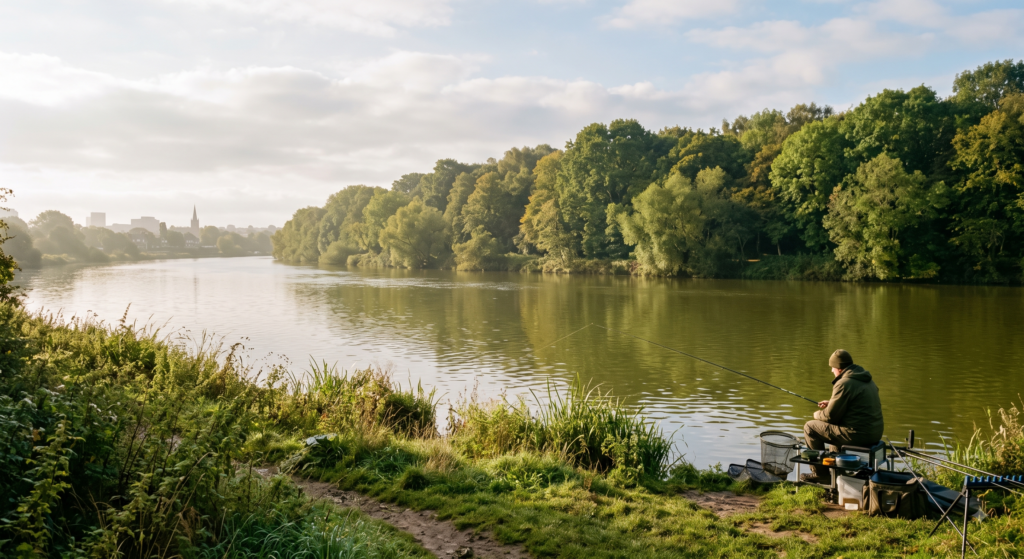
Overview
The Trent’s character changes significantly from upper to lower:
Upper Trent (source to Stoke-on-Trent area): Relatively narrow, moderately clear, with a mix of chub, dace, grayling, and trout. Club fishing primarily through local associations.
Middle Trent (Stafford to Nottingham): The most varied and productive section. Barbel, chub, bream, roach, dace, and increasingly perch and zander. The middle river is where the famous Trent barbel and bream fishing is concentrated.
Lower Trent (Nottingham to the Humber): A larger, tidal river with increasing bream, roach, and pike populations. Tidal influence extends upstream to Newark, which affects fishing conditions and tactics.
Middle Trent: Core Barbel and Bream Country
The middle river from Stoke-on-Trent downstream through Stone, Stafford, Rugeley, Burton upon Trent, and Nottingham is the heartland of Trent fishing. This section produces:
Barbel: The Trent has one of the highest densities of barbel of any UK river. The stretch around Barton, Collingham, and the Nottinghamshire beats has produced fish well into double figures. Unlike the clear chalk streams where individual barbel must be stalked, Trent barbel fishing is often a numbers game – a good swim on the right day can produce 10-20 barbel.
Bream: The Trent holds exceptional bream, including fish over 10lb from some stretches. The stretches below Nottingham and around Newark are well known for big bream shoals.
Chub: Excellent chub throughout the middle river, with fish to double figures in weight on the best stretches. Cheese paste and boilies produce well in autumn.
Perch: The Trent has seen a significant resurgence of perch populations since the 1990s. Drop shot fishing from the bank and from boats has produced fish over 4lb from the Trent in recent years.
Zander: Zander are now well established in the lower and middle Trent, having spread from the Relief Channel system (introduced in the 1960s). Lure fishing for zander in the Trent is a growing pursuit.
Pike: Large pike throughout, with fish over 20lb from the slower lower stretches and from the weir pools.
Key Stretches
The Nottingham Embankment: The river through central Nottingham is one of the most famous coarse fishing stretches in England, historically associated with the great match fishing traditions of the East Midlands. Today it produces barbel, chub, and bream; club access through the Nottingham Piscatorial Society and other clubs.
Colwick Park: A well-known Nottingham stretch below the Colwick weir producing bream, barbel, and perch.
Burton upon Trent: The Trent through Burton is strongly associated with barbel fishing. Club access through Burton Mutual Angling Association and other clubs.
Newark: The stretch around Newark, including the tidal river at its upper limit, is a classic bream water. The confluence of the Trent and Devon near Newark also holds quality barbel and chub.
Gainsborough: The tidal reaches around Gainsborough in the lower river produce exceptional bream and roach catches. Access through Gainsborough Angling Association.
Match Fishing Heritage
The Trent has a deep connection with UK match fishing. The East Midlands match fishing tradition – long roach sessions on the river, the development of stick float techniques, the emphasis on reading the current and presenting maggot and caster at precise depth – was shaped in part by the Trent and the anglers who fished it competitively through the 20th century.
The Trent match scene remains active. Club matches and regional competitions are held throughout the season on multiple Trent stretches.
Access and Permissions
Nottingham Piscatorial Society (NPS): One of the most significant clubs on the Trent, with extensive water through Nottingham and downstream. Annual membership.
Burton Mutual Angling Association: Covers stretches around Burton upon Trent.
Grantham Angling Association, Newark and District Angling Society, Gainsborough Angling Association: Cover various stretches of the middle and lower Trent.
Severn Trent Water: Some controlled access on specific stretches.
Day tickets: Day ticket fishing on the Trent is available on some stretches directly from clubs or fishery operators; less available than on some rivers. An annual club membership is the practical route to regular access on the best water.
A rod licence from the Environment Agency is required for all fishing on the Trent.
Tactics for Trent Barbel
The Trent is a big, powerful river and barbel tactics must reflect this:
Feeders: The standard approach for medium to long range. A heavy cage or flatbed feeder (50-100g) loaded with pellet, hemp, and fishmeal groundbait holds the rig in position against the current. A 30-40cm mono hooklink with a 14-18mm boilie or 10-14mm pellet hookbait.
Rolling meat: In flood conditions or at close range in streamy runs, rolling luncheon meat in the current is the traditional and still effective approach. A 1.5-2oz lead, 30cm hooklink, large luncheon meat cube (20-25mm) on a size 2-4 hook.
Pre-baiting: On popular Trent beats, consistently baiting a swim with hemp and pellet over several visits builds a reliable barbel feeding station. The Trent’s size and fish density rewards patience in swim building.
Best season: August to November for barbel, with September and October after the first spates particularly productive.
Frequently Asked Questions
Are there barbel in the whole River Trent?
Barbel are now present throughout the middle and lower Trent from Stafford downstream to Gainsborough, with the highest densities in the Nottinghamshire and Derbyshire stretches. They are present but less common in the upper Trent.
What is the best stretch of the Trent for bream?
The lower Trent around Newark and Gainsborough is the most consistently productive bream water. The tidal reaches in this area hold large shoals of bream, with fish over 8-10lb caught regularly. Early morning float-fishing with groundbait and worm is the traditional approach.
Is the Trent polluted?
Water quality in the Trent has improved significantly since the 1970s when industrial pollution made the lower river almost lifeless. The Environment Agency now rates much of the Trent as Good ecological status. The river supports healthy fish populations throughout most of its length, though some stretches near industrial areas and urban centres still show poorer water quality.
Can you fish the Trent for free?
Some limited free fishing is available on certain bank sections, but the most productive Trent fishing is through club membership. The major clubs (Nottingham Piscatorial Society, Burton Mutual AA, Gainsborough AA) offer affordable annual membership providing access to extensive stretches.
When does the River Trent close season apply?
The statutory coarse fish close season (15 March to 15 June) applies to the River Trent. Fishing reopens on 16 June. The tidal section below Gainsborough may have additional considerations – check current EA byelaws for the specific stretch.