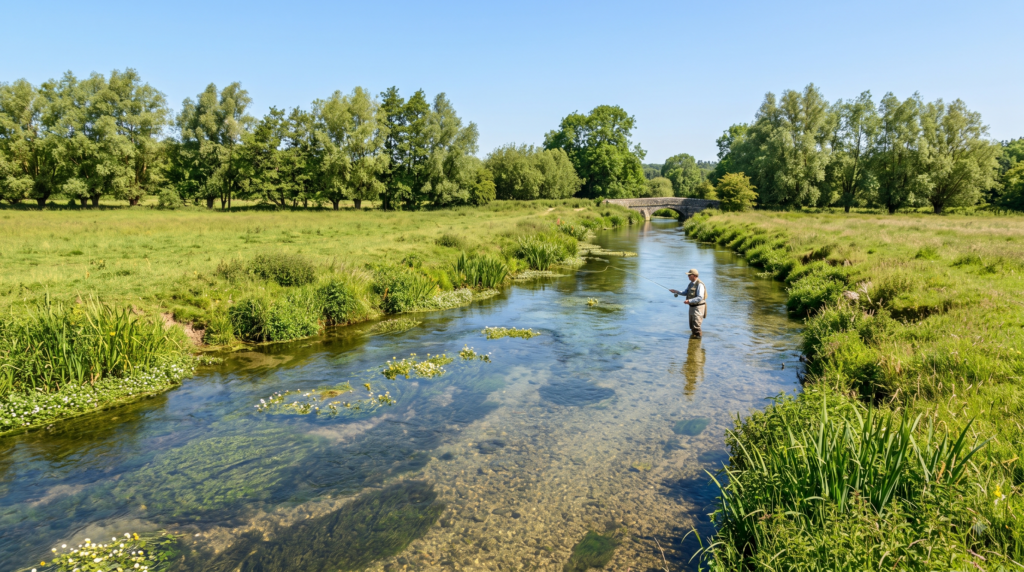
The River Kennet is one of the finest multi-species fishing rivers in England. Rising at Silbury Hill near Marlborough in Wiltshire and flowing east to join the Thames at Reading in Berkshire, the Kennet is a chalk stream: clear, cold, spring-fed, and running over a predominantly gravel bed. Its quality – the ranunculus beds, the visibility of the water, the diversity of species – makes it among the most sought-after river fishing in the country.
Within 50 miles of river you can catch chalk stream trout on dry fly, target record-class barbel in powerful autumn currents, pursue giant roach on casters over hemp, cast lures for perch and pike, and float fish for dace, chub, and grayling in fast gravelly runs. Few UK rivers cover this range.
Access is not simple. Much of the best Kennet is privately owned and fished through expensive fly fishing clubs and syndicates. But significant sections are accessible through day tickets, local angling clubs, and the Canal and River Trust canal sections. This guide covers what the river holds, the key species and methods, and where to access it.
The River Kennet: Overview
The Kennet divides broadly into three character types:
Upper Kennet (Marlborough to Hungerford): Classic chalk stream. Very clear, shallow to moderately deep, fast-flowing over gravel with ranunculus growth. Brown trout and grayling are the primary wild species. Private and club access; day tickets are available through some stretches.
Middle Kennet (Hungerford to Newbury): The transition zone. Still chalk stream in character but deeper and with a greater diversity of species. Brown trout, grayling, barbel, chub, roach, perch, pike, and dace all present. A mix of private water and club water; the most accessible section of the river for multi-species fishing.
Lower Kennet (Newbury to Reading): More river-like, less chalk stream. Slower through sections, deeper, with some clay and silt alongside gravel. Barbel, roach, chub, pike, perch, tench, and bream. Considerably more club and day ticket access than the upper river.
Kennet and Avon Canal: Running parallel to the Kennet for much of its length, the canal is separate and accessible through the Canal and River Trust and local clubs. Species: roach, bream, perch, tench, and carp. Some barbel have moved between the canal and river through sluices.
Species
Barbel
The Kennet is one of England’s most consistent double-figure barbel rivers. The middle and lower river holds barbel throughout, with good populations from Hungerford downstream to Reading. The clear water means fish can often be spotted before fishing; the ranunculus growth and gravel runs are the classic lies.
Method: boilies and pellets on a running lead or method feeder in autumn (October and November) produce the most consistent results. Natural baits (meat, worm) work well in summer when barbel are in clear water.
Best months: September to November on a rising river after rain. The Kennet responds quickly to rainfall, gains colour, and produces aggressive barbel feeding within hours of coming up.
Roach
The Kennet has produced some of the largest river roach in England. Wild chalk stream roach in 2-3lb range are present in the Hungerford to Newbury section. The clear water and the roach’s natural wariness make them challenging to catch; casters over hemp presented on a small float or fine feeder is the standard approach.
The Kennet is one of relatively few southern rivers still producing roach of specimen quality consistently.
Chub
Chub are ubiquitous on the Kennet from source to Thames. They hold under every willow, behind every bridge pier, and in every deep bend. Visual stalking in summer is productive: polarised glasses, bread flake, approach from downstream, present the bait 3 metres ahead of a visible fish. In winter, luncheon meat or a large worm legered under a willowed far bank produces chub in conditions when nothing else is feeding.
Best sections: the middle river (Hungerford to Newbury area) has abundant chub in classic habitat.
Grayling
The upper and middle Kennet holds grayling throughout its chalk stream sections. The Kennet grayling are not as famous as those on the Test or Itchen but the river produces consistent autumn and winter grayling fishing. Best accessed through Newbury Angling Association and some private stretches through Hungerford.
Dry fly in September and October, nymph through November and December, trotting with maggots from January into February.
Brown Trout
The wild brown trout of the Kennet are the reason the river has been one of the most expensive and sought-after chalk stream fisheries in England for over a century. The upper river through Marlborough holds good wild trout in beautiful, clear water. Access is almost entirely through private club membership (Kennet Fly Fishers and similar organisations) at significant cost.
Day ticket trout fishing is limited but exists on a few stretches.
Pike
Pike are present throughout the Kennet and grow to a good size in the deeper lower river sections. Lure fishing with rubber shads and jerkbaits through Thatcham and Reading is productive in autumn and winter. Deadbaiting on the lower river in winter accounts for pike to 20lb+.
Perch
Perch populations have recovered significantly on the Kennet since the perch disease outbreaks of the 1970s-80s. Drop shotting with small soft plastics in the deeper river sections and around bridge arches produces perch to 2lb+. The lower river has good perch.
Dace
Dace are present throughout the fast, gravelly sections of the Kennet. Best caught trotting with maggots on a stick float in fast runs on the middle and upper river. A productive dace section of the Kennet in a fast riffle is a classic UK river fishing experience.
Access
Newbury Angling Association (NAA): Covers significant stretches of the Kennet through and around Newbury. One of the largest stretches of accessible Kennet in public club ownership. Annual and day ticket membership; covers both the river and canal sections. The most practical access for most visiting anglers.
Berkshire Trout Fly Fishers / Kennet Fly Fishers: Private clubs covering prime upper river sections. Expensive, waiting list entry on most.
Thatcham Angling Association: Covers the Kennet around Thatcham. Accessible club membership.
Canal and River Trust (CaRT) licensed sections: The Kennet and Avon Canal sections through Newbury, Thatcham, and into Reading are licensed by CaRT and accessible with a rod licence and club membership.
Day tickets: Available on a limited number of stretches; availability changes. Check local tackle shops in Newbury and Hungerford for current access.
Regulations
- River coarse close season applies: 15 March to 15 June. No coarse fishing on the river during this period.
- Trout season on the Kennet: varies by fishery. Most chalk stream trout seasons run April to October.
- Barbless hooks are required on most club waters on the Kennet.
- Check individual club rules before fishing.
- All anglers require a valid Environment Agency rod licence.
When to Fish
For barbel: September to November; October and November after autumn rainfall are the best days.
For roach: October through January on the middle river; dawn sessions in autumn produce the best specimens.
For chub: Year-round; summer stalking with bread or slug, winter legering with meat or worm under near bank cover.
For grayling: September through February; October to January are the most productive months.
For trout: April to October (season-dependent); most productive from April to June before weed growth restricts presentation.
Frequently Asked Questions
Is the River Kennet day ticket?
Some sections have day tickets; most of the prime fishing is through club membership. The Newbury Angling Association offers membership that covers significant Kennet access. Check NAA or local Newbury tackle shops for current day ticket availability.
What is the best barbel stretch on the Kennet?
The middle river from Hungerford downstream through Kintbury, Hungerford, and toward Newbury has produced some of the finest barbel fishing on the Kennet. Access in this section is through clubs and private arrangements. The lower river toward Theale and Reading is more accessible and holds barbel alongside a wider mix of species.
Can you fish the Kennet for free?
Public access to the Kennet for fishing without club membership is very limited. The river is predominantly in private or club ownership. A rod licence is required regardless of where you fish. Some sections of the canal alongside the river may be accessible through CaRT, but always verify before fishing.
Are there carp in the Kennet?
Carp are present in the lower Kennet and the canal sections, particularly around the lakes and gravel pits connected to the river system. The river itself is not primarily a carp fishery, but large common and mirror carp are present in certain sections.
What tackle do I need for Kennet barbel?
A 1.75-2lb TC barbel rod, 4000-size reel with reliable drag, 12lb monofilament or 30lb braid with a 15lb mono leader. A running lead or in-line flat feeder (20-50g depending on flow), size 8-12 hook, and boilies or pellets as hookbait. A landing net with a 36-inch frame minimum, padded unhooking mat, and 30-minute minimum recovery in the margins before release.