Overnight carp fishing is a significant step up from day sessions. You are committing to sleeping on a lake bank, often in complete darkness, responsible for your own safety and comfort. Done well, it is one of the most immersive fishing experiences available in the UK – the lake at night, carp rolling in the margins, bite alarms screaming at 3am. Done poorly, it is cold, uncomfortable, and potentially unsafe.
This guide covers the practical side: what kit you need, how to set up an overnight carp camp, the rules around overnight fishing, and what to expect on your first overnight.
Can You Fish Overnight? Checking the Rules
Night fishing is not permitted at all venues. Before planning an overnight session, confirm:
- Fishery rules: The fishery management must specifically permit night fishing. Most commercial day-ticket fisheries do not. Club waters vary widely – some allow members to night fish all year, some restrict it to seasons, some prohibit it.
- Club membership vs day ticket: Many carp lakes that permit night fishing require season membership or 24-hour/48-hour ticket purchase, not standard day tickets.
- Fire restrictions: Open fires are prohibited on almost all UK fisheries. Stoves and gas camping cookers are typically permitted; fires are not.
- Dogs: Check the fishery’s policy on dogs overnight.
- Noise: Night sessions require quiet – consideration for other anglers and nearby residents.
Always book or confirm before arriving with overnight kit. Arriving at a gate to find you cannot stay is frustrating.
Essential Overnight Kit
Bivvy or shelter
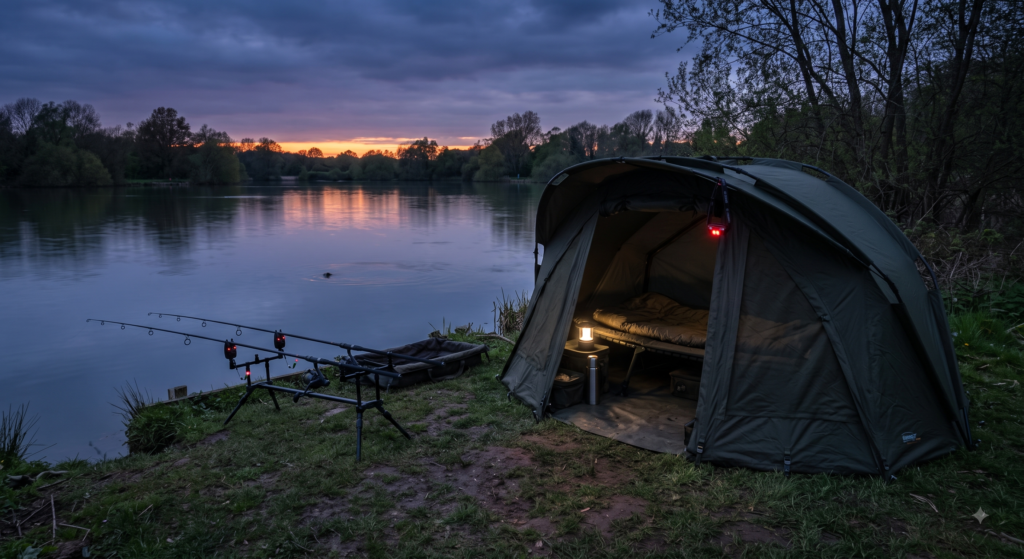
A bivvy is a low-profile fishing tent – typically a dome shape that fits over the bedchair and provides waterproof shelter. Modern bivvies are fast to erect and deal comfortably with the worst of UK autumn and winter weather.
Key considerations:
– Season rating: A 2-season bivvy suits spring to autumn; a 3-season overwrap or purpose-built winter bivvy handles UK winter conditions properly
– Size: 1-man bivvies are lighter and smaller to carry; larger 2-man sizes give more room for kit
– Groundsheet: A separate or built-in overwrap groundsheet keeps dampness out from below
Bedchair
A folding bedchair (or “carp bedchair”) replaces a sleeping bag on the ground. Most have adjustable legs to level on uneven banks and an adjustable backrest. Wider bedchairs (30+ inches) are more comfortable for tall anglers.
A sleeping bag rated for lower than the expected minimum temperature goes on the bedchair. Many carp anglers use a thermal underlayer (roll mat or sleeping bag pod) beneath the sleeping bag for additional insulation from the cold frame of the bedchair.
Bite alarms and receiver
Bite alarms are electronic sensors placed on the rod rests. When the line moves, a piezo sensor triggers an audible alarm. Overnight fishing requires a receiver unit – a small handheld device that receives wireless signals from the alarms and can be kept inside the bivvy, allowing the angler to hear bites without lying awake listening for the rods.
Modern receiver systems detect which rod triggered, provide a volume and tone that can be adjusted for night sessions, and have a low-battery indicator.
Lighting
A head torch is essential. Unhooking a carp in the dark at 2am requires hands-free illumination. A red light mode is useful for not disturbing fish in the margins when checking rods at night. A camping lantern for inside the bivvy provides general lighting without blinding you.
Unhooking mat
Night fishing unhooking presents additional challenges – the mat must be positioned correctly before the fish is landed. Keep the mat close to the water’s edge in a position you can reach reliably in the dark.
Food and drink
A camping gas stove allows you to make hot drinks and cook overnight. A flask kept full of boiling water maintains a hot drink supply through the night without needing to reboil repeatedly. Most carp anglers bring food that requires minimal preparation: sandwiches, snacks, and something simple to cook on the stove.
Keep food sealed in bags or boxes to avoid attracting wildlife overnight (particularly foxes, which are very active around carp banks at night).
Warm layers
Temperature drops significantly overnight, particularly in spring and autumn when the daytime might be mild. Layer clothing appropriately:
– Base layer (thermal)
– Mid-layer (fleece)
– Outer layer (waterproof jacket and overtrousers)
Even in summer, a carp bank at 3am is considerably colder than the afternoon suggested.
Setting Up the Swim for Overnight
Set up while it is still light. The key tasks that are difficult in darkness:
– Casting rods to your spots (use marker rods or your knowledge from the day session)
– Assembling the bivvy and bedchair
– Positioning the unhooking mat
– Checking bank footing and any hazards (steep banks, tree roots, wet mud)
Rod angles: Keep rods at a shallow angle to the water when bank fishing overnight. High rod tips create visible silhouettes that may spook fish in clear conditions, and high angles can produce false bites (line twitch from wind or drifting weed).
Line management: Clip the line on the reel at the casting distance during setup so you can recast to exactly the same spot in the dark if a rig needs replacing.
Bivvy position: Set up at a sensible distance from the water – close enough to reach the rods quickly on a run but not so close that you risk slipping into the margin in the dark. Keep the bivvy door facing the rods.
Night Session Routine
The rhythm of an overnight carp session:
- Dusk: Fish activity often increases as light fades. Be ready.
- Early night (9pm-midnight): Often a productive period as fish move into margins under cover of darkness.
- Deep night (midnight-4am): The quietest period. Experienced anglers often set alarms to check rigs every 90 minutes.
- Pre-dawn (4am-dawn): Often the most active period of the overnight session for carp. Be alert and ready to strike.
- Dawn: Fish activity typically peaks at first light and then decreases as light increases.
Safety Overnight
- Never sleep with a lit gas stove inside the bivvy
- Carbon monoxide from gas appliances in enclosed spaces is lethal; always ensure ventilation
- Be aware of your bank position in the dark – established lakes have worn paths; new venues can be treacherous
- Tell someone where you are fishing and when you expect to be back
- Keep a charged mobile phone in an accessible pocket
Frequently Asked Questions
Is overnight carp fishing allowed everywhere?
No. Night fishing requires specific permission from the fishery. Most commercial day-ticket waters do not permit it. Club-controlled carp lakes and dedicated 24-hour ticket venues are the most common places where overnight fishing is available. Always confirm in advance.
What temperature sleeping bag do I need for overnight carp fishing?
A sleeping bag rated to at least -5°C is recommended for year-round UK overnight fishing. For summer sessions only (June-August), a 0°C bag may suffice, but UK summer nights can be surprisingly cold, particularly in autumn. Better to be too warm than too cold.
Do I need an unhooking mat for night fishing?
Yes – arguably more important than in daylight. An unhooking mat provides a safe, padded surface for carp that cannot be seen as clearly in low light. Keep it positioned between the rod pods and the water’s edge, ready to use immediately when a fish is landed.
Can I have an open fire overnight at a carp lake?
Very rarely – open fires are prohibited at almost all UK fisheries due to fire risk and fishery damage. A gas camp stove is acceptable at most venues. Some venues have specific barbecue areas that are permitted, but these are the exception rather than the rule.
How many rods can I use overnight?
The EA rod licence covers two rods. Fishery rules may restrict to one rod for some night fishing permits. Check the specific venue’s conditions. Having two rods positioned reduces the chance of a long biteless night, but both must be within reach and both must be struck within a reasonable time of a run.
← Back to From the Bank – UK Fishing Articles, Tips and Stories