There is no law in England and Wales that prohibits fishing at night. Night fishing is a legal activity under a valid rod licence on any water where the fishery permits it. The rules that govern night fishing come from individual fisheries, local byelaws, and angling club conditions – not from national legislation.
This matters because the rules vary considerably from one venue to the next. A stillwater carp venue may actively encourage overnight sessions; a public river may have byelaws preventing camping or overnight presence on the bank; a canal will have Canal and River Trust (CaRT) conditions that restrict what is permitted. Understanding what applies to your intended venue is the responsibility of the angler.
The General Position: No National Ban
Night fishing for coarse fish is not prohibited by national legislation in England and Wales. The Environment Agency’s rod licence covers day and night fishing equally. There is no specific legal restriction on fishing after dark under the Salmon and Freshwater Fisheries Act 1975 or subsequent legislation for most coarse species.
Exception: Salmon and sea trout. Some specific restrictions on night fishing for migratory fish (salmon, sea trout) may apply in certain rivers under District Salmon Fishery Board byelaws or specific fishery conditions. Check the rules of the specific river if targeting migratory species after dark.
Fishery Rules Are What Matter
The practical restrictions on night fishing come from:
Fishery conditions (private lakes and day ticket venues): Many stillwater fisheries permit night fishing with a valid night ticket or as part of a 24-hour or 48-hour session booking. Others specifically prohibit it. This is the fishery owner’s right as a condition of access – it is not national legislation.
Club rules (angling association waters): Many clubs permit night fishing for members but not on day tickets; others permit it with advance notice; some prohibit it on certain stretches. Read the club rules carefully.
Canal and River Trust (CaRT) conditions: CaRT permits coarse fishing on its canal and river network. Night fishing is permitted on most CaRT waters, but:
– Bivvies, shelters, and tents are not permitted on CaRT towpaths
– You can fish through the night from a chair but cannot set up camping equipment
– Some specific CaRT stretches have restrictions in their local byelaws
Environment Agency rivers: Some EA-managed river stretches permit night fishing under the standard rod licence with no additional restriction. However, overnight camping or bivvying on the bank may be restricted by separate access conditions or landowner permissions even where fishing itself is permitted.
Private fishing: On private land where you have the landowner’s permission to fish, night fishing is permitted provided you comply with the rod licence requirement and any other legal constraints.
Night Fishing and the Close Season
The statutory coarse fish close season (15 March to 15 June on rivers in England and Wales) applies equally to night fishing. You cannot fish for coarse fish at night on a river during the close season any more than during the day. The time of day does not alter the close season prohibition.
On stillwaters, which have no statutory close season, night fishing is possible year-round subject to fishery rules.
What Fisheries Typically Require for Night Sessions
For planned overnight sessions at commercial carp fisheries:
Night permit or pre-booking: Most commercial venues charge a separate night fishing supplement or require advance booking for overnight sessions. This ensures the venue knows who is on the water and allows them to manage access.
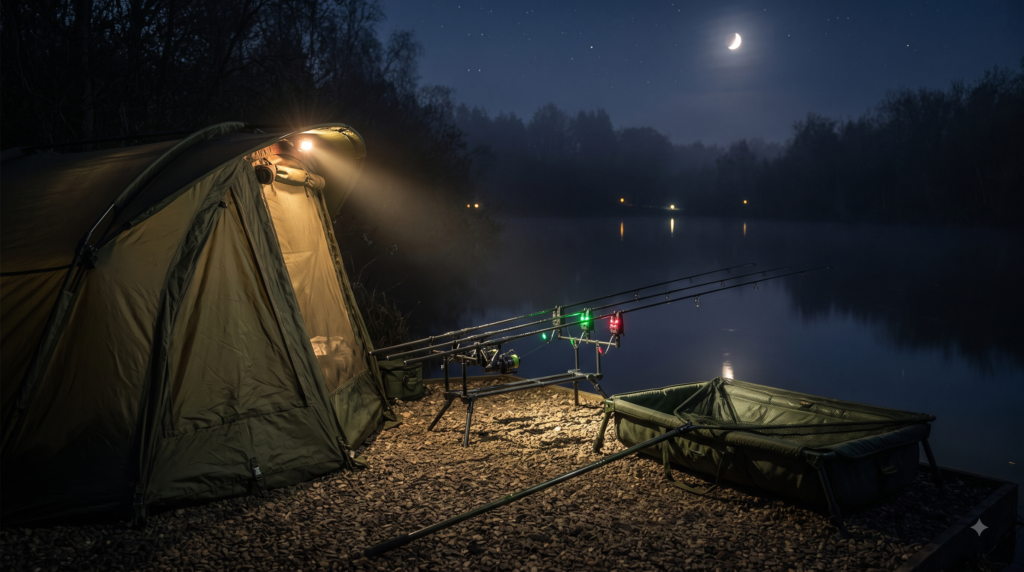
Bivvy or shelter: A proper fishing bivvy (a designed fishing shelter with a groundsheet and storm front) is expected on most night fishing venues. Standard garden tents are often prohibited under fishery rules (structural differences affect insurance and site management).
Unhooking mat and equipment: Night fishing venues typically enforce equipment rules more strictly, including unhooking mats (mandatory at most carp venues), landing nets (large enough for the species targeted), and weigh slings.
Headlamp: A hands-free headlamp is essential for night fishing for baiting, unhooking, and navigation.
Mobile phone signal: Most venues require that anglers can be contacted in an emergency. Check signal coverage before booking.
Night Fishing Safety
Night fishing carries increased risk compared to day fishing – primarily from slips, falls on wet or uneven banks, and reduced visibility near water. Basic precautions:
- Tell someone where you are. Let a family member or friend know the venue, the general swim location, and when you plan to leave.
- Bank safety. Know the bank profile of your swim in daylight before darkness falls. Steep, wet, or undercut banks require particular care.
- Life jackets/buoyancy aids. On rivers and in windy conditions on large stillwaters, a self-inflating life jacket is appropriate.
- Campsite rules. Many venues impose fire restrictions. Open fires on towpaths, riverbanks, and most commercial fisheries are prohibited. Use a purpose-made fishing stove.
Scotland
Night fishing rules in Scotland differ from England and Wales because Scotland operates under separate legislation and does not have a national rod licence system. Night fishing for most coarse fish is permitted with the landowner’s consent, subject to whatever conditions are attached to the fishing permit. Some salmon rivers prohibit night fishing in their permit conditions. Check the specific conditions of your permit.
Frequently Asked Questions
Is night fishing legal in the UK?
Night fishing is legal in England and Wales under a valid rod licence. There is no national law that prohibits fishing after dark. Restrictions come from individual fishery rules, club conditions, or local byelaws – not from national legislation.
Do I need a special licence for night fishing?
No special licence from the Environment Agency is required for night fishing. A standard annual, 8-day, or 1-day rod licence covers fishing at any time of day or night. Many commercial fisheries charge a separate night permit or session fee as a fishery condition, but this is not a government licence.
Can I fish through the night on a canal?
Canal and River Trust waters permit night fishing under the standard rod licence, but bivvies, shelters, and camping equipment are not permitted on CaRT towpaths. You can fish through the night from a chair but not set up a shelter. Some specific CaRT stretches may have additional restrictions.
What equipment do I need for night fishing?
Minimum: a headlamp, a chair or bed chair, bite alarms (for carp and pike fishing), warm layers, and all standard unhooking equipment. For overnight sessions: a bivvy, sleeping bag suitable for the season, a means of making hot drinks, and a first aid kit. Many fisheries also require an unhooking mat, weigh sling, and large landing net as a condition of night fishing.
Are there night fishing restrictions for pike?
No specific national restriction on night fishing for pike exists. Pike are commonly targeted on rivers through the night in autumn and winter using deadbait. Fishery conditions apply – some waters prohibit pike fishing at night while others specifically recommend it.
Can I camp on the riverbank while night fishing?
This depends on land access. On most river banks in England and Wales, overnight camping without the landowner’s consent is not permitted even where the fishing itself is legal. Some club waters grant overnight camping rights to members; others do not. CaRT towpaths explicitly prohibit camping.