Most anglers come to lure fishing sideways. They fish for perch with a worm, catch a small one, read something about drop shot fishing, buy a rod and a bag of soft plastics, and discover a method that changes how they think about fishing. Or they buy a plug to chase pike and realise how much more engaging it is than a static deadbait on a cold bank. Or they try a spinner on the Thames one morning and catch three chub before the float fishing regulars have set up their rod rests.
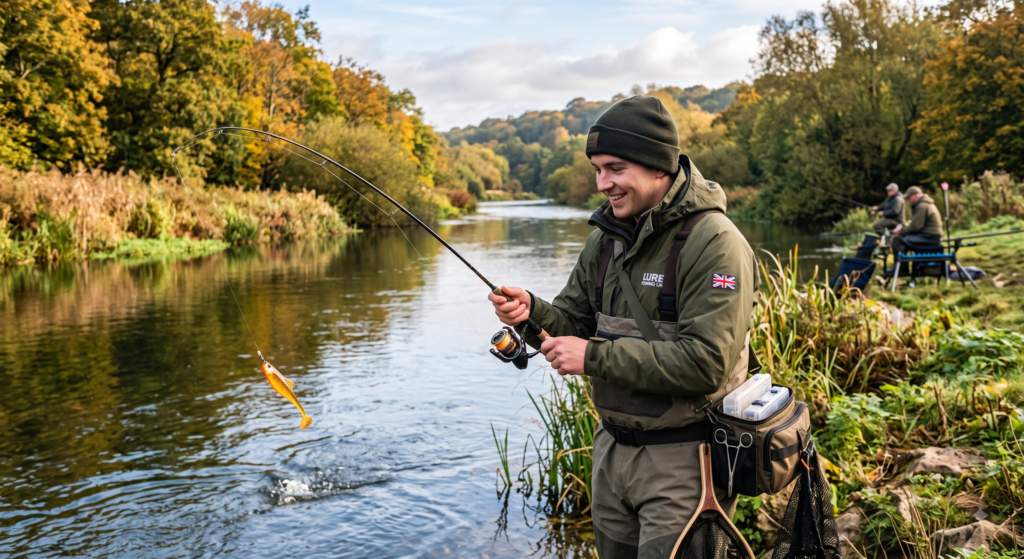
This piece is for anyone at the beginning of that journey. It covers what lure fishing in the UK actually involves, what a starter setup looks like, the species you can realistically target, and how to stop overcooking it.
What Lure Fishing Is
Lure fishing means using an artificial bait – a spinner, a soft plastic, a plug, a jig – to deceive a predatory fish into striking. The bait is cast and retrieved, usually with some combination of rod movement and reel speed to make it behave like a small injured fish or prey item.
The appeal is the active, searching quality of the method. You are not waiting for a fish to find your bait. You are covering water, moving through swims, and feeling for fish that respond. A take on a lure is usually unmistakable – a sharp pull, a sudden weight on the line, occasionally a visible chase to the rod tip. It is a more engaged form of fishing than ledgering or float fishing for many anglers.
In the UK, lure fishing is primarily associated with predator species: perch, pike, zander, chub, and bass. Each species responds to different lure types, sizes, and retrieve speeds.
A Starter Setup
You do not need much. The mistake most beginners make is buying too much too quickly, ending up with a bag of lures for every situation and no clear sense of which to use when.
Rod: A 6-7ft spinning rod rated 1-10g or 2-12g casting weight. This covers the full range of canal and river lure fishing for perch, chub, and small pike. Medium-fast to fast action. You do not need to spend a lot – rods in the 40-80 range from Daiwa, Abu Garcia, or similar brands are entirely adequate to start.
Reel: 1000-2500 size fixed spool reel. Matched to the rod. The budget equivalent of your rod rating.
Mainline: 8-10lb braid. Thin, strong, zero stretch, and excellent for transmitting the feel of the lure back to the rod. 150m is more than enough.
Leader: 12-18 inches of 8lb fluorocarbon, attached to the braid with a double grinner knot. Invisible in water, resists abrasion on bankside structure.
Lures to start with:
– A selection of small spinners (Mepps Aglia size 1-2 in gold, silver, and black)
– 2-3 inch soft plastic paddle tail shads in natural colours and one bright colour (chartreuse)
– A 3-7g jig head selection for the soft plastics
– A pencil drop shot weight set (3g, 5g, 7g)
This is enough to start catching perch and chub on most UK waters. Add to it when you understand what is not working, not before.
Species You Can Target as a Beginner
Perch
Perch are the best starting species for UK lure fishing. They are found nearly everywhere, they respond well to small spinners and soft plastics, and they give clear bites that are easy to feel. A 6oz perch on a light lure rod fights well, and when you find a shoal of bigger fish they can be caught consistently from the same spots.
Start on any canal, park lake, or river you have access to. Look for structure – bridge supports, mooring posts, lock gates, fallen trees. Work a small spinner or jig slowly past these features. Once you have caught a few fish and understand where they hold, move on to drop shot fishing for more precise depth control. See our drop shot fishing guide for the next step.
Chub
Chub are aggressive lure takers from UK rivers. They sit in shade and cover – under overhanging trees, in the shadow of bridge arches, behind fallen branches – and hit lures hard. A 2-inch paddle tail worked slowly past a chub lie will often produce an immediate, violent strike. Chub grow large on UK rivers and fight powerfully for their size.
Target chub by working upstream and casting into any piece of cover you can reach without spooking the fish. Wading is useful on rivers where bank access is limited – it allows you to cast to bankside features from the middle of the river.
Pike
Pike take larger lures – 15cm+ plugs and rubber lures are standard – and require a wire trace to prevent bite-offs. They are not the best beginner species because the larger lures, heavier rod (10-40g casting weight), and wire trace all add complications. But if you are specifically after pike rather than starting with smaller predators, the same principles apply: cover water, target structure, and vary retrieve speed until you find what works.
Use a 20-30lb wire trace at all times when pike fishing with lures. Pike have razor teeth and will cut 10lb fluorocarbon instantly.
Bass (Sea)
Bass from rocky headlands and estuaries on soft plastic lures and surface plugs is the sea fishing equivalent of perch fishing on a canal. The access requirements differ (you are on rocks, often at dawn) and the conditions are more demanding, but the technique shares the same search-and-find quality. Bass fishing with surface lures in particular produces some of the most visual and exciting takes in UK fishing.
Bass require a slightly heavier lure rod (10-40g casting weight), and fishing from rock marks requires care in surf and swell. Start on sheltered estuary marks rather than open rock marks until you understand the terrain.
What Most Beginners Get Wrong
Using too heavy a lure. A 10g jig in two feet of water, retrieved at normal speed, is in the bottom half of the water column for most of the cast. Perch and chub in shallow water see it shoot past too quickly and at the wrong depth. In most canal and river lure fishing, 3-5g is enough. Go lighter and slower than feels natural.
Covering the same water repeatedly. When the first few casts on a swim produce nothing, many beginners make the same cast twenty more times. Move. Lure fishing rewards searching, not waiting. Give each swim 4-6 different casts covering different angles, different distances, and different depths. If nothing responds, move 15 metres down the bank.
Retrieving too fast. A slow, irregular retrieve – occasional pauses, a drop and twitch, a change of direction – consistently outperforms a steady medium-speed wind. The pause is when most takes happen. If you are not pausing, you are not giving the fish a chance to commit.
Fishing the open water. The fish are not in the open water. They are at the edge of it, next to something. Every cast should be aimed to land as close to structure as you can manage. The bank-hugging chub under an overhanging tree, the perch sitting next to a bridge pillar, the pike in the shadow of the moored narrowboat – these are what you are trying to reach, not the middle of the lake.
When to Fish
The most productive lure fishing in the UK is in autumn – September to November. Fish are active, water temperatures are dropping into the range that triggers aggressive feeding, and the prey fish that predators chase are grouped up near features after summer. October specifically is the month most lure anglers would choose if they could only pick one.
Early morning and late evening are the most productive times in summer. Through autumn and into winter, the productive window extends and midday sessions can produce fish. In winter below about 8°C, slow down everything and consider whether a static bait might produce more than a lure.
Next Steps
Once you are catching perch and chub on spinners and jig heads:
- Learn the drop shot rig properly – it is a significant step up in effectiveness for perch specifically, and the drop shot guide covers it in full
- Read the perch species profile to understand seasonal behaviour and location
- Consider targeting pike in winter – a separate rod, heavier lures, and wire trace open up a different species and a productive season when perch fishing slows
The most important next step is not buying more gear. It is fishing more water, on more different days, until the habit of reading a swim – seeing structure, understanding what depth the fish are likely at, choosing the right retrieve for the conditions – becomes second nature.
← Back to From the Bank – UK Fishing Articles, Tips and Stories