The Grand Union Canal is the longest canal in England, running 137 miles from the Paddington Arm in west London to Birmingham. It passes through Hertfordshire, Northamptonshire, Leicestershire, and Warwickshire, offering an enormous length of accessible towpath fishing that is available under a CaRT (Canal and River Trust) Gold Licence across most of its length.
The canal is not a trophy venue. Its fish are not large by modern specimen standards, and much of the canal is pressured by constant boat traffic during the spring and summer months. What the Grand Union offers is something different: accessible, often underutilised winter fishing, a good heads-up style of angling that rewards observant anglers, and populations of species that are becoming increasingly scarce on many other lowland waters – roach in particular.
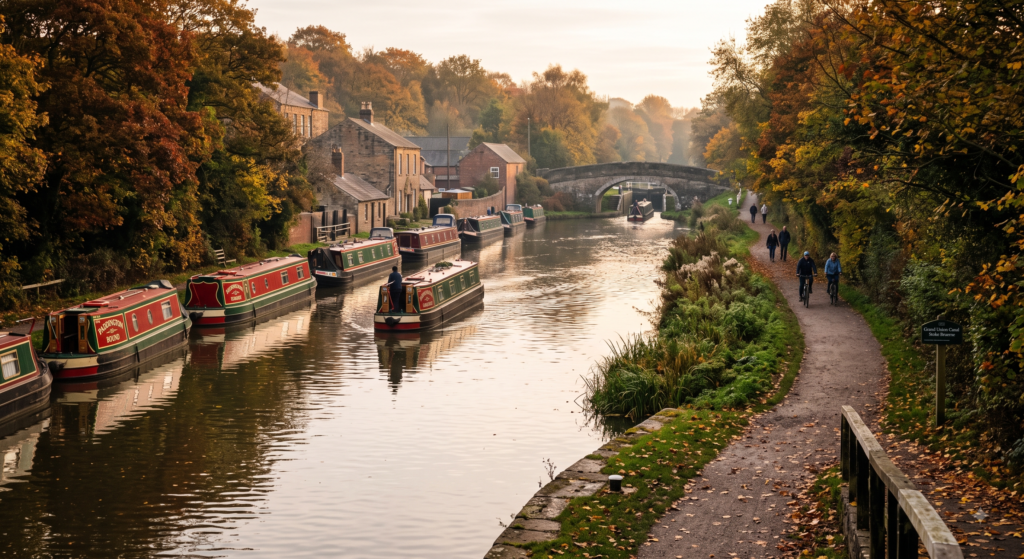
The Canal’s Character
The Grand Union is wide by UK canal standards – some sections are almost lake-like in their proportions. The main line width varies from about 10-14 metres. The Northamptonshire section near Braunston is arguably the most productive stretch; the Leicestershire section around Market Harborough holds a well-regarded perch fishery.
Water colour ranges from clear green in summer to heavily coloured after prolonged rain. Boat traffic significantly disrupts fishing from about 9am to 5pm in the summer months. Pre-dawn and post-dusk sessions, particularly in the off-season (October to March), produce the best consistent results.
The canal has significant depth variations depending on the section and whether you are fishing near a lock. Much of the main channel is 1.2-1.8 metres deep, with the deepest water typically in the centre channel. Marginal shelves at 30-60cm can hold fish in summer, particularly when boat traffic disturbs the deeper water.
The CaRT Gold Licence
Fishing the Grand Union Canal requires both an EA rod licence (for anyone aged 13 and over) and a CaRT Gold Licence. The CaRT Gold Licence covers all CaRT canals and navigable rivers in England and Wales and must be purchased separately. Day tickets are available but an annual Gold Licence is significantly more cost-effective for regular canal fishing. Purchase from the CaRT website or from tackle shops near canal fisheries.
Some stretches of the Grand Union are controlled by angling clubs that lease specific beats – these may require additional club membership on top of the Gold Licence. The CaRT towpath access is generally consistent, but always check for any local club water signs before fishing.
Species
Roach
The Grand Union’s most numerous species. Roach to about 1.5lb are present throughout the length of the canal. Large shoals can be found in winter, particularly in the section between locks where the depth is consistent and boat traffic minimal.
Canal roach respond well to squatt and pinkie loose feed (tiny maggots) rather than full-sized maggots. The reasoning is that small feed in large quantities keeps roach feeding and competing in a confined area; full-sized maggots can overfeed the fish or attract larger, less targeted species like bream.
The classic canal roach approach is with a pole and a fine bush float, fishing at 6-8 metres range with squatts fed through a pole cup.
Bream and Skimmers
Skimmer bream (small bream, 4-8oz) are present in good numbers throughout the canal. Larger bream (1.5-3lb) are found in certain sections, particularly near lock cuts and areas where the canal widens. Full-sized bream up to 5lb have been recorded from the Grand Union but they are not reliably present across all sections.
Bream fishing on canals is a groundbait game – introduce a base of groundbait at the start of the session and wait for skimmers to move in. Open-end feeder or frame feeder fishing can be effective in wider sections.
Perch
The perch fishing on the Grand Union has improved significantly over the past decade. Perch to 3lb+ are present in certain sections, particularly the Leicestershire stretch and the areas around lock structures. Lure fishing with small jigs (3-5g) and paddle-tail soft plastics (2-3 inch) accounts for good perch during the winter months. Drop-shot rigs with a single maggot or worm are also effective in tighter spots near bridge columns and lock infrastructure.
Pike
Pike are present throughout the canal, with fish to about 15lb regularly caught. The wider sections and reservoir-fed lengths tend to hold bigger fish. October to February is the productive period. Deadbaiting with a small roach or smelt on a simple running ledger, fished close to the far bank or alongside reed beds, is the standard approach. Float-fished livebaits (where permitted) and small lures also account for canal pike.
Zander
Zander are present in the southern and midlands sections of the Grand Union, where the canal connects to the wider midlands waterway network. The Grand Union connects to the Oxford Canal and other midlands canals that form part of the zander’s introduced range. Soft plastic shad lures and drop-shot worms accounting for zander in these sections.
Tench
Summer tench are present in the canal, particularly in sections with good marginal weed growth. They are less abundant than in still waters but provide excellent sport when located. Early morning fishing in margins with sweetcorn, lobworm, or pellet is the usual approach.
Best Sections and Access Points
Stoke Bruerne (Northamptonshire): A popular canal village with a good roach fishery on the lock flight. Accessible parking and well-known to local match anglers.
Braunston (Northamptonshire): The Braunston Junction area where the Grand Union meets the Oxford Canal. Wide, deep section with good roach and perch populations. Accessible from the towpath.
Market Harborough Arm (Leicestershire): The short Market Harborough Arm branching from the main line is a noted perch venue. Dead-end arm means no through boat traffic, producing calmer conditions.
Hatton Flight (Warwickshire): The 21-lock flight near Warwick. The long pounds between locks hold consistent roach shoals.
Blisworth Tunnel (Northamptonshire): The section either side of the tunnel holds roach and perch in good numbers.
Practical Notes on Canal Fishing
Boat traffic: Summer boat traffic significantly disrupts fishing. The peak disruption is 10am-5pm on busy stretches near popular villages and moorings. Early morning sessions (before 8am) or autumn/winter sessions avoid the worst of this.
Keep it quiet: Canal fish are often very close to the bank in clear conditions. Heavy footfall on the towpath spooks fish that might be feeding in the margins. Approach quietly and kneel to reduce your silhouette.
Loose feed little and often: Canal fish do not compete for large quantities of food as still water fish do. Introduce small quantities of loose feed (4-5 squatts or casters per minute on a productive roach swim) rather than large balls of groundbait that overfeed the shoal.
Seasonal Summary
| Season | What to Target |
|---|---|
| Summer (June-Sept) | Tench in margins early morning; skimmers on groundbait; perch on lures near features |
| Autumn (Oct-Nov) | Roach switching on; pike becoming active; perch in form |
| Winter (Dec-Feb) | Roach on squatts/pinkies; pike on deadbait; perch on drop-shot |
| Spring (Mar-May) | Roach active on maggots before spawning; pike and perch winding down |
Frequently Asked Questions
Do I need a day ticket for the Grand Union Canal?
You need both an EA rod licence and a CaRT Gold Licence to fish most of the Grand Union Canal. On stretches managed by individual angling clubs, you may also need club membership or a day ticket. Check for any club notice boards on the towpath section you intend to fish.
What is the best stretch of Grand Union Canal for fishing?
The Northamptonshire section (particularly around Stoke Bruerne, Braunston, and Blisworth) is widely considered to offer the best general fishing on the canal. The Leicestershire section around Market Harborough and the arm that connects to it are well-regarded for perch. Ask at local tackle shops for current conditions.
How do I avoid boat disturbance when canal fishing?
Fish very early morning (before 9am) or in the late afternoon/evening when boat traffic has largely stopped. The off-season (October to March) sees significantly less boat movement on most canals. On active boat traffic days, fish later in the day when boats have settled for the night at moorings.
Is the Grand Union Canal good for match fishing?
The Grand Union has a long match fishing history and many stretches are regularly fished in club matches, particularly in the Northamptonshire section. The canal’s consistent depth and species variety make it a reliable match venue. Contact the CaRT or local angling clubs for match peg availability and rules.
Are there big carp in the Grand Union Canal?
Carp are present in some sections of the Grand Union, particularly where the canal passes through or near urban areas. They are not the primary target species and are generally not large (most under 10lb). Some sections have been known to hold larger carp following transfers or escape from fisheries, but the canal is not marketed as or consistently produces specimen carp.