Signal crayfish (Pacifastacus leniusculus) are one of the most damaging invasive species in UK freshwater. Introduced from North America in the 1970s as a commercial farmed species, they escaped into the wild and have spread through most of England’s river systems, displacing the native white-clawed crayfish and causing significant bank erosion and habitat damage. They are a species that almost every UK river angler will encounter, and the regulations around them are important to understand.
This article covers what anglers are legally permitted to do when they catch a signal crayfish, the rules around trapping, and what you must never do.
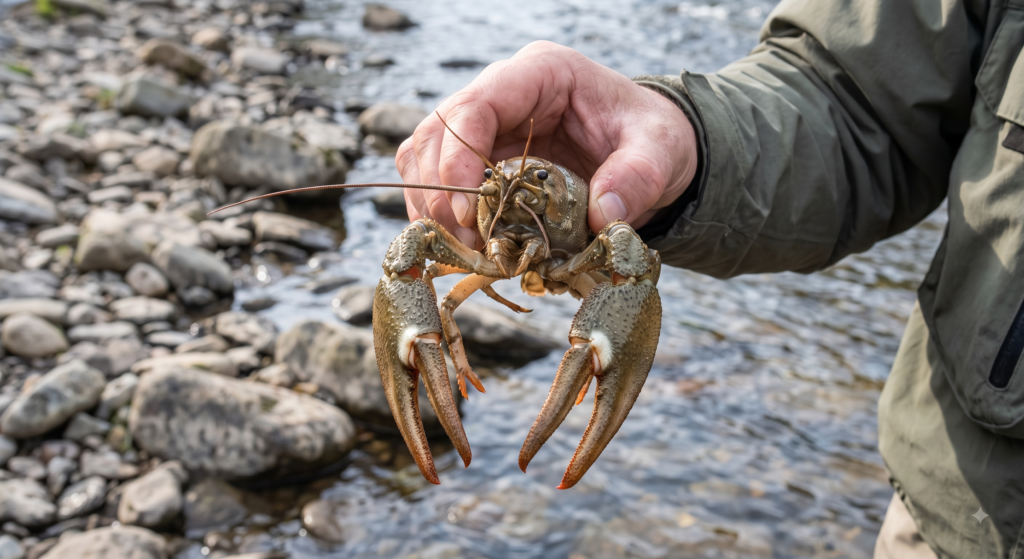
What is a Signal Crayfish?
The signal crayfish is the dominant crayfish in most English rivers. Key identification features:
Signal crayfish (invasive – Pacifastacus leniusculus):
– Body length typically 10-18cm
– Claws are broad and reddish-orange underneath
– Distinctive white or pale blue-green patch near the hinge on the top of each claw (the “signal” – this is the key ID feature)
– More robust body than native species
White-clawed crayfish (native – Austropotamobius pallipes):
– Smaller – typically 6-12cm
– Pale cream or white underside to claws (hence the name)
– No white patch on top of claw
– Confined to high-quality, calcium-rich streams and rivers; now rare and declining
If you catch a crayfish and are unsure of identification, assume it is a signal crayfish unless you are certain it is the native white-clawed species. The white-clawed crayfish is a protected species.
The Core Regulations
Signal crayfish are a Schedule 9 species
Signal crayfish are listed on Schedule 9 of the Wildlife and Countryside Act 1981 in England and Wales. This means it is illegal to:
- Release a signal crayfish back into a water course (including the water it came from)
- Allow a signal crayfish to escape back into the water
- Transport a live signal crayfish away from a water course without authorisation
This is the most critical rule for anglers: if you catch a signal crayfish, you cannot legally return it to the water. You must kill it, keep it, or dispose of it on land. Returning a live signal crayfish to the river is a criminal offence.
What you can legally do when you catch a signal crayfish
- Kill it humanely on the bank and dispose of on land (or keep for eating – signal crayfish are edible and many anglers eat them)
- Keep it alive in a sealed, dry container until you reach your vehicle, then kill it
- Leave the dead carcass on the bank (it will be consumed by wildlife)
The most common approach is simply to kill the crayfish immediately on the bank by cutting it in half with a penknife or crushing the head, and leaving the carcass. Signal crayfish are not a protected species and there is no legal obligation to handle them carefully.
Do not move them to a new water
Under the same Schedule 9 provisions, deliberately moving signal crayfish from one water body to another is an offence. This applies even if both waters already have signal crayfish populations – introducing them via bait buckets or equipment is how they spread to new catchments.
Trapping Signal Crayfish
Do you need a licence to trap signal crayfish?
Yes. Setting traps for any species of crayfish in a water course in England requires an Environment Agency (EA) licence. The specific licence depends on the purpose:
For control purposes (landowners and their agents):
The EA has a general licence arrangement that permits trapping for control in certain circumstances. Check the current EA guidance at gov.uk before setting traps, as the conditions and specific licence requirements have changed over time.
For scientific or survey purposes:
A separate surveying licence is required.
Setting a crayfish trap without the correct authorisation is an offence under the Salmon and Freshwater Fisheries Act 1975, even for signal crayfish.
Using signal crayfish as bait
Strictly speaking, because you cannot legally release a live signal crayfish back into a water course, using a live signal crayfish as bait and then returning it (alive) with the hook removed would be an offence. However, killing a signal crayfish and using it as a freshwater bait (for catfish, barbel, chub, or perch) is not prohibited.
Dead crayfish or crayfish tail section are sometimes used as bait for large species. As with all bait, check individual fishery rules.
Native White-Clawed Crayfish
The white-clawed crayfish (Austropotamobius pallipes) is fully protected in the UK:
- Listed on Schedule 5 of the Wildlife and Countryside Act 1981
- Protected under the Habitats Regulations
- It is illegal to intentionally kill, injure, or take a white-clawed crayfish
- It is illegal to damage, destroy, or obstruct access to a white-clawed crayfish shelter
- Finding a population of white-clawed crayfish in a water body should be reported to the Environment Agency
If you accidentally catch a white-clawed crayfish during angling:
– Remove it carefully with wet hands or a soft mesh
– Return it immediately to exactly where it came from
– Do not move it or hold it for longer than necessary
White-clawed crayfish are now found only in pockets of high-quality habitat – chalk stream tributaries, some upland rivers, and specially managed “crayfish refuges” (isolated water bodies stocked with white-clawed crayfish behind natural or artificial barriers to exclude signal crayfish). If you fish a water designated as a white-clawed crayfish refuge, take extra care with equipment hygiene.
Biosecurity: Check, Clean, Dry
Signal crayfish spread between water bodies partly on angling equipment – in bait buckets, in waders and boots, and on keep nets and landing nets. The Check, Clean, Dry protocol recommended by the GB Non-native Species Secretariat (GBNNSS) applies:
Check: Inspect all equipment, clothing, and footwear for live organisms, plant material, or mud before leaving any water body.
Clean: Wash all equipment thoroughly with water, paying attention to crevices and folds in landing nets, waders, and mat folds.
Dry: Allow equipment to dry fully before use in another water body. Signal crayfish can survive for several hours in damp conditions.
This protocol protects not just from crayfish but from other invasives including killer shrimp (Dikerogammarus villosus), water primrose, and floating pennywort – all of which are spread primarily on angling equipment.
Summary: What Anglers Must Know
- If you catch a signal crayfish, you cannot return it alive to the water. Kill it on the bank.
- Do not transport live signal crayfish between water bodies.
- Trapping signal crayfish requires an Environment Agency licence.
- If you catch a white-clawed crayfish (small, pale cream underside to claws, no white patch on top), return it immediately and carefully.
- Clean, dry, and check your equipment between venues.
For the latest guidance, check the Environment Agency website directly – crayfish regulations are an active area of management and specific licensing conditions change.
Frequently Asked Questions
Can I eat signal crayfish I catch while fishing?
Yes. Signal crayfish are edible and quite good to eat. The tail meat is the main edible part. Kill the crayfish humanely and take them home – you do not need any licence to eat crayfish you have caught by rod and line. The restriction is on returning them to the water alive.
Are signal crayfish all over England now?
Signal crayfish are now present in most of England’s major river catchments and many smaller rivers and streams. They are most abundant in the Midlands, East Anglia, the Thames catchment, and much of the South and Southwest. They are present but less prevalent in some upland rivers in the North and in some catchments in Wales. Scotland has populations in some Lowland rivers.
What damage do signal crayfish cause?
Signal crayfish cause damage through multiple mechanisms. They outcompete native white-clawed crayfish directly and carry crayfish plague (Aphanomyces astaci), a water mould that is lethal to native crayfish but to which signal crayfish are largely immune. They also burrow into riverbanks, destabilising them and causing erosion. They eat the aquatic invertebrates and plant material that fish depend on as food. In heavily infested rivers, crayfish can significantly reduce macroinvertebrate populations.
Should I report signal crayfish sightings?
You can report new sightings via the Environment Agency’s recording systems or via the iRecord app. In established river catchments, a new sighting is not especially notable. If you find signal crayfish in a water body where they have not been recorded before – particularly a chalk stream tributary or small upland beck – this is worth reporting as it may indicate a new incursion that can be managed if caught early.
Can I use dead signal crayfish as pike deadbait?
As with any bait, check the fishery rules. Legally, using a dead signal crayfish as bait is not prohibited by wildlife legislation. Many pike anglers use crustaceans (whole prawns are a well-established deadbait) and crayfish tail sections can work for large perch and chub. However, some fisheries ban the use of naturally caught or wild crustaceans as bait for biosecurity reasons.