The coarse fishing close season is a statutory rest period that protects fish during their spawning period. During the close season, it is illegal to fish for coarse fish on rivers in England and Wales. Fishing during the close season is an offence under the Salmon and Freshwater Fisheries Act 1975 and the Environment Agency’s byelaws, and can result in a fine.
This guide covers the exact dates, which waters are affected, which waters are exempt, special cases for different species, and what you need to know before going fishing from mid-March to mid-June.
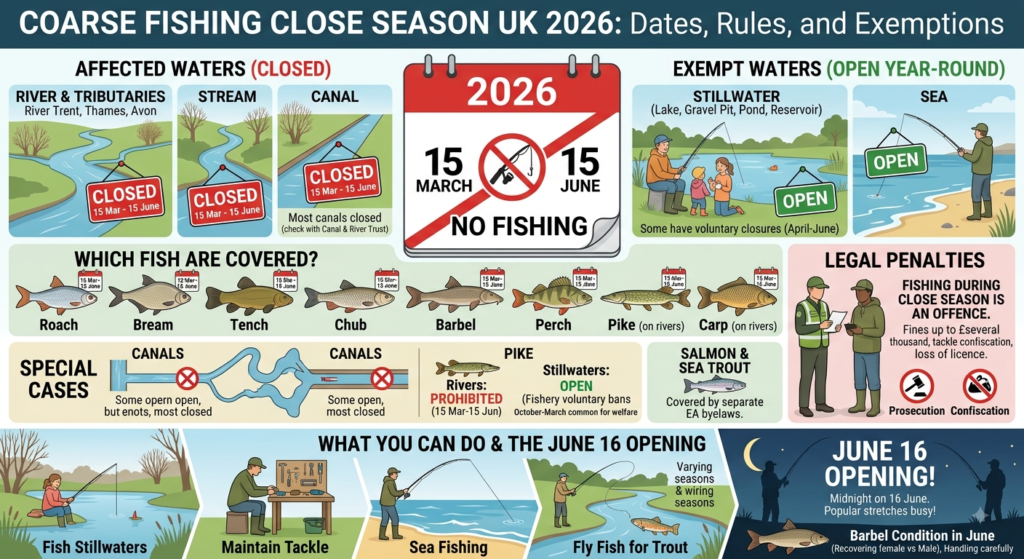
Close Season Dates (England)
The statutory close season for coarse fish on rivers, streams, and drains in England is:
15 March to 15 June (inclusive)
The season opens on 16 June at midnight (effectively the start of 16 June). The close season runs from the beginning of 15 March (midnight on 14/15 March) to the end of 15 June (midnight on 15/16 June).
These dates apply to most rivers, streams, and drains (watercourses that drain agricultural land) in England.
The exception is the River Test and River Itchen (chalk streams in Hampshire), which have a different salmon and trout-related management regime, and some specifically designated waters where the Environment Agency’s local byelaws vary the dates.
What Waters Are Affected
The close season applies to:
Rivers: All rivers and their tributaries in England. This includes the Thames, Severn, Trent, Avon, Kennet, Wye, Great Ouse, Nene, and every other named and unnamed river.
Streams and brooks: Smaller watercourses connected to river systems.
Drains and dykes: Agricultural drains and fenland dykes that are classified as watercourses.
Canals: Most canals are subject to the close season. Check with the Canal and River Trust or the relevant navigation authority for specific canal sections.
What Waters Are Exempt
Still waters (lakes, gravel pits, reservoirs, ponds) do not have a statutory close season. You can fish for coarse fish on stillwaters on any date in the year.
However:
– Individual stillwater fisheries may impose their own voluntary close periods (often April-June for spawning protection)
– Always check fishery rules before fishing
Scottish waters: Scotland has different fishing legislation. There is no equivalent England and Wales close season under Scottish law, though individual fisheries may impose their own restrictions. Contact NatureScot for Scottish freshwater fishing regulations.
Northern Ireland: Different legislation applies. Contact the Loughs Agency or the Department of Agriculture, Environment and Rural Affairs (DAERA) for current rules.
Wales: Wales follows the same statutory close season as England (15 March to 15 June) for coarse fish on rivers. There are some locally designated variations – check Natural Resources Wales (NRW) guidance for specific rivers.
Which Fish Are Covered?
The close season applies to all coarse fish species in the affected waters. The main species covered:
- Roach
- Bream
- Tench
- Chub
- Barbel
- Dace
- Perch
- Pike (on rivers)
- Carp (on rivers)
- Zander (on rivers)
- Gudgeon, ruffe, bleak, and other small species
Salmon and sea trout are not coarse fish and are covered by separate Environment Agency and local authority byelaws. Trout fishing seasons vary by water and region.
Brown trout on rivers: Covered by different legislation and varying local byelaws.
Close Season and Pike
Pike are included in the statutory coarse fish close season on rivers (15 March to 15 June). Pike fishing on rivers in England is prohibited during this period.
Pike on stillwaters are not subject to the statutory close season. Many stillwater fisheries maintain a voluntary pike close season (often October 1 to March 1, reversed from the river close season) for welfare reasons – pike caught and handled in warm water recover poorly.
The Pike Anglers Club of Great Britain advocates a voluntary close period for pike fishing on stillwaters during warm summer months (broadly April to October on many fisheries), though this is not statutory.
Close Season and Canals
Most canals fall under the close season. The Canal and River Trust (CaRT) manages most of the English and Welsh navigable canal network, and the close season applies to CaRT canals.
There are some exceptions where canals have been specifically designated as exempt waters by local byelaw. If you are unsure about a specific canal, contact CaRT or the Environment Agency.
Fishing During the Close Season – Legal Penalties
Fishing for coarse fish on rivers during the close season is an offence. Penalties include:
- Fixed penalty notices
- Prosecution leading to fines (up to several thousand pounds for serious breaches)
- Confiscation of tackle and rods
- Loss of fishing licence
Environment Agency Fisheries Enforcement Officers and Water Bailiffs have the power to check fishing licences and prosecute close season breaches. They patrol rivers through the close season, particularly around the reopening date in June when pressure on popular stretches is high.
What You Can Do During the Close Season
Fish stillwaters. Lakes, gravel pits, reservoirs, and ponds do not have a statutory close season. Game fisheries (trout fishing) also open through the spring (season dates vary – typically April to October on most stillwaters).
Maintain tackle. The close season is the traditional period for retackling reels, checking rods, tying rigs, and preparing for the new season.
Fish the sea. Sea fishing has no statutory close season in England and Wales. Shore fishing for bass, mackerel, flatfish, and other sea species continues year-round.
Fly fish for trout. Many stillwater rainbow trout fisheries operate year-round. Brown trout river seasons typically open in March or April.
The June 16 Opening: What to Expect
The 16 June opening of the coarse fish river season is one of the calendar events in UK angling. Popular river stretches – particularly barbel rivers like the Trent, Hampshire Avon, and Kennet – see significant numbers of anglers on the bank from midnight on the opening morning.
Key points for opening day:
– Night fishing from 16 June is legal from midnight (check individual fishery rules as some prohibit night fishing)
– Be prepared for busy banks on popular stretches
– Barbel on a rising river after June rainfall are the primary target for specialist river anglers
– Tench fishing on connected stillwaters should already be well underway by mid-June on most years
What Changes After the Close Season?
Fish condition changes significantly through the close season period:
June 16 barbel: Post-spawn barbel on rivers can be in poor condition in early to mid-June. Males recover first; females take longer. Handle all fish carefully in the first weeks of the season.
Chub: Generally in better condition than barbel by mid-June. Feeding switches on reliably once temperatures stabilise post-spawn.
Tench: Actively feeding from mid-June on most stillwaters; some waters (particularly in the south) may see tench spawning into early July in warm years.
Roach: Post-spawn recovery is relatively fast; summer roach in rivers feed well from mid-June in most years.
Frequently Asked Questions
Can I fish stillwaters during the close season?
Yes. The statutory coarse fish close season (15 March to 15 June) applies to rivers, streams, drains, and most canals. Stillwaters (lakes, gravel pits, reservoirs, ponds) do not have a statutory close season. Individual stillwater fisheries may apply their own voluntary restrictions.
When does the coarse fishing season open?
The coarse fishing season on rivers in England opens on 16 June each year (at midnight on 15/16 June). This date is fixed by statute and does not change year to year. The close season runs from 15 March to 15 June inclusive.
Is it illegal to fish for carp during the close season?
Carp in rivers are coarse fish covered by the close season. Fishing for carp on rivers from 15 March to 15 June is illegal. Carp on stillwaters (the vast majority of UK carp fishing takes place on stillwaters) are not subject to the statutory close season.
Can I fish for pike in the close season?
Pike on rivers are coarse fish covered by the statutory close season (15 March to 15 June). Pike on stillwaters are not subject to the statutory close season. Many stillwater fisheries and angling clubs maintain a voluntary pike close season, typically in warm months, for welfare reasons.
Does the close season apply in Scotland?
Scotland has different freshwater fishing legislation and does not have the same statutory coarse fish close season as England and Wales. Scottish freshwater fishing regulations are administered by NatureScot. Contact NatureScot or the relevant river district board for accurate current information on Scottish fishing seasons.
Is fishing near a river allowed during the close season?
You can be by a river during the close season without committing an offence. The offence is fishing – having a baited hook in the water. Observing, walking, and legal game fishing continue during the period. Fishing for sea fish at a tidal section of a river may be legal depending on where the tidal limit is defined – seek Environment Agency guidance for the specific river.