The blood knot (also called the half blood knot when used to attach a hook or swivel to a line) is one of the most widely used fishing knots in the UK. In its most common form, it ties monofilament or fluorocarbon line to a hook, swivel, or lure in a few seconds, holds reliably when tied correctly, and is the default knot for coarse, game, and sea fishing applications where monofilament is used.
There is some inconsistency in how the name is used. Some anglers call the single-line version the “half blood knot” or “blood knot,” reserving “full blood knot” or “double blood knot” for the version using doubled line. In this guide, the standard single version is described first, followed by the double (doubled line) variation, which is stronger and recommended for heavier applications and fluorocarbon.
When to Use the Blood Knot
The blood knot is suited to: – Attaching a hook directly to a monofilament or fluorocarbon mainline or hooklink – Attaching a swivel to a monofilament or fluorocarbon leader – Attaching a lure with a fixed (non-loop) connection
When NOT to use it: – Braid: The blood knot fails on braid. Braided line is round, slippery, and compressible in a way that makes wrapping knots slip and fail under load. Use the Palomar knot or a doubled Grinner for braid-to-hook or braid-to-swivel connections. – Very heavy fluorocarbon (above 25lb): Heavy, stiff fluorocarbon is difficult to wrap neatly. Use fewer turns and wet carefully, or use the Grinner knot which allows more controlled tightening on stiff material. – Applications where a loop is needed: If you need a flexible loop connection (often used for lures where freedom of movement improves action), use a loop knot (a Rapala knot or similar) instead.
What You Need
- The line you are tying (monofilament or fluorocarbon hooklink or mainline)
- A hook, swivel, or lure ring
- Moistening water or saliva
That is all. No tools required for light to medium monofilament. Fluorocarbon in heavier gauges may be easier to control with a hook disgorger to maintain tension during wrapping.
How to Tie the Blood Knot: Step by Step
Step 1: Thread the line through the hook eye. Pull through 15-20cm of tag end.
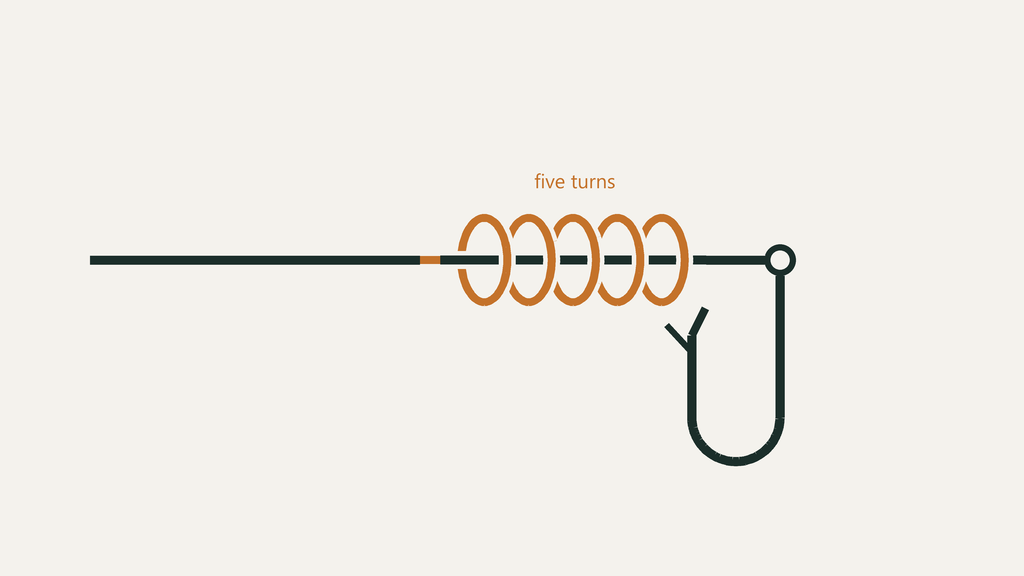
Step 2: Hold the hook in your dominant hand and the tag end in the other. Wrap the tag end around the mainline, working up away from the hook eye, for 5 turns (lighter line, under 8lb: 6-7 turns; medium line, 8-15lb: 5-6 turns; heavy mono, above 15lb: 4-5 turns).
Step 3: Pass the tag end back through the small loop that has formed immediately above the hook eye. This is the loop formed by the first wrap passing over itself – it sits tight to the hook eye.
Step 4: Wet the knot thoroughly with water or saliva. This lubrication is essential: an unlubricated blood knot will heat as it is pulled tight and weaken by 20-30%.
Step 5: Pull the mainline and tag end in opposite directions simultaneously, slowly and steadily. The coils will gather and tighten against the eye. Pull firmly until the knot is fully seated.
Step 6: Trim the tag end close to the knot – leave 1-2mm to allow for any slip under load.
Turn Counts by Line Breaking Strain
| Line breaking strain | Turns |
|---|---|
| Under 6lb | 6-7 turns |
| 6-10lb | 6 turns |
| 10-15lb | 5-6 turns |
| Over 15lb (mono) | 4-5 turns |
| Fluorocarbon under 15lb | 5-6 turns |
| Fluorocarbon over 15lb | 4-5 turns |
These are starting points. Heavier, stiffer material benefits from fewer turns because the bulk of the wraps cannot seat neatly. Lighter lines benefit from more turns to distribute load over more of the knot.
Common Mistakes
Not wetting the knot. The most common reason for blood knot failure. The friction generated when pulling a dry knot tight creates heat that weakens monofilament. Wet every blood knot before tightening.
Crossing the wraps. Wraps that cross rather than lying in neat parallel coils create uneven load distribution. Keep each wrap laid alongside the previous one as you turn.
Using the blood knot on braid. Braid compresses as it is loaded, which causes blood knot wraps to slide and fail. Use a Palomar or doubled Grinner on braid.
Insufficient tag end. Starting with less than 12-15cm of tag end makes it difficult to wrap and thread cleanly. Pull enough tag through at the start.
Pulling too fast. A slow, steady pull allows the coils to seat evenly. A fast, jerky pull can cross coils or create a hinge point at the eye.
Strength
When correctly tied and wetted before seating, the blood knot retains approximately 85-90% of the line’s rated breaking strain. A poorly tied or dry blood knot can fail at 60-70% of rated breaking strain.
This makes knot testing an important discipline. After tying a new blood knot, pull it hard against a fixed point before you fish with it. If it slips or the tag end pulls through, the knot was not properly seated – retie and test again.
Double Blood Knot (Doubled Line)
The double blood knot (tying with a doubled section of line passed through the eye) is stronger than the standard blood knot because the doubled line fills the wraps more evenly and creates a larger knot body that is more resistant to slipping.
How to double the line: 1. Double back approximately 10-12cm of the tag end so you have two parallel strands. 2. Pass the doubled end through the hook eye. 3. Make 4-5 turns with the doubled section around the mainline. 4. Pass the loop (the doubled end, now at the top of the turns) back through the first loop above the hook eye. 5. Wet and tighten as for the standard blood knot.
The double blood knot is the recommended version for fluorocarbon hooklinks, lines above 15lb, and any application where maximum knot strength is needed. It takes slightly longer to tie but is noticeably stronger and more consistent in test.
Joining Two Lines: The Double Blood Knot
The blood knot can also be used to join two lines of similar diameter – the classic application is joining fly line leader sections or joining a fluorocarbon hooklink to a monofilament mainline.
For line-to-line joining: 1. Overlap the two lines for 10-15cm with the tag ends pointing in opposite directions. 2. Wrap one tag end around the other line for 5 turns. 3. Bring that tag end back and hold it in the middle. 4. Wrap the second tag end around the first line for 5 turns in the opposite direction. 5. Pass the second tag end through the middle loop between the two sets of wraps. 6. Wet thoroughly and pull both mainlines slowly to tighten. The two sets of wraps should gather evenly toward each other.
This joining blood knot works on lines of similar diameter. For joining significantly different diameters (leader to mainline), the Grinner knot or an Albright knot is more reliable.
Blood Knot vs Grinner Knot
Both are standard UK monofilament knots for attaching hooks and swivels. The differences:
| Blood Knot | Grinner Knot | |
|---|---|---|
| Speed | Slightly faster | Slightly slower |
| Strength | 85-90% (correct) | 90-95% (correct) |
| Works on braid | No | No (braid version exists: double Grinner) |
| Best for | Light-medium mono, quick changes | Medium-heavy mono, fluorocarbon |
For everyday light coarse fishing with hooklinks under 10lb, the blood knot is the default. For heavier applications and fluorocarbon, the Grinner is more consistent.
Frequently Asked Questions
Is the blood knot the same as the half blood knot?
The terms are used interchangeably for the most common single-wrap version. Some anglers reserve “blood knot” for the joining version (two lines joined) and “half blood” for attaching a hook to a single line. In practice, when most UK anglers say “blood knot” they mean the standard hook-attachment version described in this guide.
How many turns should a blood knot have?
Five turns is the standard for medium monofilament (6-15lb). Use 6-7 turns on very light line and 4-5 turns on heavier mono or stiff fluorocarbon. The goal is enough wraps to distribute load without the coils becoming too bulky to seat properly.
Can you use a blood knot on fluorocarbon?
Yes, but wet it extremely thoroughly and tighten slowly. Fluorocarbon is denser and stiffer than mono and is more susceptible to heat damage from friction during tightening. The double blood knot is more reliable on fluorocarbon than the standard single version.
Why does my blood knot keep failing?
The three most common causes are: not wetting the knot before tightening (heat from friction weakens the line), pulling too fast (crossed coils or hinge point at the eye), or using the blood knot on braid (it will not hold on braided line). Use the Palomar knot for braid connections.
Does the blood knot work for lures?
The blood knot can be used for lure attachment but creates a fixed connection with no loop. If you want a lure to swing freely on a loop for maximum action, use a Rapala knot or Uni knot with a loose loop instead. For small spinners and fixed-attachment lures, the blood knot is fine.