Barbless hooks are compulsory on most commercial carp fisheries in the UK and strongly recommended for coarse fishing generally. If you fish UK commercial waters, you almost certainly fish barbless – most fisheries require it as a condition of access, and the welfare case for barbless is now well established. But the rules are not consistent, and what is compulsory on a commercial fishery peg may be voluntary at a club stretch of river.
This guide covers what the law and common fishery rules actually say, the welfare argument, and what to do when you want to fish barbed on the waters where it is permitted.
Is There a Law Requiring Barbless Hooks in the UK?
No national law in England, Scotland, or Wales requires barbless hooks for coarse fishing. The requirement to use barbless hooks comes from:
Fishery rules: Individual fisheries (commercial lakes, club water, nature reserves) can impose their own rules as a condition of access. Most UK commercial carp fisheries require barbless hooks as a condition of the day ticket or membership. Fishing with barbed hooks where barbless is required is a breach of fishery rules, not a criminal offence – but may result in removal from the fishery.
Match rules: Many match organisations, including the Angling Trust and most regional federations, require barbless hooks in competitions. This ensures quick, welfare-safe unhooking during timed events.
EA byelaws: The Environment Agency can impose byelaws on specific waters or river sections that may include hook requirements. Some EA byelaws on designated trout or salmon rivers require single or barbless hooks. Check EA byelaws for any specific water you intend to fish.
NRW/NatureScot: Natural Resources Wales and NatureScot (Scotland) can impose similar requirements on designated waters. Welsh trout and salmon rivers in particular may have specific hook requirements.
The short version: If you are fishing a commercial carp fishery in England, assume barbless unless the rules specifically permit barbed. If you are fishing river coarse fishing on club water, check the club rules – requirements vary.
What Is a Barbless Hook?
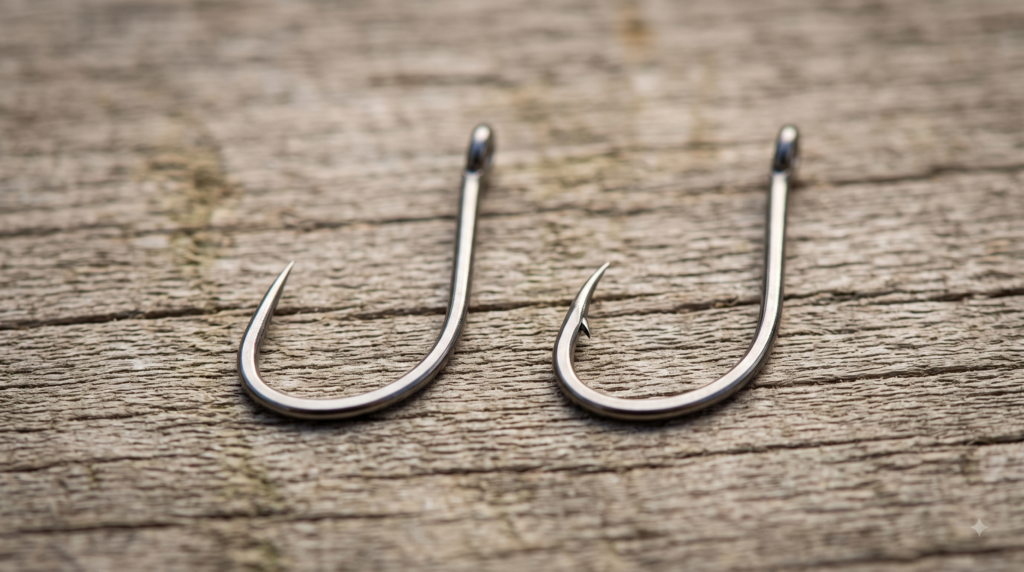
A barbless hook has no raised barb below the point. The point is smooth, which means:
- The hook enters flesh easily with minimal force
- The hook can be removed with minimal or no force (often without needing a disgorger)
- The fish has a greater chance of successfully shaking the hook if it runs into snags
Microbarb or semi-barbless hooks: These have a very small, compressed barb that is much less pronounced than a standard barb. Many manufacturers sell microbarb hooks as a middle option. Some fisheries accept microbarb; others specifically require “completely barbless” or “barbless only.” Read the rules carefully if you intend to use microbarb.
Crushed barbs: On some waters, anglers use barbed hooks with the barb physically crushed using forceps or pliers. This is accepted practice on waters that permit it – crushed barbs function similarly to true barbless. However, some fisheries specifically require factory-produced barbless, not crushed barbs.
Why Most Commercial Fisheries Require Barbless
The welfare case for barbless hooks in UK coarse fishing is straightforward:
Speed of unhooking: A barbless hook can be removed in seconds, often without tools. A barbed hook requires a disgorger and more handling time. Every second a fish is out of water under stress is a welfare cost.
Depth of hooking: Barbed hooks, particularly in match conditions where fish are hooked in rapid succession, are more likely to be swallowed deeply. A barbless hook that is taken deeply can often still be removed more easily than a barbed hook.
Catch rates in matches: On commercial fisheries with high catch rates in timed matches, anglers may be unhooking dozens of fish per session. Barbless hooks maintain fish welfare across that volume.
Self-unhooking: When fish run into snags and break free, a barbless hook works itself out. A barbed hook may remain embedded in the snag along with the mouth tissue.
Does barbless lose fish? This is the main objection from anglers who prefer barbed hooks. Evidence is mixed. On close-range commercial fishing where fish are played quickly and on constant pressure, the difference is minimal. At long range and with slack-line presentations (carp fishing at range), barbless may allow more fish to shed the hook. Many experienced specimen carp anglers use barbed hooks at range for this reason. On commercial fisheries and close-range float fishing, the difference in lost fish rates is generally considered small.
Where Barbless Is Required
Almost certainly required:
– Commercial carp fisheries (day-ticket commercial lakes)
– Match events under Angling Trust or most regional match association rules
– Many club rules on both river and still water
– Canal and River Trust (CaRT) towpath fishing on most navigations
Check the rules:
– River coarse fishing on club water (requirements vary significantly)
– National Trust and other conservation body managed waters
– Reservoir and EA managed still waters
Barbed generally permitted:
– Much UK sea fishing
– Fly fishing for trout and salmon (check specific river rules)
– Private syndicate carp and specimen fishing (check syndicate rules)
– Long-range carp fishing on many commercial specimen waters
Unhooking With Barbless Hooks
The main practical benefit of barbless hooks is immediate in unhooking:
For small fish: Most barbless hooks on small fish can be removed with a simple flick – hold the hook bend, push forward to reverse the curve, and the hook slides out. No disgorger needed.
For larger fish: A pair of forceps or long-nosed pliers makes barbless unhooking clean and fast, even if the fish has moved the hook. Grip the hook bend with the forceps, back the hook out along the path it entered. With barbless, this typically takes 5-10 seconds.
If swallowed: Deeply-taken barbless hooks can often be felt rather than seen. A thin disgorger or long forceps reaches the hook. With barbless, backing out follows the hook bend. On very deeply hooked small fish, cutting the line close to the hook and allowing the hook to rust out (leaving the fish in the water) is sometimes the welfare-positive choice over deep extraction.
Microbarb vs Barbless: What’s the Difference in Practice?
For the fish: A microbarb hook requires slightly more force to remove than a fully barbless hook, but significantly less than a standard barb. On most coarse fish species where the hook is in the lip, the practical difference is small. On deeply swallowed hooks, microbarb is notably more difficult to remove than barbless.
For hook hold: Many anglers feel microbarb provides marginally better hook hold than fully barbless, particularly at range. The very small barb gives a tiny amount of grip that may reduce hook pulls on long-range presentations.
For fishery compliance: Some fisheries specifically require “fully barbless” and do not permit microbarb. Others permit microbarb. If you carry microbarb hooks, read the fishery rules before use.
Practical Guide: Converting Barbed Hooks to Barbless
If you have barbed hooks you want to use on a water that permits crushed barbs:
- Use stainless steel forceps or strong flat-nosed pliers
- Position the jaws across the barb, gripping it from the side
- Squeeze firmly until the barb is fully flattened against the hook shank
- Run a thumbnail along the point – no barb should be felt
- Test the point on your thumbnail for sharpness (should scratch when drawn across)
Note: once crushed, the barb cannot be restored without heat treatment. Don’t crush barbs on hooks you may want to use on waters where barbed is permitted.
Summary: The Rules at a Glance
| Situation | Barbless required? |
|---|---|
| Commercial carp fishery (day ticket) | Almost always yes – check rules |
| Angling Trust match | Yes |
| Club river water | Check club rules – varies |
| CaRT canal towpath | Usually yes |
| Fly fishing for trout | Check fishery/river rules |
| Sea fishing | No statutory requirement |
| Long-range specimen carp fishing | Check fishery/syndicate rules |
Frequently Asked Questions
Is it illegal to use barbed hooks in the UK?
No UK law makes barbed hooks illegal for general coarse fishing. The requirement to use barbless is imposed by individual fishery rules, match rules, or specific EA byelaws on designated waters – not by national legislation.
Do I lose more fish on barbless hooks?
On close-range commercial fishing with constant pressure on the line (pole, short-range float), the difference in lost fish rates between barbless and microbarb is minimal. At range (long-distance carp fishing with slack line periods), barbless may result in more hook pulls. Many experienced carp anglers use barbless anyway and accept slightly more dropped fish as a welfare trade-off.
What is a microbarb hook?
A microbarb hook has a very small, compressed barb – smaller than a standard hook barb but not fully absent. They provide slightly better hook hold than fully barbless while being easier to remove than standard barbed hooks. Some fisheries accept microbarb; others specifically require fully barbless. Check the rules of your specific fishery.
Can I use barbed hooks on rivers?
Barbed hooks are not prohibited on most UK rivers under EA rules. Individual club rules may require barbless. Check the rules of the stretch you are fishing. On EA or CaRT managed stretches, check the specific conditions of the licence or permit.
Do barbless hooks hurt fish less?
Barbless hooks are believed to cause less tissue damage on removal and can be removed more quickly, reducing handling time. However, the hook still penetrates tissue on the take. The welfare benefit of barbless is primarily in faster, less damaging unhooking rather than less painful initial hooking. For catch-and-release fishing, barbless is strongly recommended.