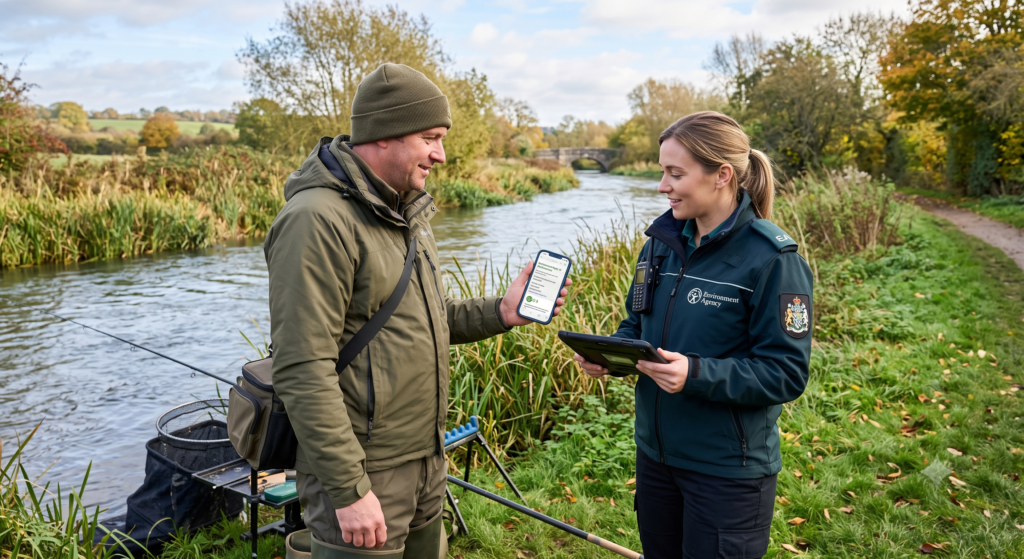
If you are 13 or over and fishing for salmon, trout, freshwater fish, smelt or eel in England or Wales, then yes, you need a fishing licence. This is the law, and it applies to every water you fish, not just rivers. Fishing without a valid licence can cost you up to a £2,500 fine, and Environment Agency officers do check on the bank.
There are real exceptions, and they are all covered below. Under 13s never need one. Sea anglers usually do not. Scotland and Northern Ireland run entirely separate systems. Prices are current as of July 2026 – the full table is further down the page.
Who Needs a Fishing Licence in England and Wales?
Anyone aged 13 or over needs a rod licence to fish for salmon, trout, freshwater fish, smelt or eel in England, Wales or the Border Esk region of Scotland. That is the core rule, and it is worth reading twice.
The most common misunderstanding is about where it applies. The licence is required everywhere you fish for those species: private lakes, day ticket waters, club stretches and all rivers, not just public water. Owning the fishing rights or paying for a day ticket does not replace the rod licence. You need both.
The age bands are simple. Under 13s need no licence at all. Anglers aged 13 to 16 need a junior licence, but it is completely free, and it must still be obtained before fishing. Turning up at 14 without the free licence still counts as fishing without a licence. From 17 and over you pay the full or concession rate.
There is a carer edge case worth knowing. A carer who never holds a rod needs no licence. The moment they hold or handle the rod, even briefly to help land a fish, they need their own licence.
One water sits outside the system. The River Tweed is not covered by the England and Wales licence – it falls under separate Scottish arrangements, even in its English stretches, because the river’s management authority is based in Scotland.
The penalty is real. Fishing without a valid licence can lead to a fine of up to £2,500, and EA enforcement officers check licences on the bank as routine.
Who Is Exempt? Sea Anglers, Scotland and Northern Ireland
Pure sea angling needs no rod licence. If you are fishing from the shore or a charter boat for bass, cod, mackerel, pollack, flatfish or wrasse, you are free to fish without an EA licence.
There is a trap in this. Sea trout and salmon are migratory fish. If you fish for them in tidal or estuarial waters you do need a Salmon and Sea Trout licence. Eels in coastal waters also require a licence. The “sea fishing is free” rule holds only for genuine salt-water species, not for migratory fish passing through the sea.
One area is genuinely grey. Fishing for salmon or sea trout in the open tidal sea sits in a legal grey zone. Rather than guess, check directly with the Environment Agency before you go.
Scotland works differently. No EA rod licence is needed anywhere in Scotland except the Border Esk region. That does not mean free fishing. You still need permission from the estate, beat or club in the form of a permit. The Land Reform (Scotland) Act 2003 gives you access to land, but it does not give you a right to fish without permission. Two Scottish specifics catch people out: Sunday salmon fishing is prohibited across the whole country, and salmon and trout seasons vary by river district.
Scotland’s permit system operates through riparian estates, angling clubs, and hotels offering fishing rights rather than through a central national system. Day permits on local association waters can cost under £10. A day rod on a prime salmon beat on the River Tay, River Dee or River Spey will cost significantly more, particularly during peak season, and some beats are booked months in advance. The main routes for finding and booking Scottish permits are the riparian estate or beat office directly, Fishpal (an online booking platform used by many Scottish estates), and local angling clubs, many of which offer visitor day tickets.
Northern Ireland is separate again. The EA licence is not valid there. DAERA, the Department of Agriculture, Environment and Rural Affairs, runs its own rod licence system, and you also need a permit from the fishery owner. NI prices are in the FAQ below.
England and Wales freshwater means an EA licence. Scotland means a permit and no EA licence. Northern Ireland means a DAERA licence plus a permit. Sea fishing usually needs nothing, except when you target migratory species.
What Type of Fishing Licence Do You Need?
There are two licence families. Trout and Coarse covers coarse fish and non-migratory trout. Salmon and Sea Trout is effectively the all-species licence, and anyone targeting salmon or sea trout needs it.
Most anglers need the Trout and Coarse 2-rod licence. It covers carp, pike, tench, bream, roach, perch, barbel, chub, rudd, dace, smelt, eel and non-migratory trout, using up to two rods. For the majority of coarse and match anglers, this is the one to buy.
If you fish three rods, there is a 3-rod option. The Trout and Coarse 3-rod licence is available as a 12-month licence only, with no 1-day or 8-day version. The third rod may only be used for freshwater fish excluding non-migratory trout. It is designed for carp anglers running three rods, or a spod-and-two setup.
On top of the licence type sit the multi-rod byelaw limits. For coarse fish and eels, the byelaw allows up to four rods. For salmon, trout and sea trout on rivers, the limit is one rod. For salmon, trout and sea trout on stillwaters, the limit is two rods.
Here is the part that trips people up. Your licence caps what the byelaw allows. A 2-rod licence lets you use two rods; a 3-rod licence lets you use three. Even though the byelaw permits four coarse rods, you cannot fish four rods on a 2-rod licence. The lower of the two limits always applies.
Spod and marker rods do not count toward your licence rod limit, as long as no hook, hooklength or lure is attached. A spod rod plus two fishing rods is perfectly fine on a 2-rod licence.
You need the Salmon and Sea Trout licence for any deliberate salmon or sea trout fishing, including in estuaries. It costs more, but it covers all species. Each family comes in 1-day, 8-day and 12-month durations, covered with prices next.
How Much Does a Fishing Licence Cost? (2026/27 Prices)
These are the current 2026/27 rates from GOV.UK.
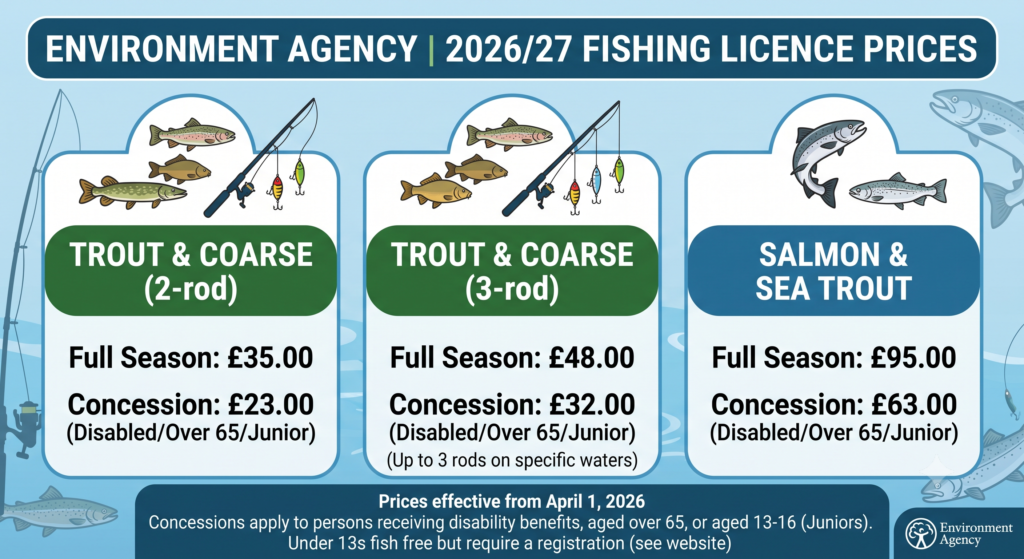
Trout and Coarse (2-rod)
| Duration | Full price | Concession |
|---|---|---|
| 1-day | £7.30 | Not available |
| 8-day | £14.70 | Not available |
| 12-month | £36.80 | £24.50 |
| Junior (13-16) | Free | Free |
Trout and Coarse (3-rod) – 12-month only
| Duration | Full price | Concession |
|---|---|---|
| 12-month | £55.30 | £36.80 |
| Junior (13-16) | Free | Free |
Salmon and Sea Trout
| Duration | Full price | Concession |
|---|---|---|
| 1-day | £13.50 | Not available |
| 8-day | £30.50 | Not available |
| 12-month | £93.10 | £62.00 |
| Junior (13-16) | Free | Free |
Concessions apply to 12-month licences only. There is no concession on a 1-day or 8-day licence, so do not expect one.
There are two routes to a concession. The first is age: you qualify at 66 or over. The threshold is 66, not 65, and this is widely misreported across angling forums and communities, so check your date carefully. The second is disability: Blue Badge holders, or those eligible for one, anyone receiving PIP at any rate, and DLA recipients all qualify.
Eligibility is self-declared when you buy, but carry proof in case an officer asks to see it.
One practical point. A 12-month Trout and Coarse licence at £36.80 works out cheaper than buying five 8-day licences at £14.70 each. If you fish more than a handful of times a year, default to the annual licence.
How to Buy Your Fishing Licence Step by Step
Buy from the official GOV.UK service at get-fishing-licence.service.gov.uk. Avoid third-party sites, which add a fee for a licence you can buy directly for the standard price.
- Go to get-fishing-licence.service.gov.uk.
- Choose your licence type, either Trout and Coarse or Salmon and Sea Trout, and your rod count, 2-rod or 3-rod where relevant.
- Choose your duration, either 1-day, 8-day or 12-month, and declare any concession, either age 66+ or disability.
- Enter your details and your first fishing date. You can buy up to 30 days in advance, but the start date must match the first day you actually fish.
- Pay. No account creation is required – the licence is linked to your National Insurance number in the EA system. Delivery by email or text arrives in approximately one hour. A posted licence takes about 10 working days.
- On the bank, show the email or text confirmation as proof. A screenshot is accepted, and you do not need a physical card.
Your 12-month licence is valid for 365 days from the date it starts, not from the start of April or any other fixed month. Buy it for the first day you intend to fish and it runs from there. An annual licence bought in November runs through to the following November.
If you lose your licence, call the Environment Agency on 03708 506 506.
A reminder for younger anglers: the free 13-16 junior licence goes through the same service, and it still has to be obtained before fishing. You can also buy by phone or at selected Post Office branches, but online is the fastest route.
The Close Season: A Separate Rule From Your Licence
The close season is not part of your licence. Your licence is valid all year round, but there are periods when you cannot fish certain waters at all. These are two different rules, and it helps to keep them apart in your head.
On rivers and streams in England, the statutory coarse close season runs from 15 March to 15 June inclusive. No coarse fishing takes place on rivers during that window, whatever licence you hold.
Most still waters are different. Lakes, ponds, reservoirs and most canals have no statutory close season, so day ticket lakes fish year-round. There are exceptions: SSSIs and the Norfolk and Suffolk Broads carry their own restrictions. Some canalised rivers and certain canals also fall under the close season – check local byelaws if you are unsure. Individual fisheries may also impose their own additional rules on top of the EA requirements, so always confirm with the venue before you go.
Wales is not identical to England. Welsh waters are governed by Natural Resources Wales byelaws, so check with NRW for the exact Welsh river dates rather than assuming the English window applies.
Salmon and sea trout anglers face a separate layer of seasons on top of the coarse close season. Migratory fish seasons are set by river district and vary significantly across England and Wales. A salmon angler on the River Tyne works to different dates to one on the River Wye. These seasons are defined in water authority byelaws and are separate from the general coarse close season. Check the Environment Agency or the relevant river authority for the current season dates on your specific river before you plan a trip.
The takeaway is simple. You need a valid licence for both open and closed seasons whenever you actually fish; the close season limits where and when you fish, not whether you need a licence. For a worked example, pike fishing on an English river in January is fine, because it is open season and you hold your licence. The same river in April is closed for coarse fishing, no matter which licence is in your pocket.
Fishing Licence FAQs
What age do you need a fishing licence?
13. Anyone under 13 fishes completely free with no licence needed. From 13 to 16, you need a junior licence, but it costs nothing – you still have to obtain it, just at zero cost. From 17 onward, you pay the full adult rate (or a concession rate if you qualify – see below).
Why do you need a fishing licence?
Rod licence income funds the Environment Agency’s fisheries work directly – stocking, habitat improvement, pollution incident response, and enforcement against illegal fishing and poaching. It is not a general tax; the money is ring-fenced for fisheries. It is also a legal requirement regardless of where you fish, including private day-ticket waters and club stretches – owning or paying for the fishing rights does not replace the licence.
Do I need a licence to fish a day ticket carp lake?
Yes. A Trout and Coarse licence is required on private and day ticket waters, not just rivers. A 1-day licence costs £7.30, and the annual is £36.80.
Do I need a licence to go pike fishing on a river in January?
Yes, a Trout and Coarse licence. January falls within the open river season, since the close season runs 15 March to 15 June, so pike fishing on rivers is legal.
Does my 10-year-old need a fishing licence?
No. Children under 13 are fully exempt from the rod licence requirement.
Does my 14-year-old need a licence?
Yes, but a junior licence is completely free. It still has to be applied for before fishing; heading to the bank without one counts as fishing without a licence.
Do I need a licence if I am a carer helping someone fish but not fishing myself?
No, not if you never hold a rod. The moment you handle the rod, even to help land a fish, you need your own licence.
Do I need a licence to fish for sea bass from the beach?
No. Sea bass is a non-migratory salt-water species and falls outside the EA licence requirement.
Do I need a licence to fish for sea trout in an estuary?
Yes. Sea trout are migratory and require a Salmon and Sea Trout licence wherever they are targeted, including tidal and estuarial waters.
I am 67 – what concession do I get?
The age concession applies at 66 and over, not 65, which is widely misquoted. The 12-month Trout and Coarse 2-rod concession is £24.50. There is no concession on 1-day or 8-day licences.
I hold a Blue Badge – do I pay full price?
No, you qualify for the disability concession on 12-month licences. It is the same price as the age concession, £24.50 for Trout and Coarse 2-rod. PIP and DLA recipients also qualify.
Does my spod rod count as one of my licensed rods?
No, as long as no hook, hooklength or lure is attached. A spod or marker rod without a hook does not count toward the rod limit on your licence.
Do I need an EA rod licence to fish in Scotland?
No, except in the Border Esk region. You need permission or a permit from the riparian estate, beat or club instead. Scotland uses a district-based permit system rather than a national rod licence.
Do I need a licence to fish in Northern Ireland?
Yes, but a DAERA licence, not an EA one. You also need a permit from the fishery owner. Adult (19-59) costs £17, juvenile (12-18) costs £2, senior 60+ or disabled costs £5, and under 12 needs no licence.
How long does a fishing licence take to arrive?
By email or text, approximately one hour. By post, approximately 10 working days. Buy online if you are fishing soon.
What is the fine for fishing without a licence?
Up to £2,500. Environment Agency officers check licences on the bank and can ask to see proof at any time.
Does one licence cover all my rods?
No. A 2-rod licence covers two rods; a 3-rod covers three. The national byelaws allow up to four coarse rods, but your licence must match the number of rods you are fishing with.